
THE SHORT ANSWER
A go-to-market strategy defines how a specific offer reaches suitable customers and becomes commercially useful. It connects product, marketing, sales and customer success. This guide helps you make the important choices and turn them into a realistic operating plan.
Start with a specific commercial task
A go-to-market plan needs a concrete reason to exist. Are you introducing a product, improving an established segment or entering another market? Each task brings different uncertainties. Describe the starting point, desired change and available resources before selecting channels. An illustrative task might be selling an existing SaaS product to German-speaking mid-sized IT service businesses for the first time. That raises questions about need, language, procurement and customer support. “More growth” does not narrow these decisions sufficiently. Also record which markets and applications you will deliberately leave outside the initial scope, so limited resources are not spread across incompatible priorities.
Understand markets through customer situations
Market size can provide orientation but does not explain an individual purchase. Investigate the work businesses need to accomplish, the alternatives they use and the events that trigger change. Speak to suitable customers, lost prospects and people who continue with their existing approach. Ask about specific past situations rather than inviting polite opinions about your idea. Separate observed evidence, reported experiences and assumptions in your notes. This distinguishes an attractive audience label from a situation with meaningful demand. A small, well-understood starting segment often supports better early decisions than a broad list of unrelated industries that require different arguments and service models.
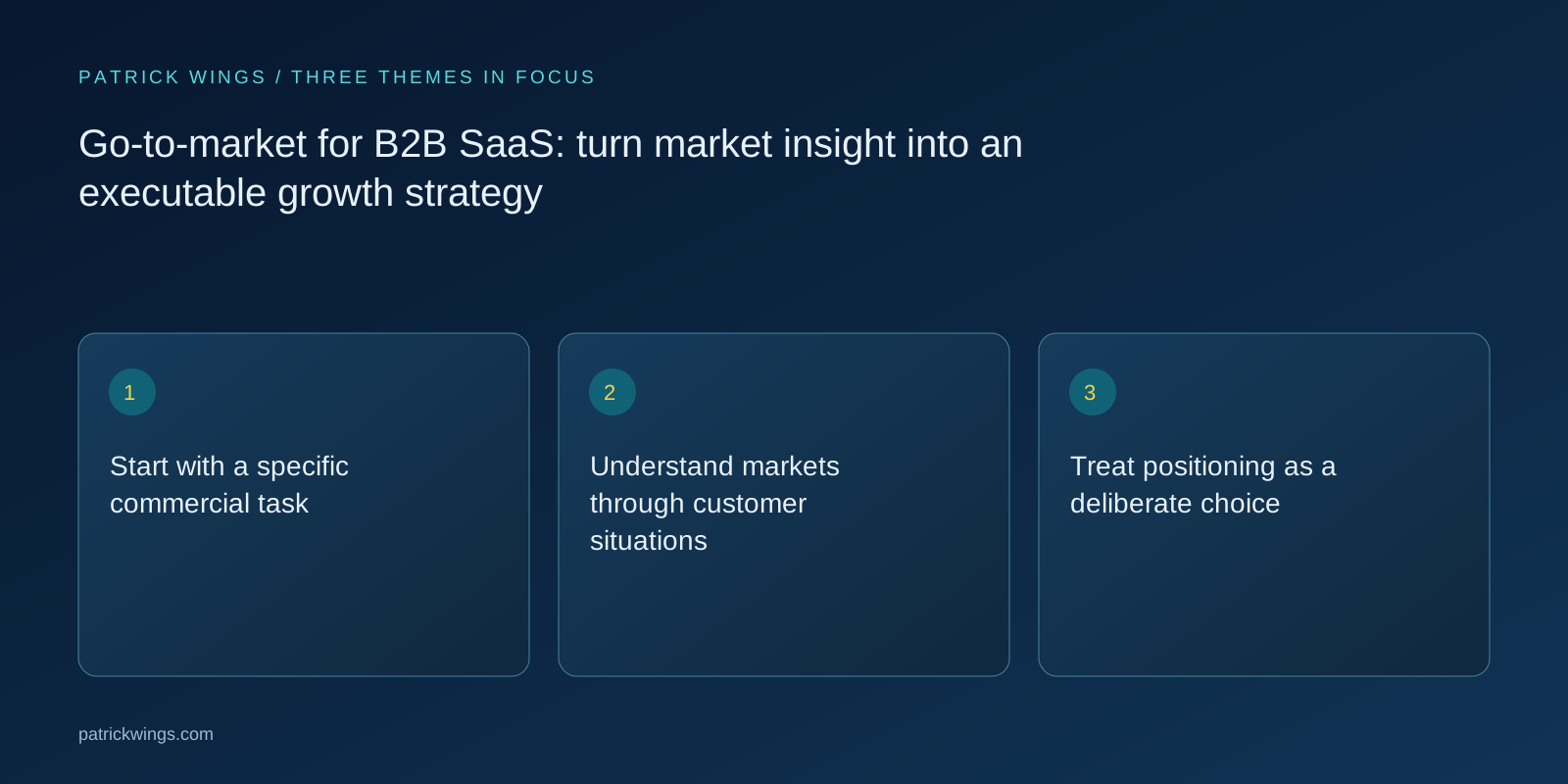
Treat positioning as a deliberate choice
Positioning explains for whom an offer is particularly useful and in what context. Define the relevant alternative, your contribution and the conditions under which that contribution matters. “Simple”, “innovative” and “AI-powered” rarely explain enough on their own. An illustrative project management product might differentiate around uncertain capacity assumptions if that problem matters to the selected audience and the capability is demonstrable. Test the explanation through conversations and actual product functionality. Useful positioning also rules out inappropriate expectations. It should connect the website, sales argument and product priorities rather than produce only a new headline disconnected from the experience customers receive. Explore this further in the guide B2B SaaS positioning: a clear buying perspective beyond interchangeable claims.
Plan the offer, price and entry point together
Specify what a customer receives, how the relationship begins and why the price makes sense. A free trial fits only when people can experience meaningful initial value. A complex product may need an assisted first conversation instead. Assess whether packages, billing units and contract structure match perceived value. Account for implementation, support and possible integrations. A low entry price loses its attraction when the necessary work becomes unexpectedly expensive afterwards. Separate pricing decisions from temporary discounts and document which assumptions about usage, willingness to pay and service effort still require validation. The whole offer should be understandable before a buyer commits.

Choose the commercial model and channel roles
Self-service, personal selling and partner approaches need different resources. Select a model based on product complexity, the buying process and commercial potential. Then give each channel a defined job. Search content can answer recurring questions, advertising can test focused assumptions and conversations can resolve complex concerns. A channel choice should not substitute for unclear positioning. Explain how someone is supported from the first relevant resource through product use and who owns each step. Check whether sales and customer success can deliver the promised next actions with existing capacity. A campaign cannot compensate for an operating model that leaves suitable prospects waiting without help.
Organise product marketing as connecting work
Translating product knowledge into a useful market argument is continuous work. Product marketing can combine customer insight, explain the offer and align sales resources with real buying decisions. It needs access to product, sales and customers rather than a content production brief alone. Agree who approves product claims, maintains competitive information and returns conversation insights to the wider team. A shared messaging document covering the audience, problem, evidence and limitations reduces contradictory promises. Treat it as a working reference and update it when the product or market understanding changes. A polished presentation by itself does not create a consistent commercial experience.
Treat international expansion as another learning process
A successful approach does not automatically transfer unchanged to a new market. Review language, relevant terminology, purchasing expectations, support and local trust signals. Treat Germany, Austria and Switzerland as distinguishable markets, even where some resources can be shared. Involve the responsible specialists when contractual, regulatory or tax questions become relevant to the specific plan. Begin with a justified market priority rather than simultaneous comprehensive coverage. Entering from abroad is possible, but prospective customers need a clear explanation of how they will communicate with you reliably and receive support after purchase. Operational readiness should influence the sequence of expansion as much as apparent market opportunity.
Translate objectives into explainable measures
Connect the commercial goal to observable intermediate progress. For a self-service offer, suitable registrations, meaningful activation and returning usage may matter. For assisted sales, relevant conversations, accepted opportunities and their progression can be more useful. Define each measure, its source, its owner and the observation period. Compare similar groups that have had sufficient time to mature. A revenue target is a planning assumption rather than a guaranteed consequence of buying a certain number of advertisements. Record uncertainty and capacity limits explicitly. A KPI framework should improve decisions instead of suggesting accuracy that weak data or untested assumptions cannot support.
Build a learning plan rather than an activity list
Prioritise assumptions whose failure would undermine the whole strategy. For example, verify that the audience considers the problem important before producing many campaign variations. Describe the hypothesis, execution, owner and decision point for each work package. A pilot needs enough focus to make relationships understandable and enough flexibility to revise wrong assumptions. Use regular reviews to make concrete decisions about the offer, message and resources. Record findings and unresolved questions. An effective go-to-market strategy is a shared basis for deliberate learning and coherent delivery. Its practical value appears when different teams can make compatible daily decisions without repeatedly reopening the foundational commercial questions.
INTERACTIVE / FROM READING TO ACTION
Three checkpoints for your implementation
Choose a checkpoint and track your reading progress. Checks are neither saved nor sent and do not score your business.
CHECKPOINT 01
Treat positioning as a deliberate choice
Positioning explains for whom an offer is particularly useful and in what context.
Explore in the article ↗CHECKPOINT 02
Plan the offer, price and entry point together
Specify what a customer receives, how the relationship begins and why the price makes sense.
Explore in the article ↗CHECKPOINT 03
Choose the commercial model and channel roles
Self-service, personal selling and partner approaches need different resources.
Explore in the article ↗Go deeper: 49 practical articles
Each article addresses a specific question. Use this guide for orientation and the supporting articles for implementation.
- Product marketing in B2B SaaS: translate product knowledge into buying relevance
Organise product marketing around customer insight, messaging, product evidence and sales enablement as a shared operating foundation.
- SaaS pricing strategy: connect packaging, billing and customer value
Build understandable SaaS pricing using a value metric, packaging, usage models and customer conversations grounded in real situations.
- Product-led growth in B2B: when self-service works and assistance helps
Assess PLG for B2B SaaS through first value, onboarding, team context, activation and appropriate sales assistance.
- DACH market entry for SaaS: build a credible entry from abroad
Position SaaS and IT in German-speaking markets through deliberate market selection, local messaging, trust, sales and support.
- B2B SaaS marketing audit: find causes and set clear priorities
Run a marketing audit connecting strategy, website, channels, data and sales handovers into a defensible improvement plan.
- B2B growth strategy and KPI planning: turn objectives into testable decisions
Plan SaaS and IT growth by connecting constraints, scenarios, capacity and KPI definitions into a realistic operating model.
- B2B buyer research: use customer interviews to make better market decisions
Plan SaaS and IT customer interviews to understand buying triggers, alternatives, roles and actual decisions without leading questions.
- B2B SaaS positioning: a clear buying perspective beyond interchangeable claims
Develop defensible positioning by connecting the customer situation, relevant alternative, product contribution and verifiable evidence.
- Planning a B2B SaaS launch: connect market communication with operational readiness
Prepare a SaaS and IT launch by coordinating the customer situation, launch offer, resources, sales readiness and learning plan.
- Sales enablement for B2B SaaS: support buying decisions with relevant evidence
Support sales through discovery questions, product evidence, objections and internal sharing rather than an unmanageable asset collection.
- Prioritising segments: where your SaaS offer becomes relevant first
Choose a segment through need, access and ability to deliver.
- Build an ICP from evidence rather than idealised customers
Create a testable customer profile with explicit exclusions.
- Recognise and interpret B2B buying triggers
Distinguish triggering changes from superficial company signals.
- Jobs to be Done for complex B2B buying decisions
Investigate desired progress, constraints and buying context together.
- Treat the status quo as a real competitor
Account for existing workflows and switching barriers in positioning.
- Competitive research beyond feature collection
Compare alternatives by buying context and verified differences.
- Win-loss interviews: understand buying decisions
Investigate won and lost decisions with a careful interview method.
- Test messaging before rewriting your website
Test message comprehension, relevance and credibility.
- Choose a market category without creating the wrong expectations
Choose a useful comparison category and define its limits.
- Build an evidence architecture for B2B product claims
Connect each important claim to evidence and a scope of validity.
- SaaS pricing interviews: explore willingness to pay carefully
Interpret price signals alongside alternatives and budget processes.
- Find a suitable SaaS value metric
Evaluate billing units for value alignment, clarity and predictability.
- Design SaaS packages around meaningful usage boundaries
Derive packages from customer situations rather than arbitrary feature tiers.
- Plan understandable pricing changes for existing customers
Work through customer impact, transition and support for a pricing change.
- Design SaaS trials around a real buying decision
Define trial scope, prerequisites and evaluation before starting.
- Define activation around first value
Derive meaningful activation from usage and customer progress.
- Find B2B SaaS onboarding friction systematically
Separate product, organisational and integration obstacles.
- When product-led growth needs human assistance
Design useful handoffs between self-service and human help.
- Recognise expansion without confusing usage with buying intent
Qualify expansion through workflow context and customer confirmation.
- Learn from churn without treating every statement as a cause
Investigate churn through situations and verifiable causes.
- Use retention cohorts for better product decisions
Build comparable customer groups and useful usage definitions.
- Understand enterprise buying groups
Map stakeholder roles, decision questions and dependencies.
- Prepare SaaS for enterprise procurement
Prepare factual evidence, ownership and procurement pathways.
- Plan B2B pilots with clear decision criteria
Agree pilot objectives, boundaries and the subsequent decision.
- Prioritise SaaS market entry by learning risk
Connect market appeal with local delivery ability and evidence.
- B2B localisation starts with buying decisions
Investigate language, trust and buying processes before translation.
- Connect marketing and sales across borders
Organise local feedback, handoffs and responsibilities.
- Launch gates: what must be resolved before going to market
Make launch decisions through claims and operating readiness.
- Beta programmes as a learning system for product marketing
Organise suitable participants, learning questions and beta feedback.
- Choose B2B channels by their role in the buying process
Choose channels through buyer access and decision needs.
- SaaS partnerships: test the shared customer situation first
Qualify partnerships through customer value, roles and delivery ability.
- Enable partners while keeping product claims accurate
Build practical partner knowledge, boundaries and handoffs.
- Design referral pathways for complex B2B offers
Design B2B referrals around suitability, voluntary introductions and a clear next step rather than indiscriminate contact collection.
- Fractional CMO: define scope, mandate and boundaries
Define a fractional CMO mandate through decisions, capacity, collaboration and explicit boundaries rather than a vague growth promise.
- Build a GTM review cadence that produces decisions
Structure GTM reviews around decision questions, relevant evidence, accountable owners and follow-through rather than status presentations.
- Connect product marketing and product management
Connect product marketing and product management through structured market evidence, clear decisions and defensible product promises.
- Make GTM assumptions visible and test them deliberately
Create a GTM assumption register that prioritises consequential uncertainties and connects tests to explicit commercial decisions.
- Use customer advisory boards for grounded market learning
Plan a B2B customer advisory board with clear learning questions, deliberately selected perspectives and a responsible feedback loop.
- Create marketing focus across a SaaS product portfolio
Prioritise SaaS offers through buyer situations, evidence and execution capacity rather than promoting every product with equal intensity.
Frequently asked questions
What belongs in a go-to-market strategy?
Target customer, need, positioning, offer, pricing logic, commercial model, channel roles, ownership and a testable learning and measurement plan.
Is go-to-market only for new products?
No. New segments, revised offers and international expansion also need coordinated choices.
When should the plan change?
When customer insight, product changes or market evidence challenge important assumptions. Regular reviews keep it usable.
How can I put “Start with a specific commercial task” into practice?
A go-to-market plan needs a concrete reason to exist. Are you introducing a product, improving an established segment or entering another market? Each task brings different uncertainties.
What matters when working on “Understand markets through customer situations”?
Market size can provide orientation but does not explain an individual purchase. Investigate the work businesses need to accomplish, the alternatives they use and the events that trigger change. Speak to suitable customers, lost prospects and people who continue with their existing approach.