
THE SHORT ANSWER
A GTM assumption register records what must be true for your route to market to work and how much you actually know. It is not a general risk list. A useful entry connects a specific claim with its decision consequences, current evidence and next test. Learning then focuses on uncertainties capable of changing the commercial plan.
To connect this decision with positioning, market entry and growth, read the pillar guide Go-to-market for B2B SaaS: turn market insight into an executable growth strategy.
Write assumptions as investigable statements
Walk through the plan: target segment, need, trigger, access, evaluation, implementation and continued use. At each stage, ask which claim you currently take for granted. Companies need greater efficiency is too vague. A more precise statement might be that a named role coordinates capacity across teams monthly and cannot complete the task reliably with existing data. Separate claims requiring different evidence. Urgency, budget ownership and technical feasibility should not collapse into one encouraging conversation. State whether the claim concerns all target customers or only a bounded situation. A useful register makes the scope of each assumption clear enough to investigate.
Expose the consequences of being wrong
Prioritise more than uncertainty alone. A poorly supported assumption may be minor, while a familiar but false prerequisite could block the whole sales motion. Ask which decision would change if the claim failed. If buyers cannot release data for an evaluation, the intended entry pathway may be unsuitable. Testing critical hypotheses early is also part of Strategyzer’s approach. Use a simple qualitative assessment of consequences and evidence quality. Avoid precise-looking scores based on the same untested opinion. A short explanation grounded in actual observations is more useful than a complicated ranking whose apparent mathematical certainty conceals the absence of reliable information.
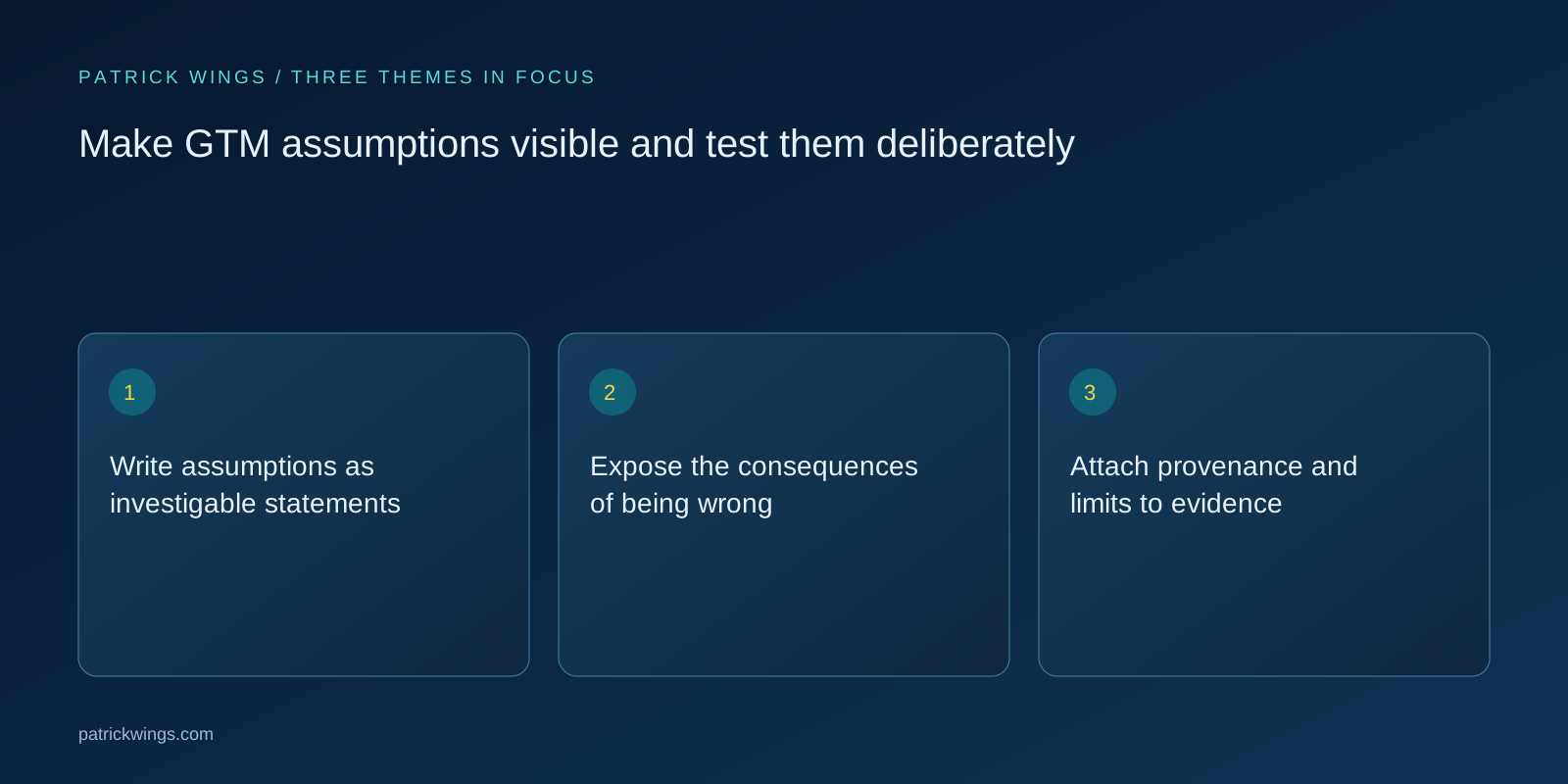
Attach provenance and limits to evidence
Link important claims to specific observations, conversation notes or process examples. Distinguish directly observed behaviour from what someone reported and what your team inferred. An enthusiastic comment does not establish a buying decision. One successful case may depend on exceptional assistance. Preserve conditions and counterexamples alongside supportive material. GOV.UK’s research planning guidance recommends turning unsupported assumptions into research questions. Applied to the register, a missing source therefore creates an explicit investigation question. It should not become a fact merely because the same assertion has appeared repeatedly in leadership presentations, campaign briefs and internal planning documents over several months.
Work through a hypothetical register entry
Imagine a SaaS company planning a self-directed evaluation. A critical assumption is that business users can provide suitable sample data without help. Several interviewees agree in principle, but nobody has completed the task. You arrange observed walkthroughs with suitable users and record each intervention they need. This is a hypothetical example, not a claimed success rate. If another department repeatedly has to prepare the data, the entry pathway changes. The team might provide a sample dataset, offer assistance or reconsider the segment. The test resolves a concrete operating question rather than collecting another round of broad expressions of interest.

Connect tests with decisions beforehand
State which observation would strengthen or weaken the assumption and where the investigation has limits. Strategyzer’s Test Card connects a hypothesis, test, measurement and a criterion defined in advance. Apply that logic without treating a small qualitative study as statistical certainty. Interviews can reveal workflows and contradictions but do not automatically establish market prevalence. Match effort to the decision. Revising a sentence and committing to an expensive market entry require different levels of evidence. Agree who conducts the investigation and when useful findings should be available. A test without a decision consequence risks becoming activity that neither changes the plan nor reduces relevant uncertainty. Explore this further in the guide B2B paid media experiments with clear decision rules.
Change the status when learning changes
A register remains useful only when entries are updated. Use understandable states such as untested, partly supported, contradicted or provisionally credible under named conditions. Add the date, owner and consequence for the commercial plan. Archive superseded assumptions without deleting their original reasoning. Otherwise old debates return without new information. Check dependencies too: evidence of customer benefit does little if access to the relevant role is still unresolved. Reviews should focus first on the open prerequisites of the next decision. The register supports learning and prioritisation rather than becoming retrospective documentation designed to defend a strategy that leadership has already decided cannot change. Explore this further in the guide B2B growth strategy and KPI planning: turn objectives into testable decisions.
INTERACTIVE / FROM READING TO ACTION
Three checkpoints for your implementation
Choose a checkpoint and track your reading progress. Checks are neither saved nor sent and do not score your business.
CHECKPOINT 01
Attach provenance and limits to evidence
Link important claims to specific observations, conversation notes or process examples.
Explore in the article ↗CHECKPOINT 02
Work through a hypothetical register entry
Imagine a SaaS company planning a self-directed evaluation.
Explore in the article ↗CHECKPOINT 03
Connect tests with decisions beforehand
State which observation would strengthen or weaken the assumption and where the investigation has limits.
Explore in the article ↗Frequently asked questions
What belongs in a GTM assumption register?
A specific claim, its decision consequence, available evidence and limits, an owner and the next investigation.
Does a positive interview validate an assumption?
It can support a claim but rarely establishes it comprehensively. Distinguish actual behaviour and authority from general opinion.
Which assumption should we test first?
Investigate the uncertain prerequisite whose failure would most substantially change an important upcoming decision.
How can I put “Write assumptions as investigable statements” into practice?
Walk through the plan: target segment, need, trigger, access, evaluation, implementation and continued use. At each stage, ask which claim you currently take for granted. Companies need greater efficiency is too vague.
What matters when working on “Expose the consequences of being wrong”?
Prioritise more than uncertainty alone. A poorly supported assumption may be minor, while a familiar but false prerequisite could block the whole sales motion. Ask which decision would change if the claim failed.