
THE SHORT ANSWER
A SaaS partnership fits when two businesses can improve a specific customer situation together and reliably provide the necessary contributions. A similar audience or an attractive network is insufficient. This guide helps you evaluate a bounded use case before committing to extensive joint marketing and making promises that depend on another organisation's delivery capability.
To connect this decision with positioning, market entry and growth, read the pillar guide Go-to-market for B2B SaaS: turn market insight into an executable growth strategy.
Start with a shared customer situation
Describe a task where your contributions would meet. Who experiences the problem, which systems are involved and what is currently missing? Identify each company's contribution separately. An implementation partner might manage introduction while the software vendor supplies the product and technical support. That differs from simply making mutual referrals. Distinguish sales access, technical complementarity and ongoing service. The partnership needs a recognisable benefit for the customer, not just a benefit for both marketing teams. If that benefit cannot be explained through a concrete working process, a joint launch is probably premature and further investigation is more useful than producing shared announcements or presentation materials. Explore this further in the guide Partner leads: clarify origin, influence and double counting.
Expose incentives and expectations
Discuss why each side wants to invest time and what costs it expects to carry. One company may want immediate referrals while the other wants a long-term integration; pleasant conversations can conceal that basic mismatch. Clarify contributions, available people and decision authority. Avoid undefined promises such as access to our network. Which introduction would be appropriate, what information can be shared and who handles the resulting questions? Commercial terms belong in an appropriate agreement with specialist review. A fit assessment can surface those issues without replacing a binding arrangement. The important point is to discuss economic expectations before a public announcement instead of assuming that both parties understand the same business model.
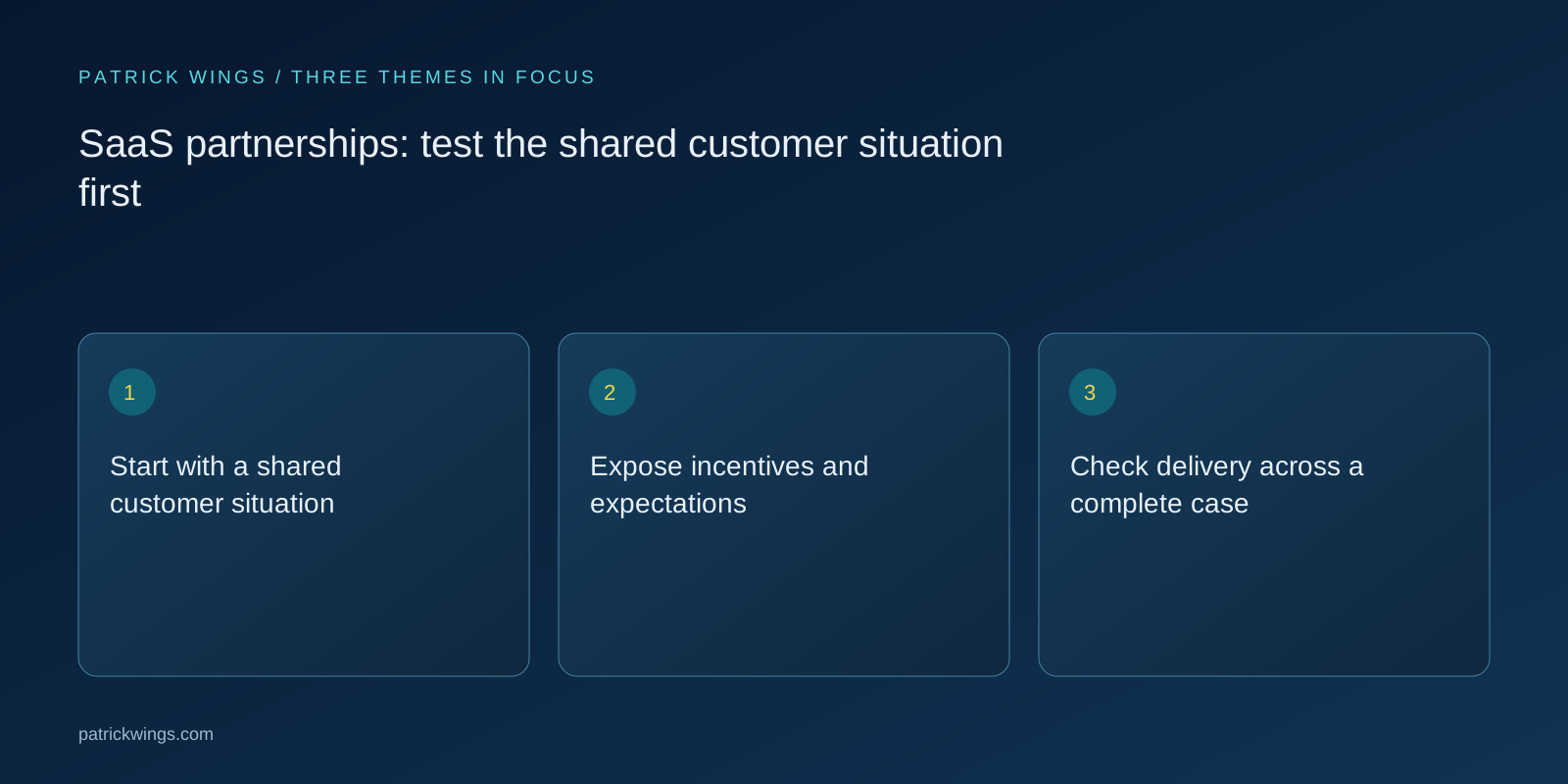
Check delivery across a complete case
Walk through a suitable case from the first conversation to ongoing operation. Who qualifies the enquiry? Who explains each service? Who answers integration questions and remains available when problems arise? Check actual capacity and required knowledge. A recognisable logo or success in a different segment does not prove this process works. Record dependencies such as product version, supported data formats or the availability of particular specialists. Document unresolved matters as open investigations. Customers should not discover a gap between two appealing descriptions where each partner assumes the other is responsible for the missing work, particularly after a commercial commitment has already been made on the combined offer.
Agree a bounded joint experiment
Choose a small investigation that addresses the most important uncertainty. It could be a joint workshop with a relevant prospect or an internal demonstration of the full process. Define the objective, contributions and review in advance. Strategyzer's Test Card helps make the hypothesis, procedure and decision criterion explicit. Your partnership assessment remains a separate application of that discipline. An extensive campaign is unnecessary for this first investigation. The immediate purpose is to learn whether customer value and collaboration work under the stated conditions. Manage participant expectations and permissions carefully. A customer should know whether they are evaluating an available offer or helping explore an arrangement that is not yet resolved.

Assess an illustrative partnership scenario
Suppose a planning tool considers working with a process consultancy. The consultancy reaches relevant businesses but needs a data integration the vendor does not currently support. This example is hypothetical. The shared audience is encouraging, but it does not justify a broad implementation promise. A bounded fit assessment might first explore a use case without that integration. Alternatively, the relationship remains a research option for now. Document the constraint preventing expansion. This turns a positive relationship into a clear decision rather than creating an announced partnership whose actual service must be improvised after the first customer enquiries arrive and reveal the missing dependency.
Decide continuation and exit transparently
After the experiment, assess customer value, collaboration, delivery capability and unresolved commercial matters separately. Record the next scope and accountable roles. A partnership can suit one narrow use case while remaining unsuitable for others. Decide when to review it again, such as after product changes or entry into another market. Also agree how to handle joint claims, outstanding enquiries and shared access if the relationship does not proceed. Partnership quality is not measured by the number of logos published. It is demonstrated when customers receive a coherent offer, contributions are reliable and both organisations can communicate the boundaries of their collaboration honestly before those boundaries become a customer problem. Explore this further in the guide Enable partners while keeping product claims accurate.
INTERACTIVE / FROM READING TO ACTION
Three checkpoints for your implementation
Choose a checkpoint and track your reading progress. Checks are neither saved nor sent and do not score your business.
CHECKPOINT 01
Check delivery across a complete case
Walk through a suitable case from the first conversation to ongoing operation.
Explore in the article ↗CHECKPOINT 02
Agree a bounded joint experiment
Choose a small investigation that addresses the most important uncertainty.
Explore in the article ↗CHECKPOINT 03
Assess an illustrative partnership scenario
Suppose a planning tool considers working with a process consultancy.
Explore in the article ↗Frequently asked questions
Is a shared audience enough for partner fit?
No. Also examine joint customer value, specific contributions, economic expectations and actual delivery capability.
Do we need a joint campaign first?
Not necessarily. A bounded case-based experiment can investigate critical uncertainty with less effort.
Can a partnership fit only one use case?
Yes. Document the scope and expand only when prerequisites and responsibilities are resolved.
How can I put “Start with a shared customer situation” into practice?
Describe a task where your contributions would meet. Who experiences the problem, which systems are involved and what is currently missing? Identify each company's contribution separately.
What matters when working on “Expose incentives and expectations”?
Discuss why each side wants to invest time and what costs it expects to carry. One company may want immediate referrals while the other wants a long-term integration; pleasant conversations can conceal that basic mismatch. Clarify contributions, available people and decision authority.