
THE SHORT ANSWER
A marketing audit should explain why outcomes occur and which change deserves priority. A list of visible website issues is not enough. Examine the connection between target customer, offer, communication, measurement and actual follow-up.
To connect this decision with positioning, market entry and growth, read the pillar guide Go-to-market for B2B SaaS: turn market insight into an executable growth strategy.
Define the decision and scope
Start with a specific reason for the audit: declining enquiry quality, unclear channel performance or the need for a new growth plan. Identify the products, markets and periods under review. Without these boundaries, an audit becomes an unmanageable collection of individual observations. Record missing or unreliable information as well. An illustrative objective could be reviewing one SaaS offer's acquisition journey through to a qualified conversation. That makes the relevant pages, campaigns and CRM steps clear. Additional subjects can then be included deliberately rather than allowing the scope to expand silently until nobody knows which commercial question the work is meant to answer.
Compare strategy with the actual market experience
Ask the team to explain the target customer, problem and product contribution in their own words. Compare these answers with pages, advertisements and sales resources. Different emphasis can be useful, but contradictory promises indicate a problem. Check whether the actual customer mix matches the claimed focus and which assumptions remain unproven. Examine specific contact cases. When a page repeatedly attracts requests for unavailable functionality, the issue may extend beyond wording. Positioning, offer and handover might need attention together. Keep the explanation open until evidence supports it, rather than fitting every finding into the first convenient diagnosis. Explore this further in the guide B2B SaaS positioning: a clear buying perspective beyond interchangeable claims.
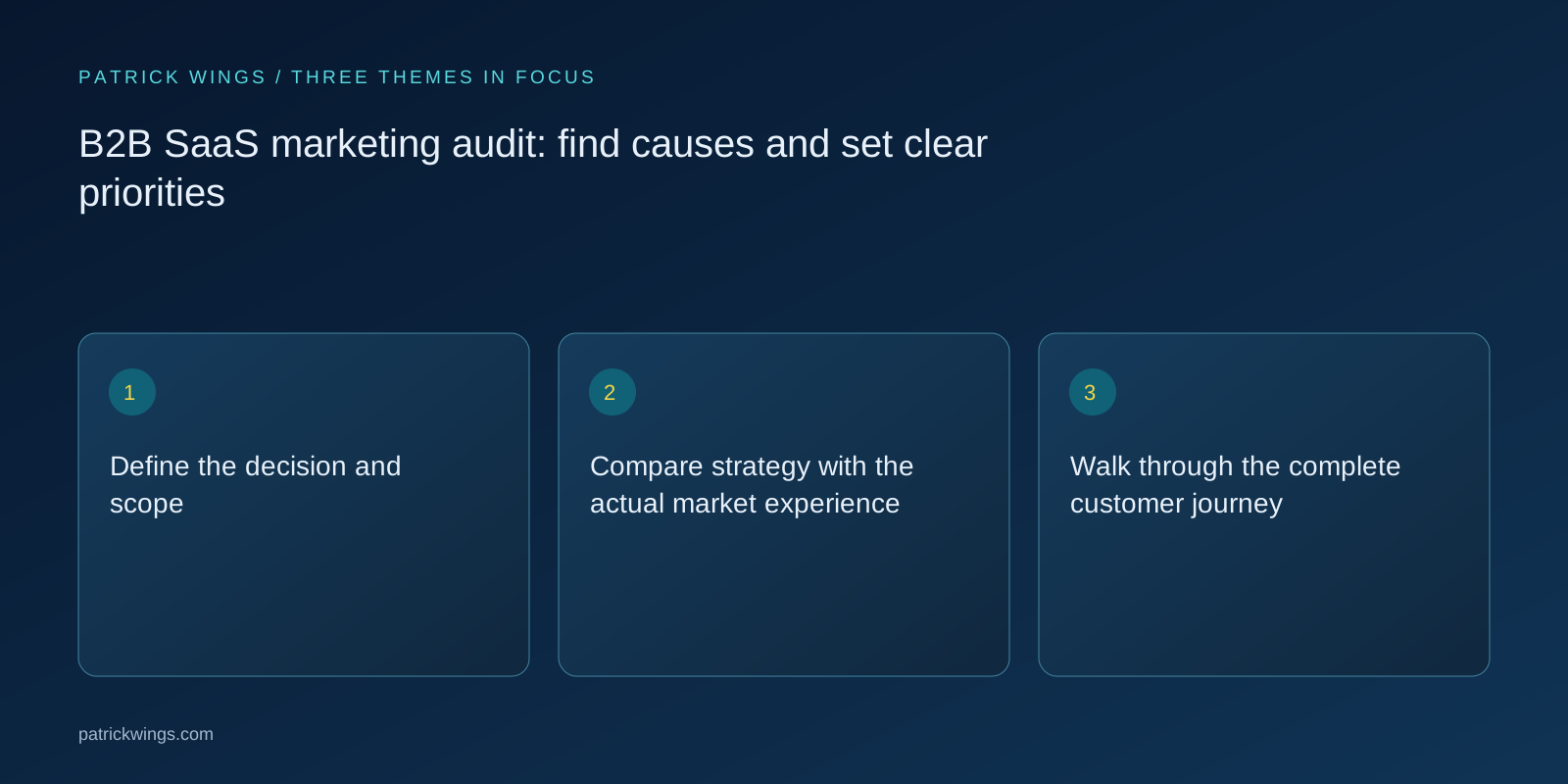
Walk through the complete customer journey
Simulate a plausible entry from content or an advertisement through to the company's actual response. Check mobile display, forms, confirmation, downloads and ownership. Include unclear inputs and failure cases. A sophisticated page offers little value when a submission reaches the wrong inbox. Compare the experience with the promised next action. An educational download should not unexpectedly become a confirmed demo request. Record concrete evidence such as reproducible errors and missing information without unnecessarily copying personal data. Findings should be clear enough for someone implementing a fix to understand the problem and for the team to verify the corrected behaviour afterwards.
Reconcile data sources through definitions
First establish what each metric means. An advertisement click, a website session and a CRM contact are different events. Google explains the different perspectives of Search Console and Analytics; comparable differences arise between other systems. Do not automatically assume an error when totals differ. Investigate definitions, time windows, filters and duplicates. Also check whether source information persists reliably and status changes can be explained. A sound reconciliation can prevent apparent channel problems from being caused only by inconsistent measurement. Document limitations rather than replacing missing evidence with invented accuracy or presenting a stitched-together report as a single complete view of the buyer.

Prioritise findings by impact and dependencies
Separate immediate operational faults, foundational positioning questions and later optimisation ideas. A broken form needs different treatment from an untested channel proposal. Describe the observation, likely explanation, commercial significance and next check for each finding. Estimate work and dependencies realistically. A new dashboard cannot solve an unclear lead definition. A design adjustment is not automatically important because it is easy to see. Use an understandable sequence and identify assumptions still requiring confirmation. The audit should make choices easier rather than demonstrate its scale through the largest possible number of red annotations or minor issues with little connection to the stated objective. Explore this further in the guide B2B growth strategy and KPI planning: turn objectives into testable decisions.
Finish with a usable follow-through plan
Translate the important findings into limited work packages with an owner, expected effect and appropriate review point. Specify when one change depends on another. Agree how implementation and outcomes will be assessed. An illustrative first step might be separating guide requests from demo requests in the CRM before reallocating campaign budgets. Preserve the starting condition as an understandable comparison point. An audit succeeds when the team better understands causes and can implement concrete improvements. A large presentation without a clear decision about the next action only partly fulfils that purpose, even when its observations are individually correct and attractively presented.
INTERACTIVE / FROM READING TO ACTION
Three checkpoints for your implementation
Choose a checkpoint and track your reading progress. Checks are neither saved nor sent and do not score your business.
CHECKPOINT 01
Walk through the complete customer journey
Simulate a plausible entry from content or an advertisement through to the company's actual response.
Explore in the article ↗CHECKPOINT 02
Reconcile data sources through definitions
First establish what each metric means.
Explore in the article ↗CHECKPOINT 03
Prioritise findings by impact and dependencies
Separate immediate operational faults, foundational positioning questions and later optimisation ideas.
Explore in the article ↗Frequently asked questions
How does an audit differ from reporting?
Reporting presents defined metrics. An audit also investigates relationships, process failures and possible causes, then prioritises changes.
Must an audit cover every channel?
No. Scope should match the commercial question. A focused review can be more useful than shallow comprehensive coverage.
What should the output include?
Supported findings, visible data gaps and an executable plan with priorities, ownership and review points.
How can I put “Define the decision and scope” into practice?
Start with a specific reason for the audit: declining enquiry quality, unclear channel performance or the need for a new growth plan. Identify the products, markets and periods under review. Without these boundaries, an audit becomes an unmanageable collection of individual observations.
What matters when working on “Compare strategy with the actual market experience”?
Ask the team to explain the target customer, problem and product contribution in their own words. Compare these answers with pages, advertisements and sales resources. Different emphasis can be useful, but contradictory promises indicate a problem.