
THE SHORT ANSWER
An enterprise buying group contains people with different decision rights, review tasks and dependencies. A contact list is therefore insufficient. Establish who influences which part of the decision, what makes approval possible and where a legitimate veto may arise. This helps support the buying process accurately without inferring authority from titles or assuming one enthusiastic contact represents the entire organisation.
To connect this decision with positioning, market entry and growth, read the pillar guide Go-to-market for B2B SaaS: turn market insight into an executable growth strategy.
Map decisions rather than roles alone
Begin with decisions necessary for purchase. Confirming need, allocating budget, reviewing technical suitability and owning implementation may sit with different people. Ask about the actual procedure in this organisation. Executives need not make every decision, while a less visible specialist may own an essential review. Separate known rights, inferred influence and open questions. Nielsen Norman Group’s stakeholder analysis considers power and interest. For enterprise buying, extend this perspective with specific approvals and dependencies rather than placing people only in broad power categories. The aim is to understand how this purchase can legitimately be decided.
Expose dependencies between reviews
Establish which steps can run in parallel and which need an earlier decision. IT might require a defined data flow before assessment, while procurement needs confirmed scope. One missing document can therefore block several later activities. Create a simple record of decision, prerequisite, responsible role and required evidence. Use it as a discussion aid with the customer rather than pretending it fully represents their internal process. Procedures can change. After important transitions, check for new participants or requirements and whether your previous understanding remains accurate. This is more useful than maintaining a static hierarchy of job titles. Explore this further in the guide Prepare SaaS for enterprise procurement.
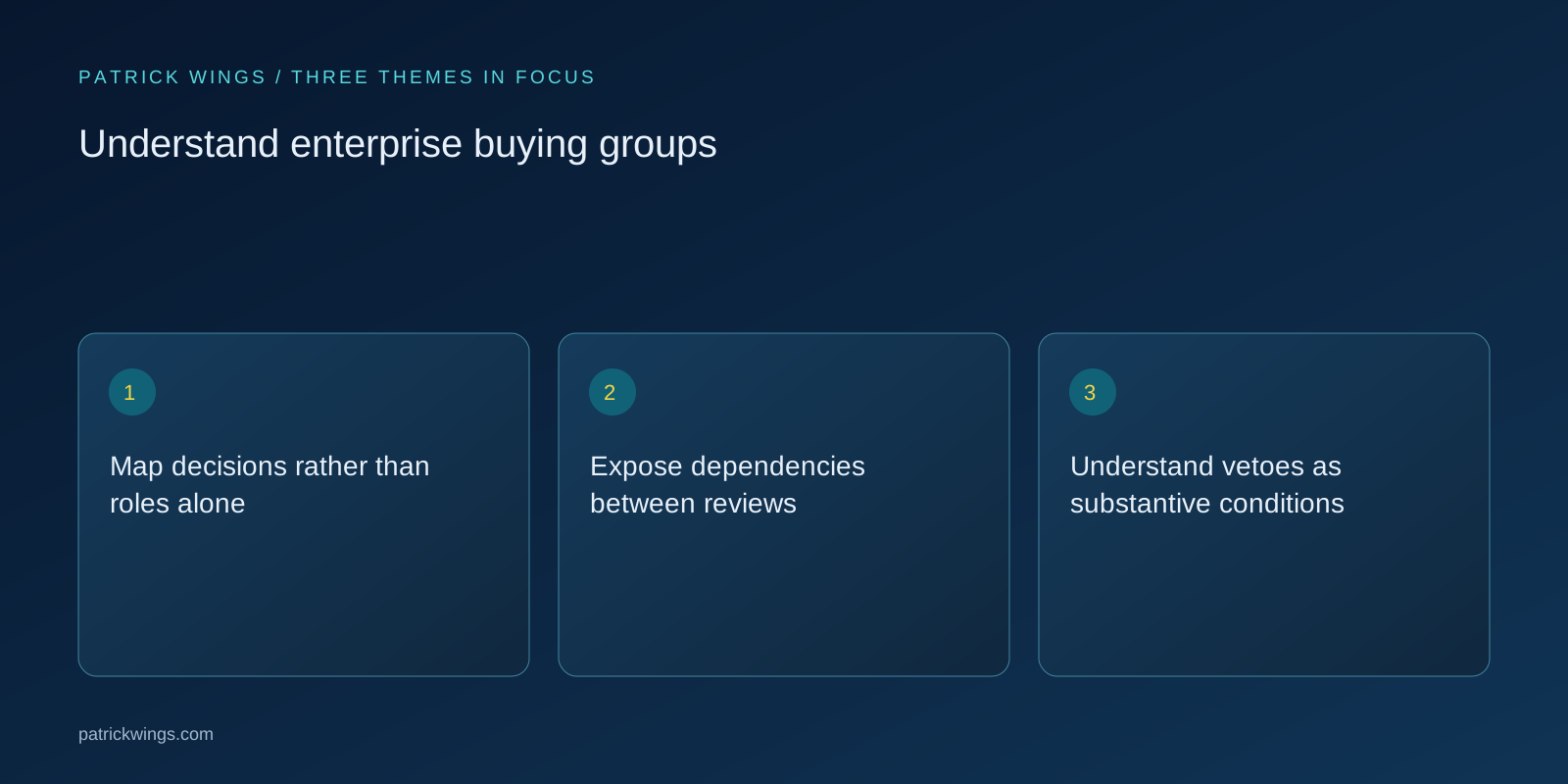
Understand vetoes as substantive conditions
A role raising concerns is not automatically an opponent. Security, operations and purchasing can represent legitimate boundaries. Ask what condition must be met and whether it is achievable. Separate missing information, genuine mismatch and an unresolved internal decision. Provide evidence where it helps and state limitations honestly. A mandatory technical requirement does not disappear through a more persuasive benefit presentation. An enthusiastic user cannot grant a formal approval belonging elsewhere. Sales and specialists should understand these distinctions before making commitments, particularly where delivery responsibilities or assumptions about customer resources remain unresolved.
Hypothetical example: departmental approval
A fictional department supports a planning product, and the supplier initially treats the deal as nearly decided. Later it discovers that IT needs a documented identity process and procurement begins contract review only afterwards. The project owner has also not reserved implementation capacity. The team maps these dependencies and checks which prerequisites it can deliver. This example predicts no faster close. It illustrates why agreement with the benefit is not a complete purchase decision and why the sequence of reviews can matter as much as the enthusiasm of individual participants in early product demonstrations.

Support accurate internal circulation
Prepare information each role can use correctly. An internal advocate needs a clear explanation of the task, boundaries and open decisions rather than an overloaded company presentation. Reviewers need relevant details and named contacts. Keep statements about the product and implementation consistent. Avoid persuading different roles through contradictory promises. Ask which information is actually needed internally and how it may be shared. Useful support enables an informed decision, including a reasoned rejection, while respecting customer responsibilities. The supplier’s role is to make its offer assessable, not to replace the organisation’s own governance. Explore this further in the guide Plan B2B pilots with clear decision criteria.
Judge progress through resolved conditions
Assess status through confirmed decisions and remaining prerequisites. Numerous meetings and positive comments can demonstrate activity without advancing approval. Record what was reviewed, the result and the agreed next action. If essential roles remain unavailable or fundamental conditions are missing, the decision stays uncertain. Update planning accordingly. Buying-group analysis is not a method for manipulating people. It makes decision mechanics comprehensible and helps both sides evaluate effort, limitations and realistic next steps together. This also creates a more defensible account of opportunity status than confidence based primarily on the relationship with one contact.
INTERACTIVE / FROM READING TO ACTION
Three checkpoints for your implementation
Choose a checkpoint and track your reading progress. Checks are neither saved nor sent and do not score your business.
CHECKPOINT 01
Understand vetoes as substantive conditions
A role raising concerns is not automatically an opponent.
Explore in the article ↗CHECKPOINT 02
Hypothetical example: departmental approval
A fictional department supports a planning product, and the supplier initially treats the deal as nearly decided.
Explore in the article ↗CHECKPOINT 03
Support accurate internal circulation
Prepare information each role can use correctly.
Explore in the article ↗Frequently asked questions
Is our champion the decision-maker?
Not automatically. Establish their specific authority and the approvals required.
How should we handle an IT veto?
Investigate its underlying condition and whether you can meet it. Do not try to persuade away a substantive requirement.
What indicates genuine progress?
Confirmed decisions and fulfilled prerequisites rather than additional meetings alone.
How can I put “Map decisions rather than roles alone” into practice?
Begin with decisions necessary for purchase. Confirming need, allocating budget, reviewing technical suitability and owning implementation may sit with different people. Ask about the actual procedure in this organisation.
What matters when working on “Expose dependencies between reviews”?
Establish which steps can run in parallel and which need an earlier decision. IT might require a defined data flow before assessment, while procurement needs confirmed scope. One missing document can therefore block several later activities.