
THE SHORT ANSWER
Launch gates make a B2B release decision auditable. They connect published product promises with evidence, operating capability and accountable owners. This guide shows how to design release checks so a calendar date does not conceal unresolved service boundaries or the absence of support for the experience being promoted.
To connect this decision with positioning, market entry and growth, read the pillar guide Go-to-market for B2B SaaS: turn market insight into an executable growth strategy.
Define the release being approved
Start by describing what is actually launching: a limited beta, a new package, an additional market or a generally available product. These require different conditions. Name the audience, available capabilities, implementation route and support arrangements. Explicitly state what is excluded. Connect this scope to every visible entry point, from advertisements and landing pages to demonstrations and contractual materials. A gate approves this defined scope. If the offer changes near the deadline, reassess the approval against the new version. Otherwise participants may approve different interpretations of the same launch without realising that the shared plan contains contradictory expectations about what customers will receive. Explore this further in the guide Planning a B2B SaaS launch: connect market communication with operational readiness.
Connect promises with acceptable evidence
List the claims buyers will encounter at launch. Each material statement needs evidence or a precise limitation. Check the product version and use case to which the evidence applies. Include implementation, availability and support claims. Language such as ready immediately creates difficulty if customer configuration must happen first. The gate does not require an exhaustive proof collection for every advertising phrase. It requires that decision-relevant expectations are not based on unverified assumptions. Unreleased functions must not appear in screenshots or demonstrations in ways that imply they are already part of the package being offered to the intended audience on the release date.
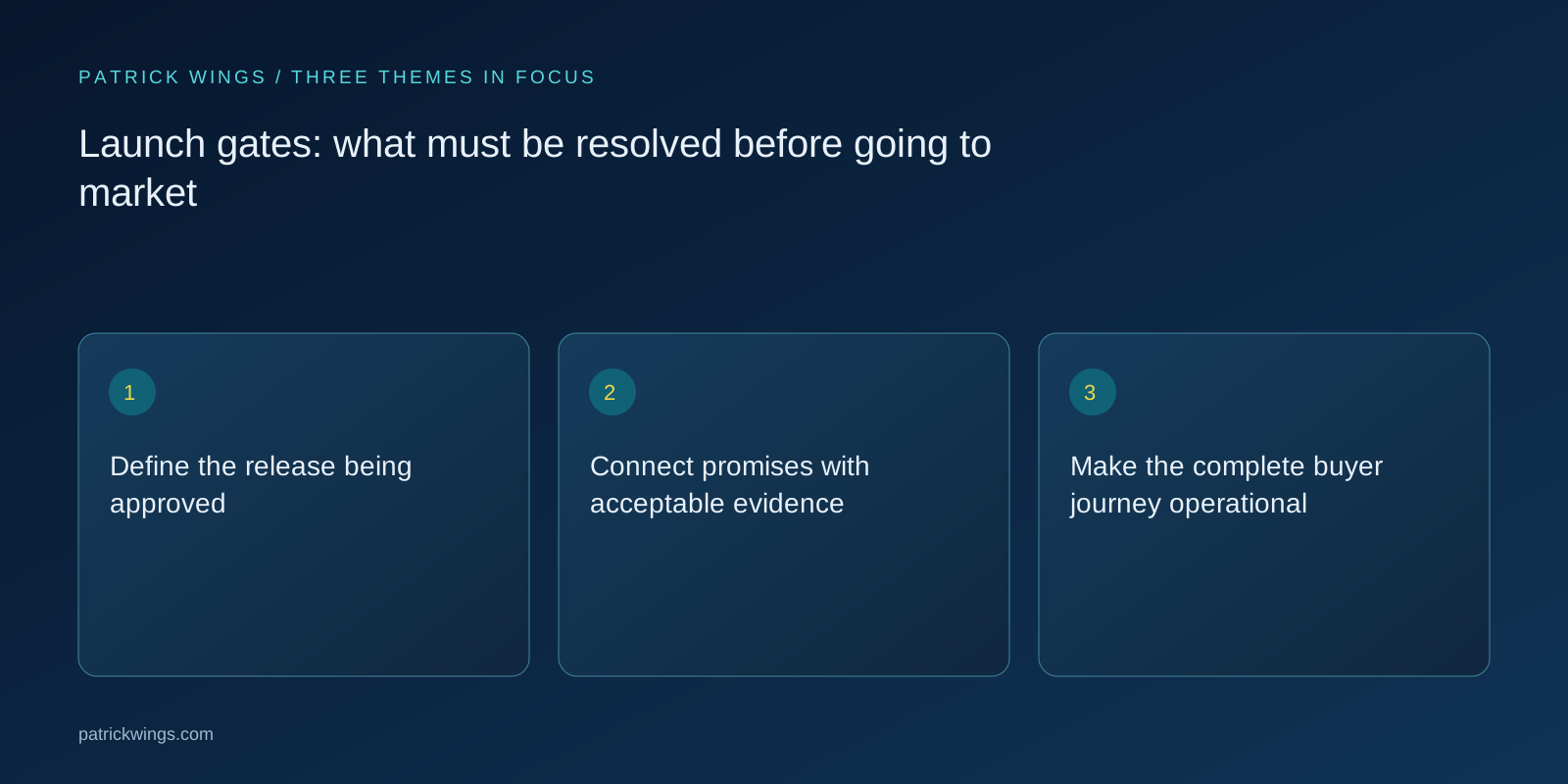
Make the complete buyer journey operational
Test more than the website. An enquiry needs to reach the right person; a prospect needs the promised documentation; a new customer needs access to the agreed implementation path. Check ownership, access, support channels and billing where they belong to the launch scope. Also agree how to respond to errors and unexpectedly high enquiry volume. The practical question is whether current resources can fulfil the published promise. A planned hire or an unconfirmed partner is not present operating capacity. For a limited release, explicit participation boundaries can be more useful and honest than an open entry point that cannot provide the assistance it advertises.
Agree decision rules before the meeting
Define a small number of gates, each with an owner, required evidence and possible decision. Useful outcomes include approval, approval for a narrower scope or postponement. Several harmless green indicators must not cancel out a critical problem. State which failures block the proposed release. Strategyzer's Test Card makes the hypothesis, test, measurement and success threshold explicit; a launch gate can use comparable decision discipline. The release structure described here remains your own operating design. Its criteria should fit the product, buyer expectations and consequences of failure rather than reproduce a generic traffic-light template that nobody can explain when a difficult case arises. Explore this further in the guide Plan B2B pilots with clear decision criteria.

Consider an illustrative limited approval
Suppose a reporting capability works reliably with one supported data format while another integration is still under evaluation. This example is hypothetical. Instead of approving the entire proposal, the team could launch only for the verified format. The website, demonstrations, sales and support would use the same boundaries. Prospects with different prerequisites would receive a clear answer rather than a waiting-list position disguised as a purchase commitment. The decision would also identify the evidence needed for expansion. This makes the release date useful without allowing approval to drift into functions or customer situations that have not yet received an adequate assessment from the people responsible for delivery.
Revisit the decision after release
Record the approved version, date and outstanding restrictions. After launch, observe whether enquiries match the expected audience and use case. Review problems across the full journey, including implementation and support. GOV.UK's beta research guidance also considers the end-to-end service and evidence from its use. Apply that perspective in your release review. If central assumptions fail, revise scope and communication. A gate is not a permanent certificate of market readiness. It is a traceable decision based on a particular state of knowledge, with an accountable next review and explicit opportunities to correct an offer before a limited problem becomes an entrenched expectation.
INTERACTIVE / FROM READING TO ACTION
Three checkpoints for your implementation
Choose a checkpoint and track your reading progress. Checks are neither saved nor sent and do not score your business.
CHECKPOINT 01
Make the complete buyer journey operational
Test more than the website.
Explore in the article ↗CHECKPOINT 02
Agree decision rules before the meeting
Define a small number of gates, each with an owner, required evidence and possible decision.
Explore in the article ↗CHECKPOINT 03
Consider an illustrative limited approval
Suppose a reporting capability works reliably with one supported data format while another integration is still under evaluation.
Explore in the article ↗Frequently asked questions
Should every launch use identical gates?
No. A beta and general availability make different promises. Gates should fit the approved scope and the consequences of failure.
What happens when a critical issue remains open?
Narrow the release or postpone it. Other completed tasks should not cancel out a critical blocker.
Who approves the launch?
Owners provide evidence for their respective commitments, and a named decision maker approves the documented scope.
How can I put “Define the release being approved” into practice?
Start by describing what is actually launching: a limited beta, a new package, an additional market or a generally available product. These require different conditions. Name the audience, available capabilities, implementation route and support arrangements.
What matters when working on “Connect promises with acceptable evidence”?
List the claims buyers will encounter at launch. Each material statement needs evidence or a precise limitation. Check the product version and use case to which the evidence applies.