
THE SHORT ANSWER
A SaaS trial should support a realistic buying decision. Prospective customers need an appropriate task, achievable prerequisites and clear conditions at the end. A free registration is not automatically a useful test. Design a repeatable path from entry to a defensible product assessment before choosing duration or optimising conversion tactics that could obscure the purpose of the experience.
To connect this decision with positioning, market entry and growth, read the pillar guide Go-to-market for B2B SaaS: turn market insight into an executable growth strategy.
Define the decision being tested
Describe what a suitable participant should be able to assess afterwards, such as workflow fit or the practicality of collaboration. A full enterprise integration often falls outside a standard trial. Specify suitable customer situations and when assisted evaluation is required. This distinguishes the trial from an individually negotiated enterprise pilot: its scope and route are largely repeatable. The boundary manages expectations and keeps support feasible. Without it, the same trial may promise a simple exploration to one person while implicitly committing the supplier to a bespoke implementation for another organisation. Explore this further in the guide Plan B2B pilots with clear decision criteria.
Make prerequisites visible before entry
Explain required data, permissions and participants. Check whether prospects can obtain them without extended internal procurement. Otherwise provide a suitable example mode or another entry route with clear limitations. Sample data can demonstrate interaction and workflow without establishing suitability for real company data. Avoid letting the entire trial period expire during unresolved technical approval. Show these conditions before registration and provide a route for clarification. Later abandonment should not automatically be classified as lack of interest when the participant never had the authority or resources needed to attempt the intended task.
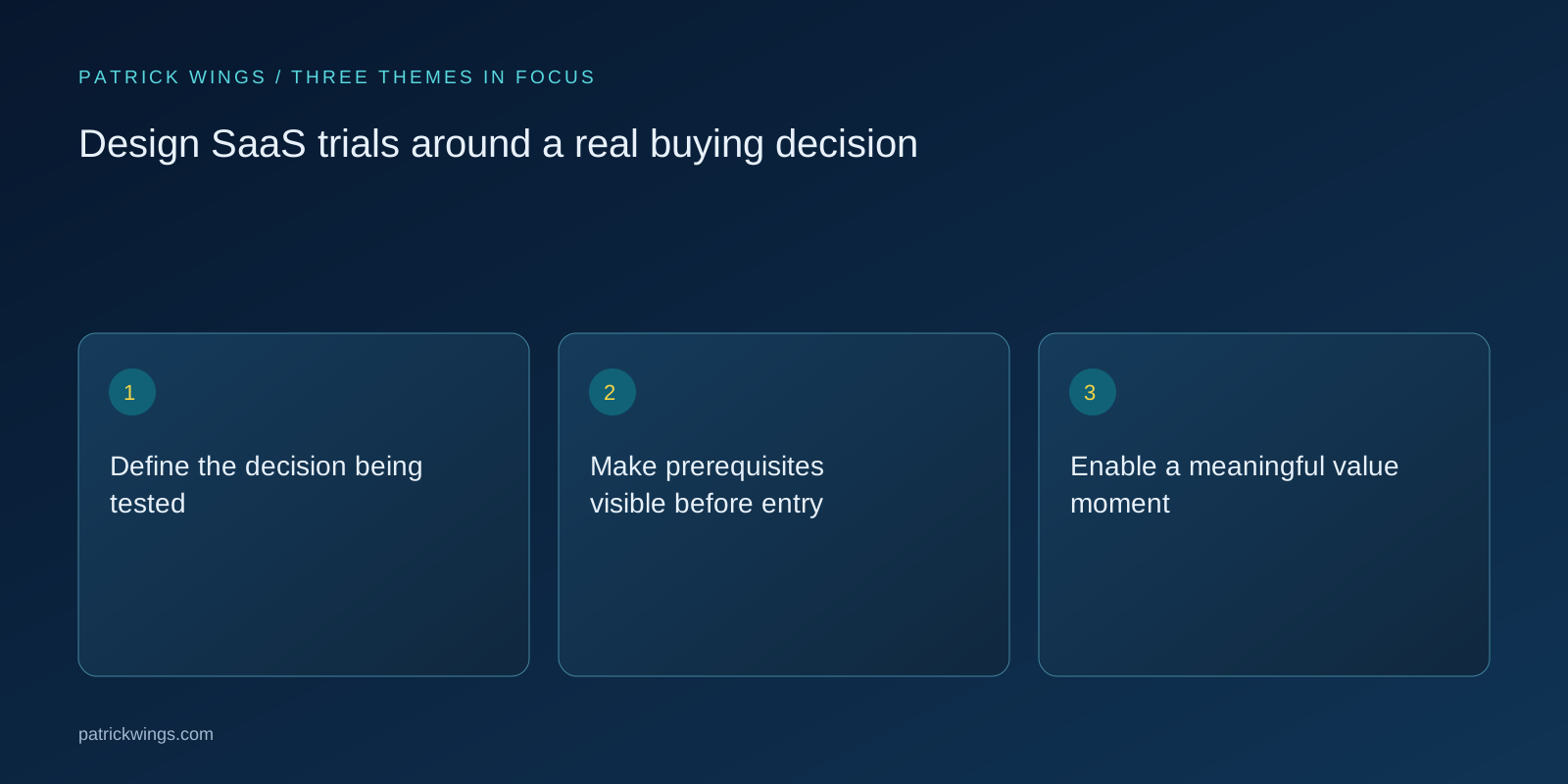
Enable a meaningful value moment
Organise entry around one complete, bounded task. Guidance, templates and prompts should help users connect the product to their work. A checklist of completed setup actions is insufficient. Observe whether the task is completed and the result understood. Distinguish technical faults, unclear meaning and missing prerequisites; each needs a different response. Offer targeted support without automatically turning independent exploration into a mandatory sales meeting. The aim is to let appropriate participants learn enough to make a decision while identifying situations where the product route itself is creating avoidable confusion or effort.
Hypothetical example: one approval workflow
A fictional supplier offers a trial for internal document approval. It defines a standard case: select a template, invite participants and complete a traceable approval. Sample data supports the first attempt, with an explanation of what it cannot establish about real deployment. A prospect needing complex enterprise integration is offered a separate discussion first. This example illustrates the boundary between repeatable product exploration and individual evaluation. It predicts no conversion rate and does not suggest that completing a sample workflow alone justifies implementation across an entire organisation with different requirements and constraints.

Keep end conditions clear and consistent
Explain charges, subsequent conditions, access, data treatment and cancellation before the trial begins. Check that the explanation matches actual billing and product behaviour. Stripe documents different trial and transition arrangements, for example; your configured arrangement is what matters. Do not copy assumptions from a generic template. Remind users about relevant decisions and provide understandable options. A surprise invoice or unexpected loss of data is not a useful conversion mechanism. Even an ending without purchase should give participants a clear conclusion and accurate information about any remaining rights or available export options. Explore this further in the guide Demo pages that set useful expectations before the conversation.
Measure the complete experience
Examine suitable starts, fulfilled prerequisites, completed tasks and subsequent decisions together. Registration count alone explains little. Segment by context that genuinely affects usage, then investigate abandonment through observation or conversations. People unable to reach the value moment differ from those who experienced it and still declined the offer. Translate this distinction into improvements to access, product or commercial scope. Extending trial duration makes sense when time is the demonstrated obstacle. It does not resolve an unclear task or unsuitable product, and can simply prolong an experience from which neither the participant nor the team learns much.
INTERACTIVE / FROM READING TO ACTION
Three checkpoints for your implementation
Choose a checkpoint and track your reading progress. Checks are neither saved nor sent and do not score your business.
CHECKPOINT 01
Enable a meaningful value moment
Organise entry around one complete, bounded task.
Explore in the article ↗CHECKPOINT 02
Hypothetical example: one approval workflow
A fictional supplier offers a trial for internal document approval.
Explore in the article ↗CHECKPOINT 03
Keep end conditions clear and consistent
Explain charges, subsequent conditions, access, data treatment and cancellation before the trial begins.
Explore in the article ↗Frequently asked questions
How long should a trial last?
Long enough for the defined task under realistic conditions. There is no universal optimum for that purpose.
Is a trial the same as a pilot?
Here a trial is standardised; an enterprise pilot is negotiated for an individual decision.
Should we require a payment card?
That is a design choice. Clear charges, end conditions and appropriate access matter for the target audience.
How can I put “Define the decision being tested” into practice?
Describe what a suitable participant should be able to assess afterwards, such as workflow fit or the practicality of collaboration. A full enterprise integration often falls outside a standard trial. Specify suitable customer situations and when assisted evaluation is required.
What matters when working on “Make prerequisites visible before entry”?
Explain required data, permissions and participants. Check whether prospects can obtain them without extended internal procurement. Otherwise provide a suitable example mode or another entry route with clear limitations.