
THE SHORT ANSWER
A product launch is more than a publication date. It connects market understanding, product readiness and the first real customer interactions. Preparation should clarify what can be promised and how the business responds to interest, questions and new evidence.
To connect this decision with positioning, market entry and growth, read the pillar guide Go-to-market for B2B SaaS: turn market insight into an executable growth strategy.
Define the launch reason and objective
Establish whether you are introducing a new product, a significant update or a new market entry. Then describe the relevant customer situation and intended first action. A beta needs different expectations from general availability. An illustrative launch might invite selected IT teams to a supported trial of a clearly bounded workflow. Suitable participants and useful feedback would initially matter more than maximum public reach. Specify what you need to learn and which information remains missing. This turns the launch plan into a decision instrument rather than a lengthy publication calendar whose activities do not share a clear commercial or learning objective. Explore this further in the guide Sales enablement for B2B SaaS: support buying decisions with relevant evidence.
Bound the available offer honestly
Check which capabilities can actually be used and under what conditions. Distinguish current functionality from roadmap, pilot access and individual services. Clarify support, implementation and limitations with responsible teams. An attractive announcement can create substantial later work if it suggests a maturity level the product has not reached. A limited, well-explained entry is often more useful than a comprehensive promise. Record approved claims and how questions about unavailable capabilities should be answered. That foundation should connect the website, external announcements, social posts and sales resources. Consistency matters most when different people begin responding to interest at the same time.
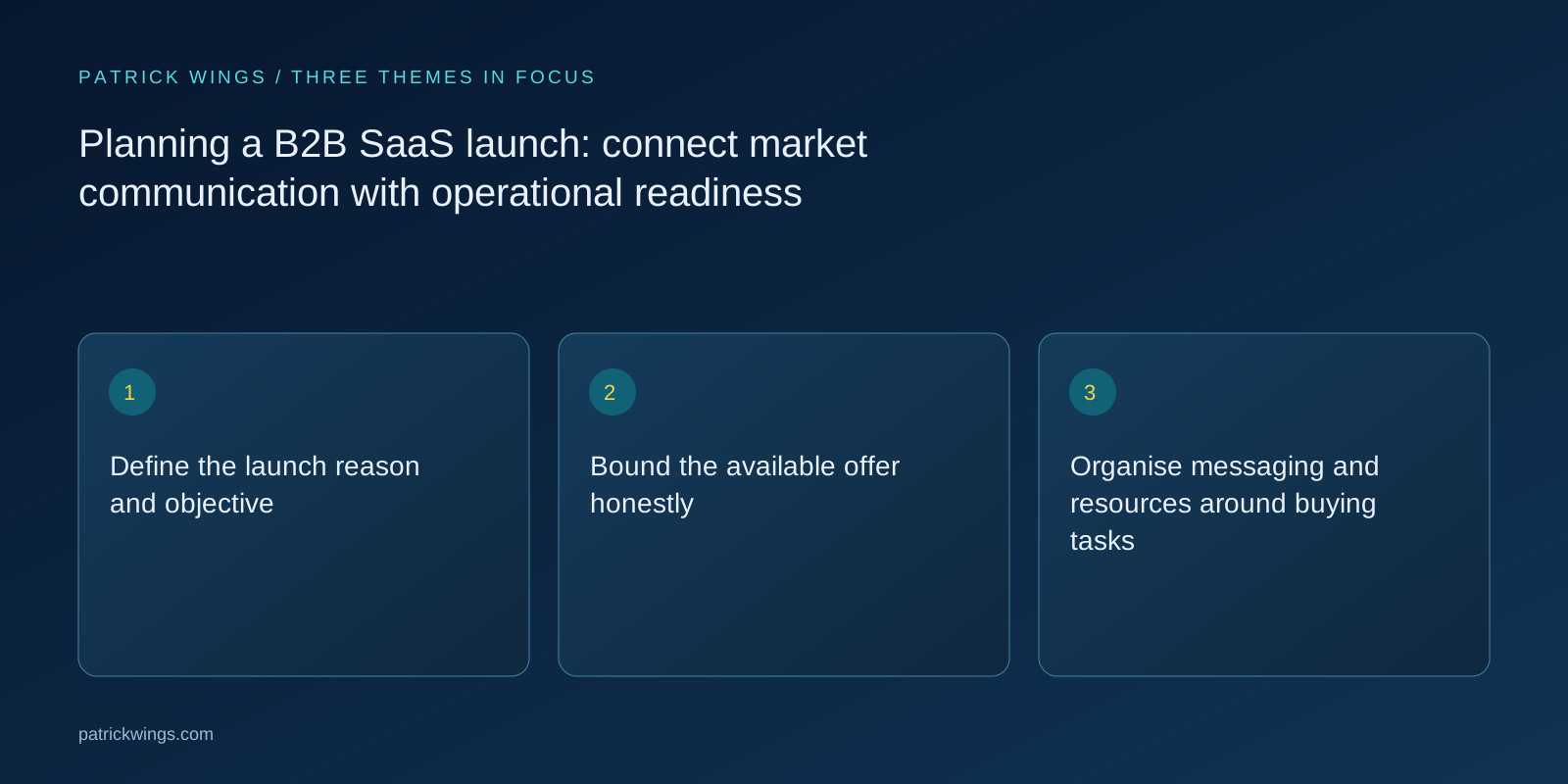
Organise messaging and resources around buying tasks
First develop a clear account of the problem, product contribution and appropriate application. Derive the launch page, demonstration and essential conversation aids from it. Add answers to likely technical and commercial questions. Not every format idea belongs in the starting scope. A short, understandable workflow can help more than many vague announcement variations. Check whether all resources explain the same entry point and lead to the same available offer. Genuine customer evidence needs suitable permission. Illustrative examples can improve understanding but must not resemble completed customer projects or verified outcomes. The material should make evaluation easier rather than merely repeat that something new exists.
Test the operational journey beforehand
Walk the whole route as a prospective customer: content, page, form, confirmation, scheduling or access, and the personal response. Check smaller screens, errors and redirects. Test ownership during absences and technical transmission to the CRM. Sales should know whom the launch addresses, what was promised and which questions are likely. Customer success needs clarity about initial use and support. A working publication process alone does not establish readiness. When suitable prospects cannot reliably reach the next step, a high-reach announcement consumes attention that the business cannot usefully receive. Resolve these operational gaps before treating additional distribution as the only remaining launch task.

Give channels a defined role in the start
Identify channels that already provide trust and access to the audience. Customer communication, partners, expert resources, social media and paid tests can perform different jobs. A large simultaneous rollout is not always necessary. Coordinate sequence and messaging so early feedback can still influence later activity. An illustrative pilot might begin with a limited specialist group before expanding distribution. Justify that sequence through product maturity and learning needs rather than assuming a universal launch formula. Also document what would trigger a pause or change in communication. A deliberate sequence is easier to adapt when early experience contradicts an important assumption about the offer.
Turn the start into a learning rhythm
After launch, collect misunderstandings, exclusion reasons and entry problems alongside reach and enquiries. Separate short-term curiosity from suitable contacts and actual use. After an appropriate period, assess which assumptions gained support and what should change first. Product marketing, sales and product should interpret the evidence together. Update resources when important claims change. A launch does not end with the last social post. It becomes a sustainable market process when the company learns systematically from real interactions and reliably delivers the promised offer. The useful outcome is a stronger connection between what the audience expects and what customers can actually experience.
INTERACTIVE / FROM READING TO ACTION
Three checkpoints for your implementation
Choose a checkpoint and track your reading progress. Checks are neither saved nor sent and do not score your business.
CHECKPOINT 01
Organise messaging and resources around buying tasks
First develop a clear account of the problem, product contribution and appropriate application.
Explore in the article ↗CHECKPOINT 02
Test the operational journey beforehand
Walk the whole route as a prospective customer: content, page, form, confirmation, scheduling or access, and the personal response.
Explore in the article ↗CHECKPOINT 03
Give channels a defined role in the start
Identify channels that already provide trust and access to the audience.
Explore in the article ↗Frequently asked questions
Does a launch require a fixed date?
A date helps coordination, but should not justify publishing past unresolved product or service issues.
Must all channels launch together?
No. A staged sequence can support learning when it suits the objective and operating conditions.
What should be measured afterwards?
Suitable contacts, meaningful next actions, initial usage and relevant feedback. Reach alone does not describe market readiness.
How can I put “Define the launch reason and objective” into practice?
Establish whether you are introducing a new product, a significant update or a new market entry. Then describe the relevant customer situation and intended first action. A beta needs different expectations from general availability.
What matters when working on “Bound the available offer honestly”?
Check which capabilities can actually be used and under what conditions. Distinguish current functionality from roadmap, pilot access and individual services. Clarify support, implementation and limitations with responsible teams.