
THE SHORT ANSWER
A customer advisory board is a deliberately selected group of customers helping you investigate strategic market and product questions. It can provide valuable perspectives without representing the whole market. Effective advisory work starts with a clear question, transparent expectations and a feedback process explaining what you decide after the discussions.
To connect this decision with positioning, market entry and growth, read the pillar guide Go-to-market for B2B SaaS: turn market insight into an executable growth strategy.
Define a sufficiently focused purpose
Specify the decision the board should inform. Understanding changing procurement conditions requires different participants and material from investigating a future product task. Pragmatic Institute describes advisory boards as a way to bring customer perspectives into strategic discussion. Avoid combining a sales presentation, support clinic and roadmap vote. Before inviting anyone, write down the questions you want to investigate and those outside the session. A board can contextualise experience and challenge assumptions. It does not remove leadership’s responsibility for priorities, product choices and investment decisions, nor should customers be left believing that participation grants them control over those choices.
Select perspectives rather than revenue alone
Consider which experiences matter for the question: company size, usage situation, implementation maturity or buying responsibility. Your largest accounts may represent a narrow and unusually demanding subset. Do not invite only enthusiastic supporters. If the decision concerns a new market, existing customers may be insufficient, requiring complementary research with noncustomers. Record the missing perspectives. Also consider whether dominant participants might silence other experiences. A deliberately curated group supports depth but cannot establish a representative distribution of behaviours across the market. That limitation should remain visible in the internal presentation instead of disappearing when findings are converted into attractive summary slides.
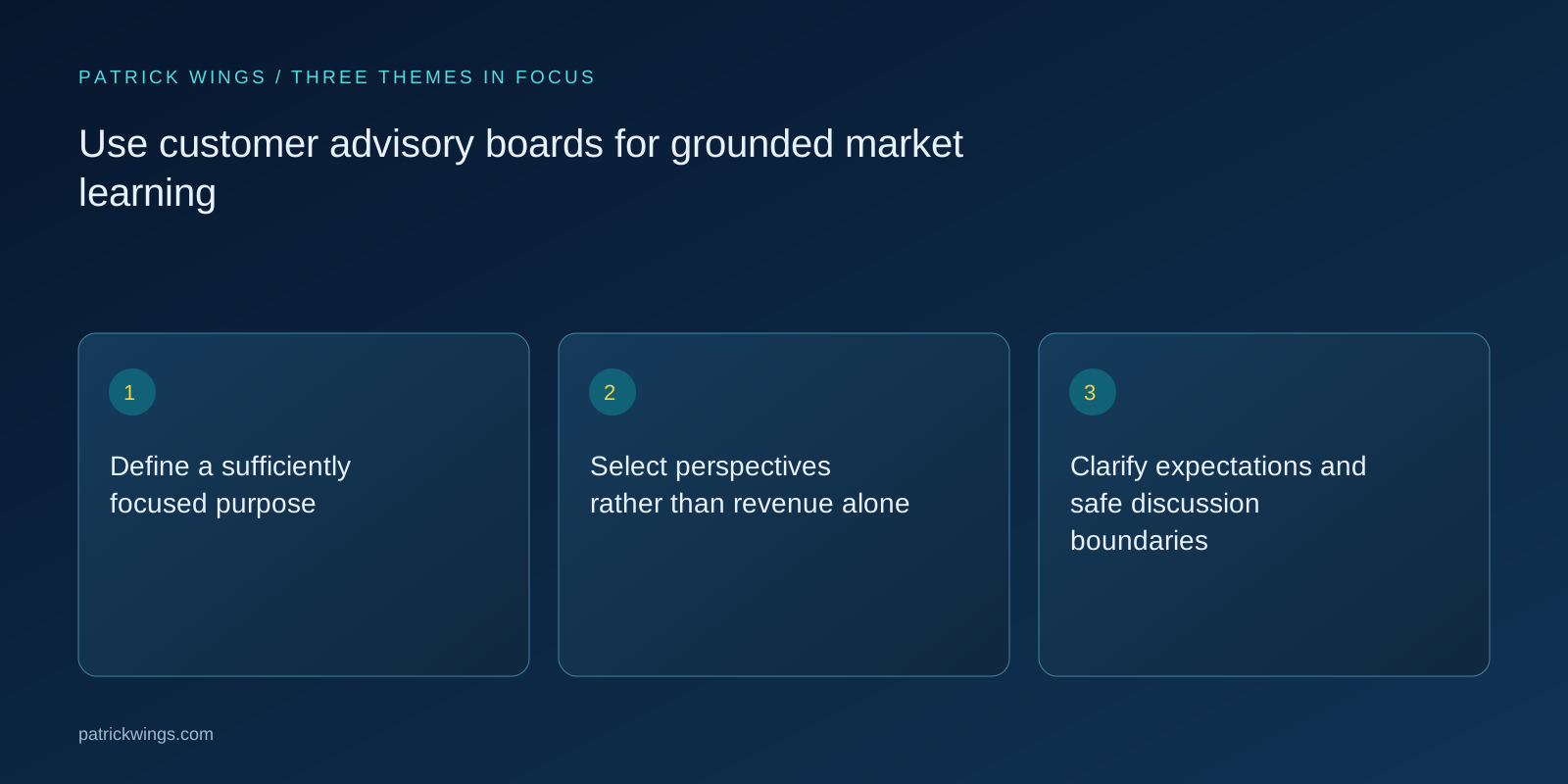
Clarify expectations and safe discussion boundaries
Explain the purpose, format, treatment of notes and planned feedback process. Make clear that participation does not guarantee priority for individual feature requests. Agree what participants may share and how sensitive examples are handled. Avoid pressure to disclose confidential plans or other organisations’ commercial details. Where participating businesses compete, discussion boundaries deserve particular care and review by the relevant internal specialists. Separate bilateral support matters from group research so one customer’s incident does not consume the session. Participants should understand how their contributions will be used and what they can reasonably expect after investing their time.
Design a hypothetical learning session
Imagine an IT platform investigating how customers allocate responsibility when several teams merge. Before the meeting, participants receive a brief question about a recent handover. Each describes their situation before the group discusses solutions. The facilitator explores triggers, participating roles and approaches that failed. This is a hypothetical scenario without a claimed customer result. Only afterward does a concept help investigate reactions to possible support. That order reduces the risk of an appealing presentation obscuring real experiences. It also makes it easier to distinguish actual problems from polite agreement with a solution that participants have just seen for the first time.

Analyse contributions carefully
Separate direct statements, apparent common patterns and your interpretation. Note whether an idea comes from someone’s own experience or arose during group discussion. Shared nodding does not establish that all organisations handle the task identically. Examine contradictory examples and compare findings with individual interviews, implementation experience or lost opportunities. GOV.UK’s research planning guidance recommends deliberately setting questions and methods and updating them as learning develops. For an advisory board, this means connecting findings with the next research question. Keep unanswered questions visible rather than treating a small curated discussion group as a complete market study with broader authority than its sampling supports. Explore this further in the guide AI interview analysis: separate observation from interpretation.
Close the feedback loop and revisit usefulness
After the meeting, provide an understandable account of what you learned, what you decided and what remains open. Explain which suggestions will not proceed and why. Do not share delivery dates that have not been approved internally. Before the next session, check whether the same membership still fits the question and whether customers find the exchange worthwhile. An advisory board should not continue automatically after its purpose becomes unclear. Quality lies in defensible market learning and responsible treatment of contributions. Prestigious participant names, enthusiastic discussion and a large number of recurring meetings cannot establish that the programme is informing useful decisions. Explore this further in the guide Connect product marketing and product management.
INTERACTIVE / FROM READING TO ACTION
Three checkpoints for your implementation
Choose a checkpoint and track your reading progress. Checks are neither saved nor sent and do not score your business.
CHECKPOINT 01
Clarify expectations and safe discussion boundaries
Explain the purpose, format, treatment of notes and planned feedback process.
Explore in the article ↗CHECKPOINT 02
Design a hypothetical learning session
Imagine an IT platform investigating how customers allocate responsibility when several teams merge.
Explore in the article ↗CHECKPOINT 03
Analyse contributions carefully
Separate direct statements, apparent common patterns and your interpretation.
Explore in the article ↗Frequently asked questions
Is a customer advisory board representative market research?
It is generally a deliberately selected group. Explain which perspectives are present and absent before drawing broader conclusions.
Should customers vote on the roadmap?
You may investigate preferences without implying binding authority. Product and business accountability remain governed internally.
How do we avoid turning it into a sales event?
Set learning questions in advance, begin with actual experiences and distinguish product presentations, support issues and commercial discussions from the research purpose.
How can I put “Define a sufficiently focused purpose” into practice?
Specify the decision the board should inform. Understanding changing procurement conditions requires different participants and material from investigating a future product task. Pragmatic Institute describes advisory boards as a way to bring customer perspectives into strategic discussion.
What matters when working on “Select perspectives rather than revenue alone”?
Consider which experiences matter for the question: company size, usage situation, implementation maturity or buying responsibility. Your largest accounts may represent a narrow and unusually demanding subset. Do not invite only enthusiastic supporters.