
THE SHORT ANSWER
B2B localisation adapts a buying decision to a new market. Before translating pages, investigate local terminology, trust requirements, alternatives and procurement pathways. This guide shows how to turn that research into a practical brief that gives translation, content and sales teams concrete decisions rather than a broad description of a country.
To connect this decision with positioning, market entry and growth, read the pillar guide Go-to-market for B2B SaaS: turn market insight into an executable growth strategy.
Study a decision rather than a national stereotype
Define the offer and buyer group you intend to localise. A general report about Germany will not explain how an IT director at a mid-sized business evaluates a monitoring tool. Describe the task, trigger and intended entry point. List known delivery boundaries: support languages, integrations, implementation effort and technical documentation. These produce focused research questions. Which words do buyers use? What alternative feels normal? Who becomes involved before a trial can begin? The output should identify missing content and operating capabilities before market entry. It should not become a collection of assumptions about national personality or communication preferences. Explore this further in the guide B2B buyer research: use customer interviews to make better market decisions.
Gather language from actual situations
Recruit relevant participants with different experiences, including people who rejected comparable software. Ask them to describe a previous buying decision and explain the terms used at the time. Request examples of documents, searches or internal questions when these can appropriately be shared. The GOV.UK interview guide recommends open questions grounded in concrete experiences. Apply that principle without treating a handful of conversations as representative of an entire country. Record the original phrase, its meaning and its context separately. A familiar technical expression can sound similar across markets while implying different service boundaries or expectations about the work required to introduce a product.
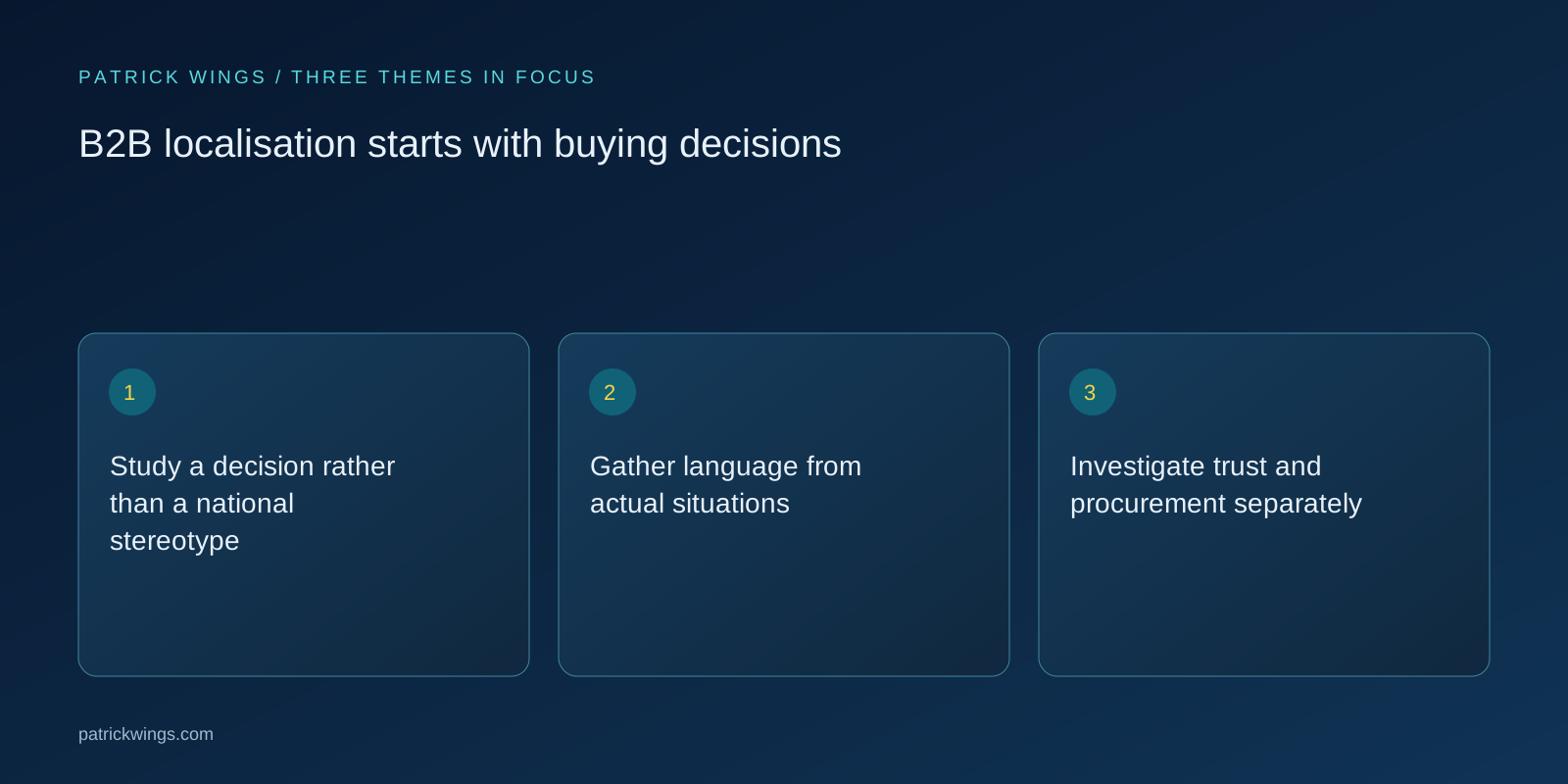
Investigate trust and procurement separately
Do not ask only whether a translated page looks professional. Investigate the evidence buyers need and the people who assess it. A local reference may help initial understanding, while technical evaluators need integration documentation. Procurement and security teams can raise different questions. Label what participants actually reported and what your team has inferred. Ask the appropriate specialists to verify legal or contractual prerequisites. Market research can reveal such questions without providing a definitive answer to them. The brief should therefore contain open verification tasks and named owners instead of presenting unconfirmed requirements as universal rules that apply to every organisation in the market.
Turn an example into a translation brief
Suppose an English SaaS site promises effortless onboarding. Interviews with German-speaking prospects instead focus on migration and the customer's internal implementation capacity. This is an illustrative scenario. A better local version would do more than find an attractive translation of effortless. The brief would request a clear implementation explanation, required customer actions and available support. Terminology, examples and calls to action would address that decision. Existing product limits would remain visible. Without those limits, persuasive language could create an inaccurate expectation that sales must correct later, introducing avoidable uncertainty at precisely the point when the buyer is deciding whether further evaluation is worthwhile.

Create a shared research artefact
For each page type or sales document, write a short decision card containing the target role, task, language used, relevant alternatives, required evidence and open questions. Link observations to their source and collection date. Add a terminology list with the preferred expression, intended meaning and ambiguities to avoid. A native speaker checks natural language; a subject expert confirms the product description. Sales and support verify that promised next steps actually work. This keeps localisation operationally consistent. A vocabulary list alone cannot do that because it does not explain the connection between a buyer's decision, the claim, its evidence and the action the organisation can deliver. Explore this further in the guide Connect marketing and sales across borders.
Validate through a bounded release
Test a connected package containing an entry page, a relevant proof asset and the subsequent conversation. Observe whether buyers can explain the offer accurately and which questions remain. Assess comprehension separately from purchase intent: understandable language does not create an urgent need. Record changes and review both language versions when product promises change. The International Trade Administration distinguishes direct market research from secondary research; use both while recognising their limitations. Update the brief as actual conversations produce new information rather than freezing the initial country assumptions. A small, traceable learning cycle is more useful than a large translation sign-off with no feedback from real buying situations.
INTERACTIVE / FROM READING TO ACTION
Three checkpoints for your implementation
Choose a checkpoint and track your reading progress. Checks are neither saved nor sent and do not score your business.
CHECKPOINT 01
Investigate trust and procurement separately
Do not ask only whether a translated page looks professional.
Explore in the article ↗CHECKPOINT 02
Turn an example into a translation brief
Suppose an English SaaS site promises effortless onboarding.
Explore in the article ↗CHECKPOINT 03
Create a shared research artefact
For each page type or sales document, write a short decision card containing the target role, task, language used, relevant alternatives, required evidence and open questions.
Explore in the article ↗Frequently asked questions
Is professional translation enough for B2B localisation?
It is one component. Buyer questions, evidence and deliverable next steps also need to fit the local decision context.
Who should we interview?
People in the intended segment with different buying and rejection experiences. Document the limitations of that sample.
What is the main research output?
An actionable brief covering terminology, decision needs, evidence, unresolved checks and implications for content and sales.
How can I put “Study a decision rather than a national stereotype” into practice?
Define the offer and buyer group you intend to localise. A general report about Germany will not explain how an IT director at a mid-sized business evaluates a monitoring tool. Describe the task, trigger and intended entry point.
What matters when working on “Gather language from actual situations”?
Recruit relevant participants with different experiences, including people who rejected comparable software. Ask them to describe a previous buying decision and explain the terms used at the time. Request examples of documents, searches or internal questions when these can appropriately be shared.