
THE SHORT ANSWER
Competitive research should improve a particular market decision. A large feature table does not establish which alternatives buyers seriously consider or why they choose them. Investigate actual comparisons, verifiable product conditions and the significance of differences for your target customers. The useful result is reasoned guidance with visible gaps rather than an apparently complete catalogue.
To connect this decision with positioning, market entry and growth, read the pillar guide Go-to-market for B2B SaaS: turn market insight into an executable growth strategy.
Define the decision the research serves
First clarify why you need competitive knowledge. A positioning decision requires different information from preparation for a particular sales conversation. Write an answerable question, such as which alternatives project managers consider when their current resource planning becomes unreliable. Bound the segment, use case and period. Without this frame, research expands into a general industry archive. A clear assignment also helps exclude interesting announcements that would not change your decision. Name an owner and a date for producing a recommendation. This makes research an input to action rather than an activity maintained for its own sake.
Identify alternatives buyers actually consider
Start with customer interviews, documented sales cases and credible loss reasons. April Dunford emphasises alternatives from the buyer’s perspective. Include internal development, service providers and the existing approach where they genuinely appear in the decision. Search visibility alone does not establish competitive relevance. Distinguish observed alternatives from possible future competitors. Future threats can matter for product strategy without diluting today’s sales message. For each alternative, record the customer type and decision context in which it appeared, together with whether the information comes directly from participants or through an indirect account. Explore this further in the guide Treat the status quo as a real competitor.
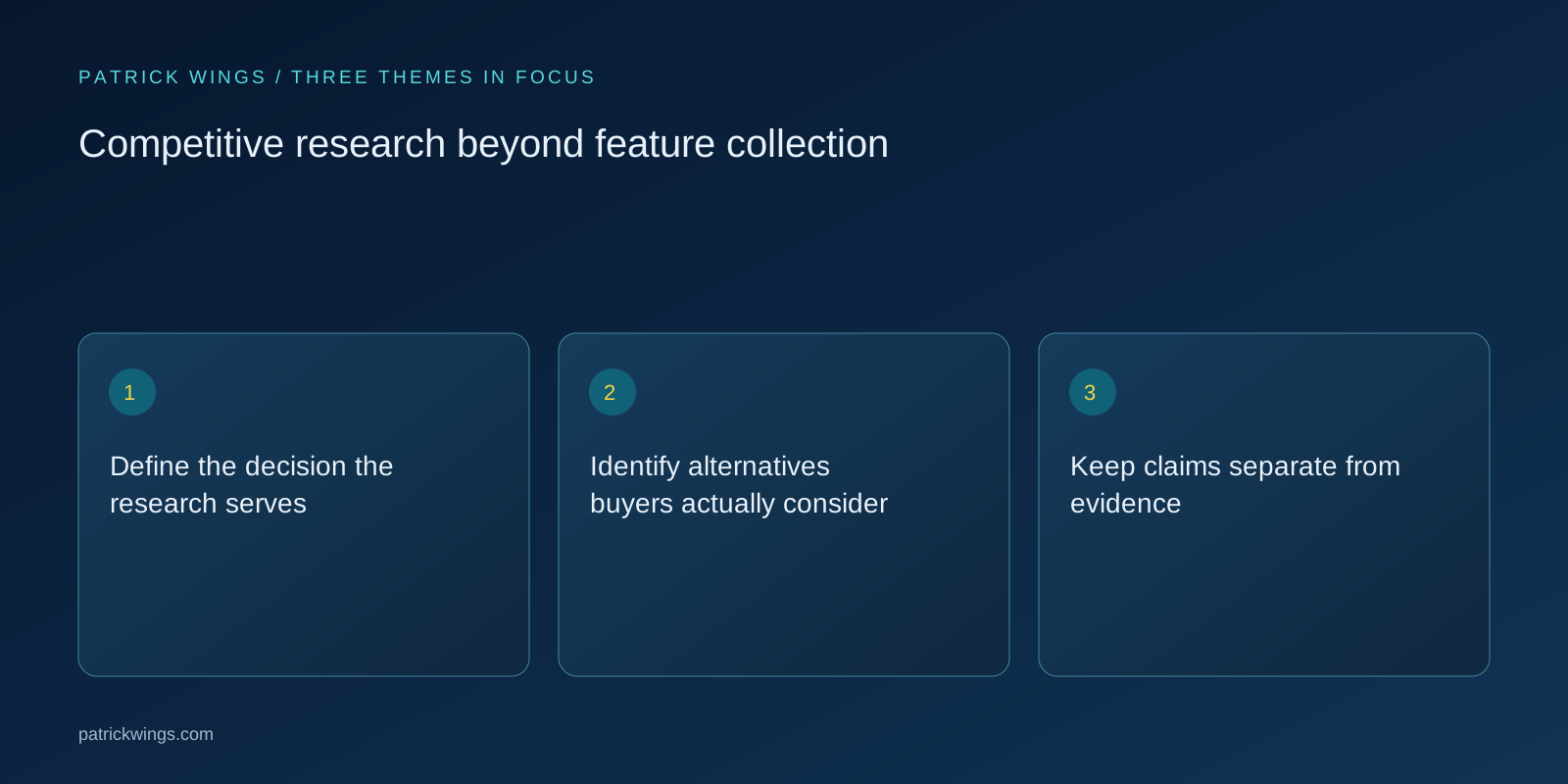
Keep claims separate from evidence
Use accessible original sources such as product documentation, official pricing information and clear service descriptions. Record the observation date, package boundaries and prerequisites. Marketing copy documents what a supplier claims; it is not independent proof of performance. Mark unknown details explicitly. If you test a product yourself, record the conditions and version used. Avoid saying a supplier cannot do something merely because you found no public documentation. In sales material, the more accurate output is often a question customers can investigate during their own comparison. This keeps uncertainty from becoming an unsupported negative claim. Explore this further in the guide B2B SaaS positioning: a clear buying perspective beyond interchangeable claims.
Hypothetical example: comparing integrations
A fictional SaaS team researches project controlling products. Two alternatives advertise ERP integration. Their documentation reveals different prerequisites: one regularly imports master data, while another supports a specific approval workflow through additional configuration. A customer planning weekly might need only the import; another might require that approval process. Research therefore does not simply rank more integrations as better. It describes supported tasks and unresolved checks. The team creates a comparison question for conversations and avoids a broad superiority claim that would not be true for every target customer. The example illustrates method rather than measured product performance.

Translate findings into useful decision support
For recurring comparisons, prepare concise internal guidance explaining when an alternative fits, which difference you can demonstrate and what question the conversation should resolve. Link significant points to their sources. Include circumstances in which your own offer is unsuitable. This helps new colleagues more than a large collection of disconnected screenshots. Separate internally useful hypotheses from claims suitable for external use. Sales and product management should jointly check whether a proposed distinction matters to the customer’s workflow or merely looks technically interesting. The guidance should support understanding rather than scripting an automatic attack on the other supplier.
Update according to decision relevance
Review information more frequently where changes directly affect decisions, including prices, package boundaries and essential product conditions. Repeating a complete investigation of every supplier can consume capacity without improving judgement. Withhold outdated claims until they have been checked again. Also monitor whether the expected comparisons actually occur in conversations. If they do not, reconsider your set of alternatives. Useful competitive work ends with a changed decision or a targeted unanswered question. It does not need to produce constant alerts or position your product against every conceivable solution available anywhere in the market.
INTERACTIVE / FROM READING TO ACTION
Three checkpoints for your implementation
Choose a checkpoint and track your reading progress. Checks are neither saved nor sent and do not score your business.
CHECKPOINT 01
Keep claims separate from evidence
Use accessible original sources such as product documentation, official pricing information and clear service descriptions.
Explore in the article ↗CHECKPOINT 02
Hypothetical example: comparing integrations
A fictional SaaS team researches project controlling products.
Explore in the article ↗CHECKPOINT 03
Translate findings into useful decision support
For recurring comparisons, prepare concise internal guidance explaining when an alternative fits, which difference you can demonstrate and what question the conversation should resolve.
Explore in the article ↗Frequently asked questions
Can we publish comparisons?
Use verifiable, current statements and check their conditions. Legal edge cases need separate review.
How many competitors belong in the research?
Include those relevant to the decision. Appearance in actual buying comparisons matters more than general visibility.
What if documentation is missing?
Mark the point as unknown and create a verification question rather than a negative claim.
How can I put “Define the decision the research serves” into practice?
First clarify why you need competitive knowledge. A positioning decision requires different information from preparation for a particular sales conversation. Write an answerable question, such as which alternatives project managers consider when their current resource planning becomes unreliable.
What matters when working on “Identify alternatives buyers actually consider”?
Start with customer interviews, documented sales cases and credible loss reasons. April Dunford emphasises alternatives from the buyer’s perspective. Include internal development, service providers and the existing approach where they genuinely appear in the decision.