
THE SHORT ANSWER
A GTM review cadence connects market learning with decisions about audiences, offers and execution. Its purpose is not another meeting filled with status slides. It needs recurring questions, relevant evidence and clear decision rights. Choose a rhythm that matches the pace of learning and gives people time to complete agreed actions.
To connect this decision with positioning, market entry and growth, read the pillar guide Go-to-market for B2B SaaS: turn market insight into an executable growth strategy.
Separate operational coordination from strategic choices
Distinguish immediate obstacles from questions that could change your route to market. An advertisement awaiting approval needs different participants from a decision to exclude a segment. Define a small number of review types with distinct purposes. Operational reviews resolve handovers and blockers, learning reviews assess tests, and strategic reviews adjust priorities. Frequency is an organisational choice rather than a universal standard. After several cycles, check whether the same issues circulate between meetings. Repetition often signals a missing decision maker, an unclear question or insufficient information for the next meaningful action, rather than a shortage of meeting time.
Start each review with a decision question
Before the meeting, write down the required decision and what remains blocked without it. Campaign performance might become a question about continuing a segment test or changing the message. State the options and the conditions under which each would make sense. An owner prepares relevant observations, ideally available for advance reading. Atlassian’s DACI offers a role structure for decisions involving several stakeholders. You do not need another software system to apply the underlying distinction. The essential point is that facilitation, expert contribution and binding decision authority should not be confused silently during the discussion.
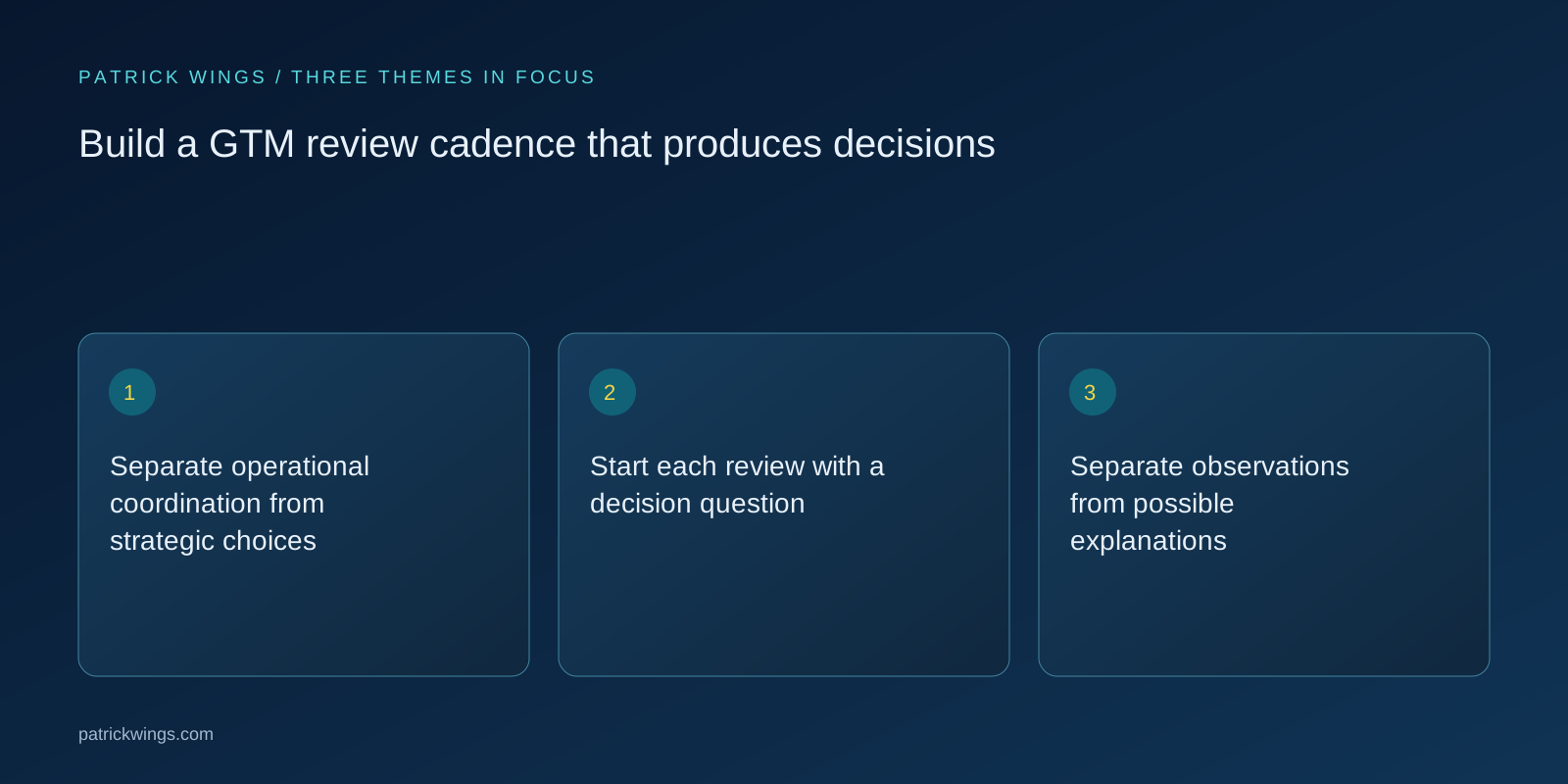
Separate observations from possible explanations
Establish what was actually observed before choosing a response. Fewer demonstration requests might reflect reduced reach, a different audience, a measurement fault or an unsuitable offer. Distinguish these explanations instead of immediately launching another campaign. Include conversation excerpts, product behaviour and sales progress where they help answer the question. State data gaps and time delays explicitly. A recently launched campaign cannot yet have produced a mature pipeline. The review should decide which early signals are meaningful and when a later assessment becomes possible, rather than turning immature data into a confident final judgement about commercial suitability. Explore this further in the guide Marketing pipeline review: ask the right questions with sales.
Walk through a hypothetical review
Imagine a SaaS team exploring a segment where several departments participate in evaluation. Advertising generates suitable conversations, yet planned evaluations rarely start. Sales shows that an internal project owner is often missing. The review decides to test a brief internal responsibility guide before increasing reach. Marketing prepares it, sales uses it in suitable conversations, and product clarifies implementation prerequisites. This is a hypothetical learning example without a claimed result. The next review examines whether the guide helped prospects resolve the ownership question. A useful discussion therefore concerns a specific blocked transition rather than declaring that marketing or sales simply needs to work harder. Explore this further in the guide AI team ownership: who decides, reviews and operates?.

Record decisions with conditions and owners
Document the chosen option, its rationale, significant objections and one accountable owner. Add the next observable action and a review point. Record what will deliberately not proceed. Without exclusions, the workload can expand despite regular prioritisation meetings. A decision may remain conditional when a critical prerequisite is unresolved. In that case, specify who investigates it and how different findings would affect the choice. Avoid minutes that merely list discussed subjects. People absent from the meeting need to understand what changes in their work, why the change was chosen and which assumptions still require investigation before the decision can be treated as settled.
Improve the cadence through its decision effects
Periodically review previous decisions rather than only recent metrics. Were actions completed, uncertainties resolved and weak assumptions changed? Repeated postponements are evidence of unclear authority or questions too large for the available information. Adjust participation and preparation before adding more meetings. Not every short-term fluctuation justifies a strategy change. Specify what new evidence can reopen a decision so current learning has some stability without becoming resistant to contradiction. A useful cadence leaves fewer unresolved handovers and a more understandable chain of decisions. Meeting volume itself provides no convincing evidence that the organisation is making better choices or learning faster.
INTERACTIVE / FROM READING TO ACTION
Three checkpoints for your implementation
Choose a checkpoint and track your reading progress. Checks are neither saved nor sent and do not score your business.
CHECKPOINT 01
Separate observations from possible explanations
Establish what was actually observed before choosing a response.
Explore in the article ↗CHECKPOINT 02
Walk through a hypothetical review
Imagine a SaaS team exploring a segment where several departments participate in evaluation.
Explore in the article ↗CHECKPOINT 03
Record decisions with conditions and owners
Document the chosen option, its rationale, significant objections and one accountable owner.
Explore in the article ↗Frequently asked questions
How often should a SaaS team review GTM?
Often enough to use new decision-relevant information while allowing agreed work to happen. Operational and strategic questions can need different rhythms.
Who needs to attend?
The decision maker and people whose knowledge is needed for the specific question. A large permanent group is not inherently more useful.
What belongs in the record?
The decision, rationale, unresolved conditions, accountable owner, next action and review point. A list of discussion topics is insufficient.
How can I put “Separate operational coordination from strategic choices” into practice?
Distinguish immediate obstacles from questions that could change your route to market. An advertisement awaiting approval needs different participants from a decision to exclude a segment. Define a small number of review types with distinct purposes.
What matters when working on “Start each review with a decision question”?
Before the meeting, write down the required decision and what remains blocked without it. Campaign performance might become a question about continuing a segment test or changing the message. State the options and the conditions under which each would make sense.