
THE SHORT ANSWER
Activation describes the first defensible moment when a suitable user or team experiences the intended value. Registration or completed setup qualifies only when it genuinely represents that progress. Develop a definition that makes sense for the work, can be observed technically and fits the context of use. The purpose is to understand early value rather than simply improve a convenient counter.
To connect this decision with positioning, market entry and growth, read the pillar guide Go-to-market for B2B SaaS: turn market insight into an executable growth strategy.
Describe first value from the customer perspective
Ask which bounded task should become meaningfully better at the beginning. The entire long-term benefit need not appear immediately. A planning team might make its first agreed resource allocation; one login would not show this. Identify who experiences the value and who can judge it. B2B products often distribute these roles across several people. Avoid an exclusively individual definition when progress depends on collaboration. Check the description against observed workflows and customer explanations before converting it into a fixed analytics event. Otherwise an internal assumption can acquire apparent certainty simply because it appears on a dashboard. Explore this further in the guide Use retention cohorts for better product decisions.
Separate prerequisites from the value moment
List the steps required before the first useful result. Importing data, configuring settings and inviting colleagues may be necessary without constituting activation. This distinction reveals where someone invests substantial effort without experiencing benefit. Classify steps by their actual function and remove unnecessary prerequisites. If the value moment requires technical or organisational approval, account for that in the definition. Otherwise suitable customers may be classified as unsuccessful when they merely lack access. A useful activation concept makes these causes visible instead of burying different problems inside one abandonment rate that provides little guidance for action.
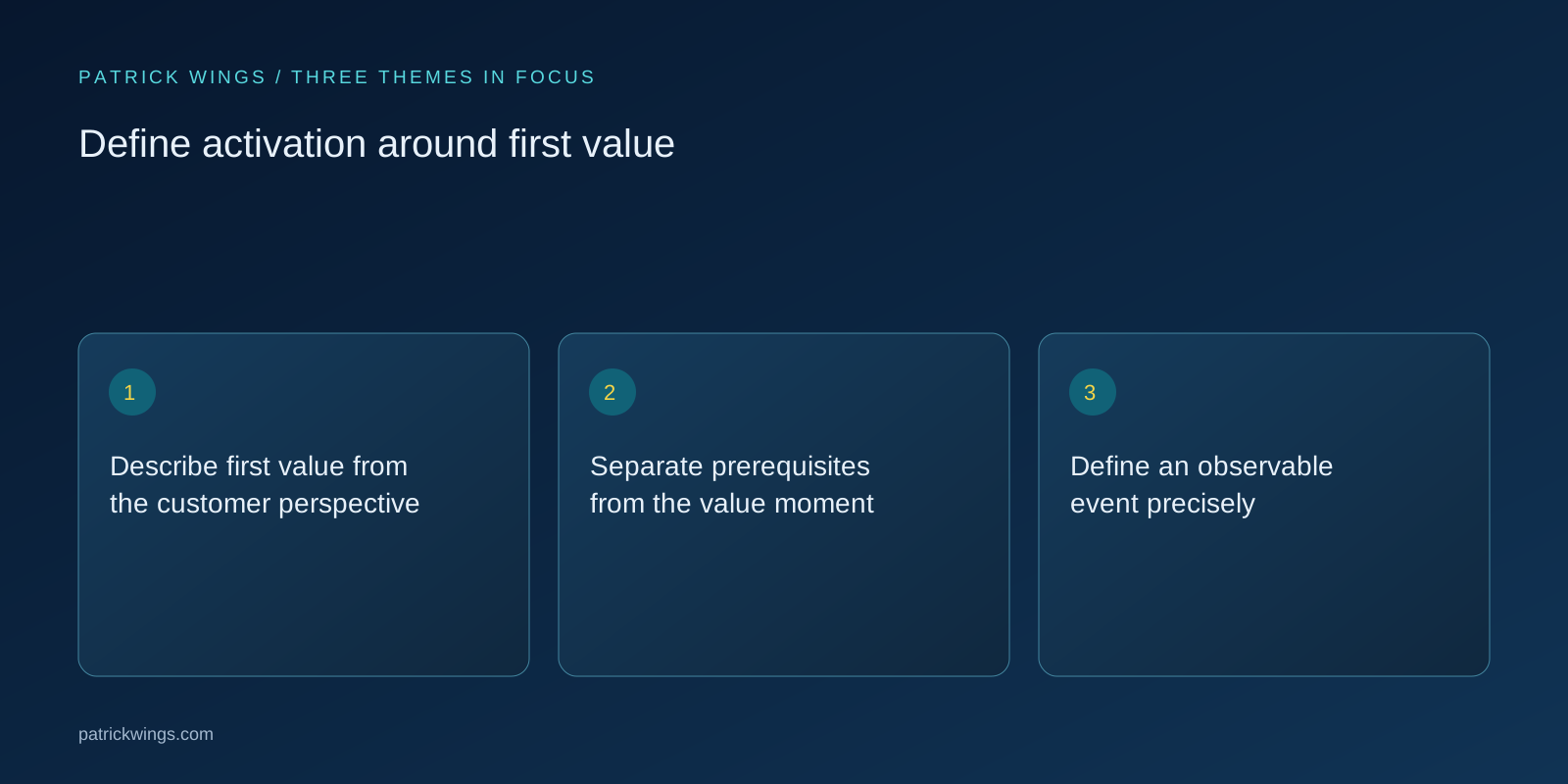
Define an observable event precisely
Translate the value moment into an event with explicit conditions. Decide whether sample data counts, which role must act and whether the workflow must complete successfully. Document timing, account level and treatment of repetition. Product analysis requires stable event definitions; Amplitude illustrates selecting starting and returning events for usage analysis. Choosing the meaningful event remains your responsibility. An easily measured click is a poor substitute if it says little about task completion. Verify instrumentation against real workflows rather than only an internal demonstration, including incomplete attempts and actions performed by staff on a customer’s behalf.
Hypothetical example: collaborative planning
A fictional SaaS team currently counts data import as activation. Observation shows many accounts never proceed to collaborative planning. The team proposes a new hypothesis: first value occurs when responsible participants agree and save a plan. It checks whether the event reflects genuine collaboration or can be triggered by an internal test. It then examines later usage separately for these paths. The example establishes no proven connection with retention. It demonstrates how a more meaningful definition begins as a testable assumption, with attention to the quality of the workflow rather than the mere presence of an event.

Examine the relationship with later use
Compare users or accounts reaching the proposed moment with appropriate groups, considering segment, entry route and observation period. Association with subsequent use does not prove causation: highly motivated teams might both activate more often and remain longer. Add qualitative investigation and, where suitable, deliberate changes to onboarding. Record analytical limitations. Do not choose a definition solely because it produces the most attractive historical curve. It must still explain customer progress and guide improvements to the experience. A proxy that predicts something but cannot be interpreted operationally may be less useful than the dashboard initially suggests.
Maintain the definition and ownership
Publish the definition where product, marketing, sales and customer success can use it. Explain inclusions, exclusions and the date from which measurement applies. Changes require traceable versions so comparisons do not mislead. Combine the metric with investigation of barriers rather than using it as an isolated judgement on team performance. If customers reach the moment yet remain disappointed, a quality condition may be missing. Useful activation measurement makes early value easier to examine. It does not replace assessment of longer-term benefit or commercial suitability, and should evolve when the underlying task or product experience materially changes. Explore this further in the guide Product-led growth in B2B: when self-service works and assistance helps.
INTERACTIVE / FROM READING TO ACTION
Three checkpoints for your implementation
Choose a checkpoint and track your reading progress. Checks are neither saved nor sent and do not score your business.
CHECKPOINT 01
Define an observable event precisely
Translate the value moment into an event with explicit conditions.
Explore in the article ↗CHECKPOINT 02
Hypothetical example: collaborative planning
A fictional SaaS team currently counts data import as activation.
Explore in the article ↗CHECKPOINT 03
Examine the relationship with later use
Compare users or accounts reaching the proposed moment with appropriate groups, considering segment, entry route and observation period.
Explore in the article ↗Frequently asked questions
Is a login activation?
Only if it genuinely represents first value. Usually it is merely an access step.
Should we measure users or accounts?
Use the level at which value occurs. Collaboration may require an account-level definition.
Can we change the definition?
Yes, with a documented reason, version and careful treatment of historical comparisons.
How can I put “Describe first value from the customer perspective” into practice?
Ask which bounded task should become meaningfully better at the beginning. The entire long-term benefit need not appear immediately. A planning team might make its first agreed resource allocation; one login would not show this.
What matters when working on “Separate prerequisites from the value moment”?
List the steps required before the first useful result. Importing data, configuring settings and inviting colleagues may be necessary without constituting activation. This distinction reveals where someone invests substantial effort without experiencing benefit.