
THE SHORT ANSWER
A growth strategy explains where progress should come from and which assumptions support it. KPI planning makes those assumptions testable. Together they translate a revenue ambition into priorities without presenting an uncertain model as a certain future.
To connect this decision with positioning, market entry and growth, read the pillar guide Go-to-market for B2B SaaS: turn market insight into an executable growth strategy.
Name the type of growth clearly
Distinguish new customers, expansion within existing relationships and stronger retention. These paths need different activities and owners. Specify which segments and offers should contribute. A target such as “more revenue” leaves open whether acquisition, product usage or customer development is the relevant lever. Review actual journeys and operating capacity before selecting initiatives. An illustrative SaaS team might find that suitable accounts sign up but never reach collaborative use. An onboarding problem could then matter more than additional reach. The strategy should explicitly account for that diagnosis rather than assume that every growth objective begins with a larger advertising budget or a new acquisition channel.
Prioritise the main constraint
Map the route from relevant attention through suitable contacts and usage to the commercial relationship. Identify where plausible opportunities are lost. Weak demand, unclear messaging, technical entry barriers and slow sales handling can look similar in a summary revenue report but require different work. Use concrete cases and sufficiently comparable evidence. Name alternative explanations where the cause remains uncertain. Prioritise a constraint whose removal can improve the whole process. Rebuilding every channel, page and product package simultaneously without an explicit order makes learning harder and can consume capacity without addressing the reason growth is currently limited. Explore this further in the guide B2B SaaS marketing audit: find causes and set clear priorities.
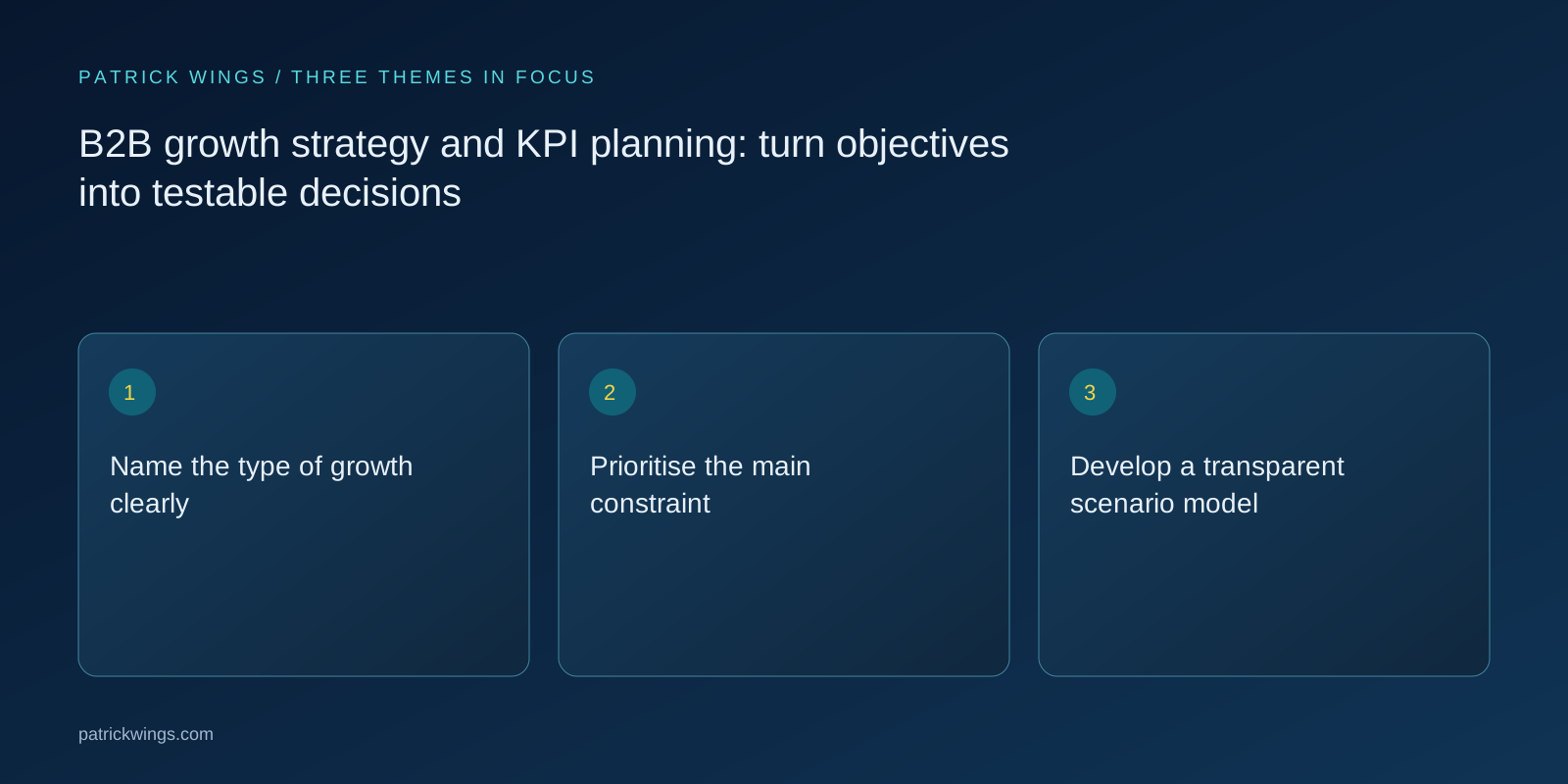
Develop a transparent scenario model
Work backwards from the objective to required intermediate progress and label every assumption. Use your own observed figures where they are reliable. Where knowledge is limited, use explainable ranges rather than precise-looking single values. An illustrative model might connect contact volume, qualified discussions and accepted opportunities. It remains a calculation structure rather than a promise. Include delays between contact and revenue and the capacity of the existing sales team. Check which assumption has the greatest influence on the result. That assumption may deserve additional research or a limited pilot before you commit a substantial budget to a plan whose central dependency remains untested.
Document KPI definitions explicitly
Every important measure needs a business definition, source, accountable person and time logic. For example, define whether an activated account must complete an individual task or a shared productive workflow. Separate contacts, companies and opportunities so several people are not accidentally counted as separate commercial outcomes. Agree when a cohort is mature enough for a specific evaluation. Analytics tools can group people by behaviour, but your team remains responsible for interpreting commercial meaning. A dashboard label is not enough. Written definitions expose conflicting expectations and data gaps before they become embedded in resource decisions or misleading assessments of team performance.

Connect resources to the plan
Assess the work required from marketing, sales, product and customer success. Producing content helps little if nobody can answer the underlying expert questions. More suitable enquiries help only when handling capacity also develops. Give each prioritised initiative a bounded work package with ownership and dependencies. Clarify what the team can deliver internally and where outside support is useful. Fractional marketing leadership can add direction and coordination but needs explicit decision rights. A realistic growth plan shows more than spending: it identifies the time, knowledge and operational connections needed inside the business. Without those conditions, an apparently affordable campaign can become impossible to execute well. Explore this further in the guide Product-led growth in B2B: when self-service works and assistance helps.
Use reviews to make course decisions
Regularly check whether the chosen constraint remains the right focus and whether observations support the assumptions. Separate early process indicators from later commercial results. A short-term increase in an intermediate measure does not automatically justify major expansion. Compare similar cohorts and include insights from customer conversations. Record the decision and its rationale. A review should be able to continue, adjust or stop an initiative. The strategy then remains a working instrument instead of an annual statement that survives contradictory evidence. KPI planning cannot guarantee the future, but it can provide a stronger shared basis for deciding what to do next and what evidence would change the plan.
INTERACTIVE / FROM READING TO ACTION
Three checkpoints for your implementation
Choose a checkpoint and track your reading progress. Checks are neither saved nor sent and do not score your business.
CHECKPOINT 01
Develop a transparent scenario model
Work backwards from the objective to required intermediate progress and label every assumption.
Explore in the article ↗CHECKPOINT 02
Document KPI definitions explicitly
Every important measure needs a business definition, source, accountable person and time logic.
Explore in the article ↗CHECKPOINT 03
Connect resources to the plan
Assess the work required from marketing, sales, product and customer success.
Explore in the article ↗Frequently asked questions
How many KPIs should a growth plan contain?
Use enough to assess the objective, main constraint and quality, while keeping each measure tied to a real decision.
Is a funnel model a forecast?
It begins as a scenario built from assumptions. Its usefulness depends on evidence, comparable conditions and sufficient time to mature.
When is fractional marketing useful?
When strategic direction or coordination is needed without a suitable full-time internal role. Ownership and decision rights must be clear.
How can I put “Name the type of growth clearly” into practice?
Distinguish new customers, expansion within existing relationships and stronger retention. These paths need different activities and owners. Specify which segments and offers should contribute.
What matters when working on “Prioritise the main constraint”?
Map the route from relevant attention through suitable contacts and usage to the commercial relationship. Identify where plausible opportunities are lost. Weak demand, unclear messaging, technical entry barriers and slow sales handling can look similar in a summary revenue report but require different work.