
THE SHORT ANSWER
Learning from churn means examining the sequence before a customer relationship ends. One exit statement rarely explains every cause. Combine the customer conversation, usage history, support and changing circumstances. The aim is a traceable explanation with implications for product, qualification or service, without assuming that every cancellation should have been prevented or reversed through another retention offer.
To connect this decision with positioning, market entry and growth, read the pillar guide Go-to-market for B2B SaaS: turn market insight into an executable growth strategy.
Bound the event and its history
Define whether you are investigating complete cancellation, reduced scope or non-renewal. Record the contract ending separately from the decision date, because the choice may have happened much earlier. Build a short chronology of implementation, important usage moments, support cases and customer changes. Mark information gaps. This discourages treating the most recent visible problem as the main cause automatically. Separate voluntary decisions from administrative or technical events as well. Different situations need different research questions and should not be combined merely because they share the same CRM status or appear in one reporting category.
Use open conversations rather than a rescue script
Explain that you want to understand the history and keep any recovery offer separate from research. Ask about concrete moments: when doubt first appeared, what was attempted and what made the decision final. GOV.UK guidance supports open questions and experienced examples in in-depth interviews. Apply that principle without treating one person as the voice of the whole organisation. Establish their role and limits of knowledge. Someone processing cancellation may understand administration but not every user difficulty or the budget owner’s full reasoning. Their account is evidence from a particular perspective, not necessarily a complete explanation. Explore this further in the guide Win-loss interviews: understand buying decisions.
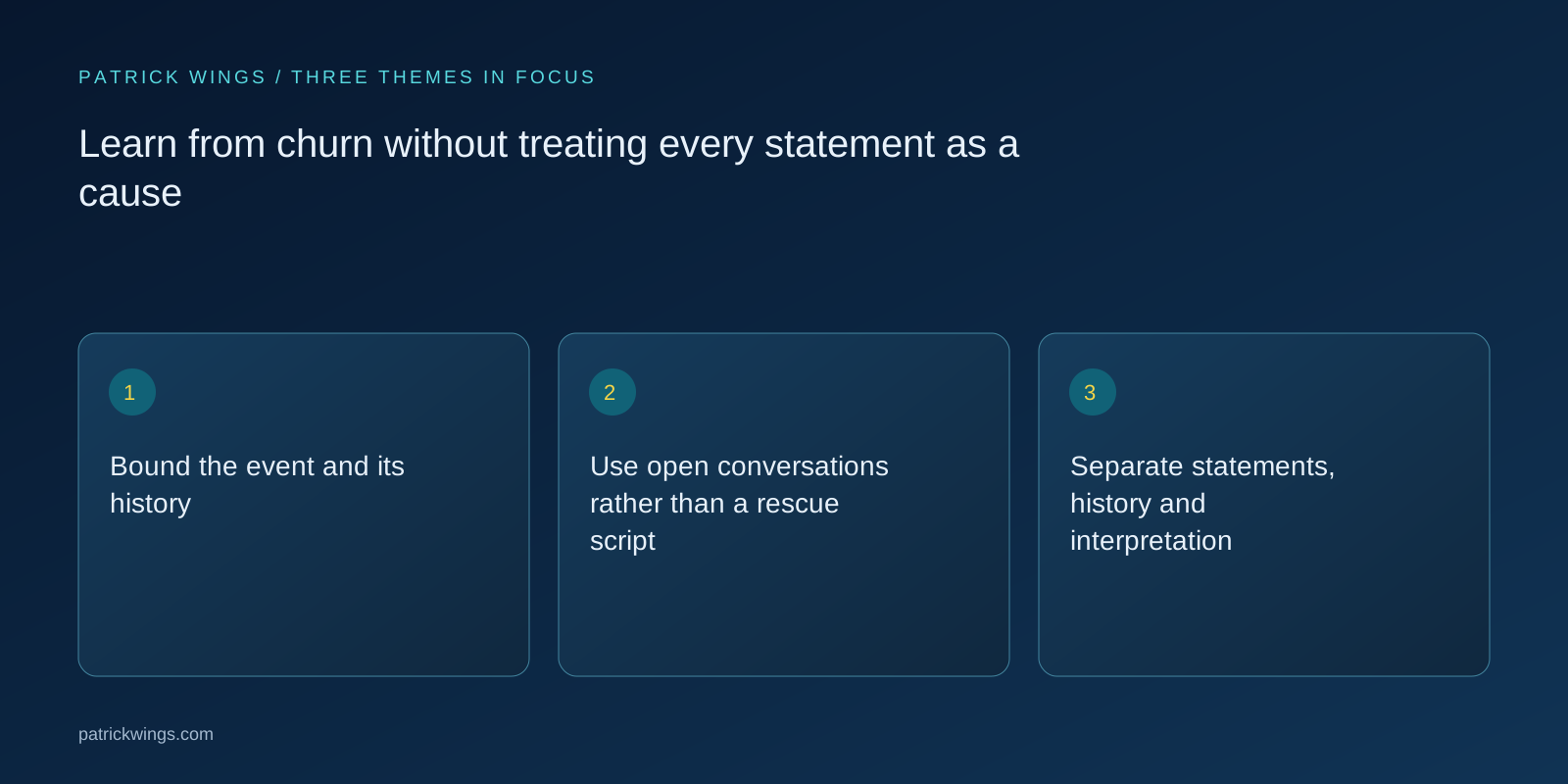
Separate statements, history and interpretation
“We no longer use it” initially describes a state. Investigate how it developed: incomplete adoption, a disappearing task and unsuitable functionality imply different causes. Compare the conversation with usage and documented support. Preserve contradictions rather than selecting the most convenient story. Lack of usage can be a cause, consequence or accompanying symptom. Avoid blaming a team before the sequence is understood. Maintain several plausible explanations if evidence cannot distinguish them. This uncertainty is an honest research result and a better foundation for further work than a confident label unsupported by the available information.
Hypothetical example: an apparently missing feature
A fictional customer cites a missing export capability when cancelling. The conversation reveals that the project owner changed months earlier and implementation was never resumed. Export became important only while evaluating another solution. The supplier therefore does not automatically treat that feature as the original cause. It investigates the responsibility handover while also checking whether export is inadequate. This example proves no causal chain. It shows why the final explanation and the longer development of the decision provide different information, both of which may matter without being interchangeable or reducible to a single cancellation reason.

Compare patterns with appropriate cases
Group similar histories by task, implementation and operating conditions. Seek counterexamples: which customers stayed despite the same limitation, and what differed? Where useful, include at-risk active customers. Selective interview participation can distort findings, so document cases you could not reach. Avoid apparently representative percentages from a few conversations. Useful analysis shows recurring explanations, contradictory evidence and open questions. It may also indicate that some departures arise from persistent audience mismatch rather than a support problem. Recognising this can improve qualification instead of committing service teams to indefinitely compensate for a product that does not fit the task.
Match actions to the demonstrated issue
Choose a few owned changes. Unclear responsibility may require a better handover; a disappearing use case does not need another reminder sequence. An unmet product requirement needs deliberate prioritisation and accurate communication. Define how you will later examine whether a change addresses the relevant problem. Monitor work quality and support burden alongside cancellations. Churn learning is useful when it improves causal hypotheses and supports appropriate action. It should not represent every customer decision as an avoidable failure or treat polite interview responses as the entire truth simply because the exit process needs a completed field. Explore this further in the guide Use retention cohorts for better product decisions.
INTERACTIVE / FROM READING TO ACTION
Three checkpoints for your implementation
Choose a checkpoint and track your reading progress. Checks are neither saved nor sent and do not score your business.
CHECKPOINT 01
Separate statements, history and interpretation
“We no longer use it” initially describes a state.
Explore in the article ↗CHECKPOINT 02
Hypothetical example: an apparently missing feature
A fictional customer cites a missing export capability when cancelling.
Explore in the article ↗CHECKPOINT 03
Compare patterns with appropriate cases
Group similar histories by task, implementation and operating conditions.
Explore in the article ↗Frequently asked questions
Is the form’s cancellation reason enough?
It is a starting point. Understanding causes needs context, history and sometimes other perspectives.
Should we sell during the interview?
Keep research and recovery clearly separate so participants can speak openly.
Must every cancellation be prevented?
No. A disappearing or unsuitable task can justify ending the relationship.
How can I put “Bound the event and its history” into practice?
Define whether you are investigating complete cancellation, reduced scope or non-renewal. Record the contract ending separately from the decision date, because the choice may have happened much earlier. Build a short chronology of implementation, important usage moments, support cases and customer changes.
What matters when working on “Use open conversations rather than a rescue script”?
Explain that you want to understand the history and keep any recovery offer separate from research. Ask about concrete moments: when doubt first appeared, what was attempted and what made the decision final. GOV.UK guidance supports open questions and experienced examples in in-depth interviews.