
THE SHORT ANSWER
Before rewriting your website, establish which message suitable buyers understand and find relevant. Messaging tests examine more than preference: they investigate product interpretation, expected value, credibility and an appropriate next step. A useful test separates wording problems from weaknesses in the offer and produces specific editing decisions rather than a competition between favourite headlines.
To connect this decision with positioning, market entry and growth, read the pillar guide Go-to-market for B2B SaaS: turn market insight into an executable growth strategy.
Specify the uncertainty
Decide what you need to check: whether visitors understand the product category, recognise their use case or distrust a central claim. These questions require different materials. A short extract may be enough for categorisation, while credibility requires evidence and context. Avoid changing positioning, design and pricing logic simultaneously if you want to understand feedback. Write down the assumption and the observation that would prompt a revision. This prevents the exercise becoming a vote on personal writing preferences. It also gives colleagues a shared basis for assessing contradictory comments after the sessions are complete.
Choose relevant participants and realistic material
Recruit people familiar with the relevant task and buying situation. Existing customers already understand your vocabulary and cannot replace prospective first-time visitors. Show a realistic piece of communication with enough context, such as an introduction, product explanation and supporting evidence. Keep conditions comparable between variants. If one version includes a specific demonstration while the other contains only an abstract sentence, you are testing more than wording. Do not first explain what the copy is intended to communicate. That assistance would hide precisely the comprehension problems the research is supposed to uncover.
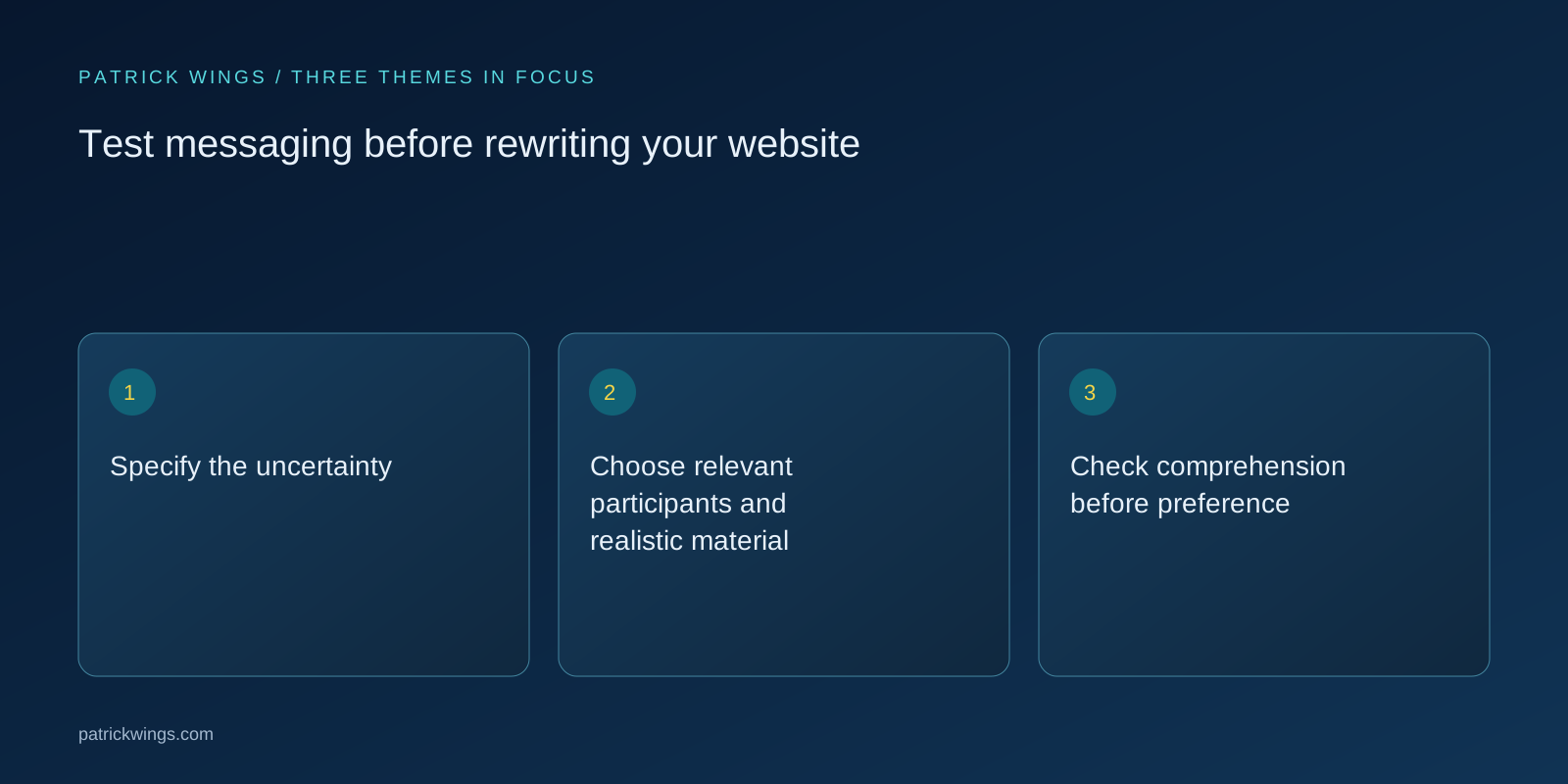
Check comprehension before preference
After reading, ask participants to explain the offer in their own words: what is available, who it suits and what change they would expect. Only then explore relevance and credibility. Use neutral follow-up questions about specific passages. GOV.UK interview guidance provides methodological grounding; this messaging process is a separate application. Record misinterpretations alongside approval. Someone can enjoy a piece of copy while expecting a service you do not provide. Their favourable rating is therefore not automatically a positive communication result. It may reveal an expectation problem that more persuasive wording would otherwise amplify.
Hypothetical example: control versus speed
A fictional SaaS team compares introductions for approval software. One promises faster coordination; another describes traceable responsibility. Interviews suggest that participants like speed but are particularly troubled by unclear ownership of external approvals. Some also interpret “control” as continuous employee surveillance. The team therefore adopts neither version unchanged. It describes the specific approval situation and adds a demonstrable workflow. The example illustrates how testing clarifies the meaning of words. It provides no prediction about conversion uplift and does not establish that the same message would work for a different buying group or product.

Distinguish understanding from behaviour
An interview reveals how people interpret and explain a message. It does not prove they will buy later. A suitable field test can add behavioural evidence, such as whether qualified visitors choose an appropriate next step after reading an explanation. Define the audience, measured event and analysis before launch. With limited traffic, quantitative comparisons may remain inconclusive; targeted qualitative investigation is more honest than declaring a premature winner. Examine downstream quality as well. More clicks generated by a misleading promise can create additional unsuitable conversations and expectations that the product cannot fulfil. Explore this further in the guide Choose a market category without creating the wrong expectations.
Document changes and their reasons
Summarise findings against the initial questions. Which passage was misunderstood, which evidence was missing and which expectation did not fit? Connect each proposed edit to an observation. Review the wording with sales and product colleagues to ensure it remains accurate and deliverable. Preserve unresolved issues rather than announcing an artificially clear winning message. After publication, use customer conversations and support questions to assess whether the same misunderstandings persist. A sound writing decision connects comprehensible language, credible performance and an appropriate next step for the actual buying situation, rather than optimising a headline in isolation. Explore this further in the guide B2B SaaS positioning: a clear buying perspective beyond interchangeable claims.
INTERACTIVE / FROM READING TO ACTION
Three checkpoints for your implementation
Choose a checkpoint and track your reading progress. Checks are neither saved nor sent and do not score your business.
CHECKPOINT 01
Check comprehension before preference
After reading, ask participants to explain the offer in their own words: what is available, who it suits and what change they would expect.
Explore in the article ↗CHECKPOINT 02
Hypothetical example: control versus speed
A fictional SaaS team compares introductions for approval software.
Explore in the article ↗CHECKPOINT 03
Distinguish understanding from behaviour
An interview reveals how people interpret and explain a message.
Explore in the article ↗Frequently asked questions
Should we ask for a favourite version?
Check comprehension first. A preferred phrase can still create incorrect expectations.
Are existing customers sufficient?
Not for first-time comprehension. Include relevant people unfamiliar with your terminology.
Does an interview prove higher conversion?
No. It examines understanding and explanations; actual behaviour requires an appropriate additional measurement.
How can I put “Specify the uncertainty” into practice?
Decide what you need to check: whether visitors understand the product category, recognise their use case or distrust a central claim. These questions require different materials. A short extract may be enough for categorisation, while credibility requires evidence and context.
What matters when working on “Choose relevant participants and realistic material”?
Recruit people familiar with the relevant task and buying situation. Existing customers already understand your vocabulary and cannot replace prospective first-time visitors. Show a realistic piece of communication with enough context, such as an introduction, product explanation and supporting evidence.