
THE SHORT ANSWER
Enterprise procurement examines more than the functional benefit of SaaS. Customers need to understand how operations, security, contracts and implementation fit their requirements. Prepare dependable information and clear ownership. Readiness does not mean accepting every request; it means enabling an appropriate decision without improvised or contradictory statements that later become delivery commitments nobody has assessed.
To connect this decision with positioning, market entry and growth, read the pillar guide Go-to-market for B2B SaaS: turn market insight into an executable growth strategy.
Ask for specific requirements early
Clarify which reviews the intended use requires and who owns them. A small bounded deployment may differ from organisation-wide use of sensitive data. Ask about scope, data categories, integrations and mandatory criteria. Avoid assumptions about what “enterprise” always requires. Separate confirmed requirements from unanswered questions. Do this before making firm implementation commitments, so a fundamental mismatch does not emerge only after the commercial proposal. The relevant question is whether your actual offer can be assessed and is suitable for this use, rather than whether the supplier can present a generic enterprise label.
Build a dependable information base
Prepare current descriptions of architecture, data flows, responsibilities and support. Add contractual and operational information relevant to your scope. Give each item an owner and version date. Sensitive details need appropriate access; not everything belongs on a public website. Cloud Security Alliance describes CAIQ as a questionnaire for transparency about security controls, explicitly not a certification itself. Frameworks can structure preparation but do not replace implemented controls, assessment of customer requirements or an actual certification. Maintain that distinction in sales material so useful preparation does not become an inaccurate assurance claim.
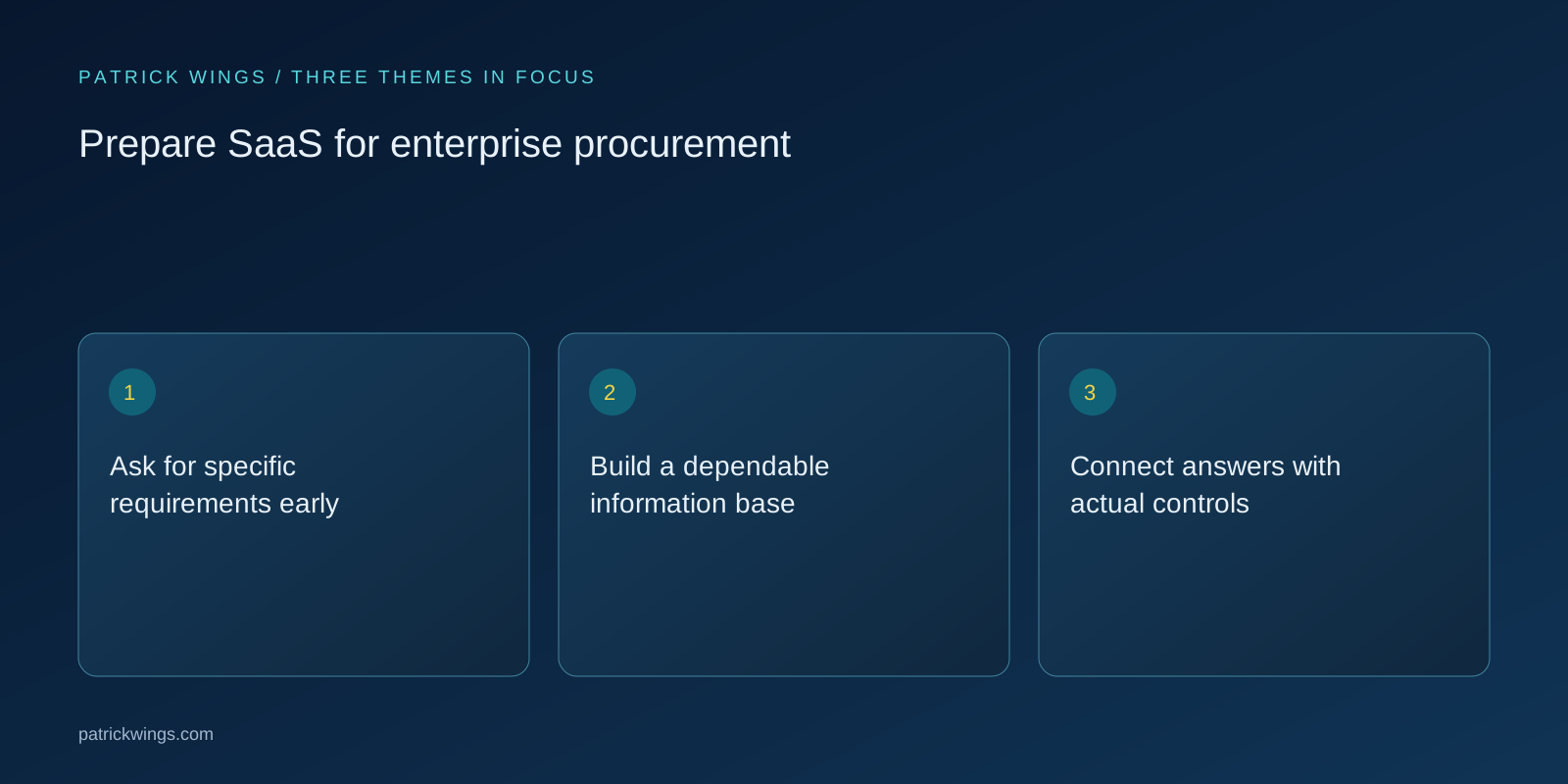
Connect answers with actual controls
Complete questionnaires from documented facts. A planned feature is not an existing safeguard, and a manual exception is not a fully automated process. Clarify ambiguous questions through the intended use. Explain limitations and shared responsibilities between supplier and customer. Avoid standard answers nobody has reviewed. A response library helps when it remains current and exceptions are visible. Marketing and sales should not independently expand security statements beyond specialist-approved facts. Quickly completing a questionnaire achieves little if the result misrepresents the service or commits another team to a process it does not operate.
Hypothetical example: identity requirements
A fictional customer requires a particular sign-in process for broad adoption. The supplier supports it only under additional conditions. Instead of checking an unqualified “yes”, the team describes the supported version and discusses the difference with customer IT. It discovers that the intended deployment requires further work and adjusts scope and timing. This example makes no claim about a real standard. It illustrates why the conditions of a capability matter commercially and why an accurate limitation raised early is more useful than an enterprise promise that cannot later be fulfilled. Explore this further in the guide Technical one-pagers that connect value and prerequisites.

Separate negotiation from product decisions
Some requirements need clearer explanation; others materially change the product or agreement. Define who assesses and authorises changes. Check feasibility, ongoing effort and effects on other customers. An individual commitment can create lasting operational obligations. Do not treat it as a minor wording adjustment at the end of a sale. If you cannot meet a condition, say so early. Consider a narrower use only where both parties substantively accept it. Do not replace unresolved requirements with vague roadmap promises whose timing, scope or delivery ownership has never been agreed internally.
Maintain readiness as an ongoing process
Update material after significant product and operational changes. Record recurring procurement questions and use them to improve documentation or product decisions. Assess follow-up questions, corrections and impossible requirements alongside response speed. A fast answer later withdrawn is not progress. Before implementation, verify that the final agreement matches what can actually be delivered. Enterprise readiness comes from accurate information, accessible specialists and deliberate boundaries. It is not a collection of polished documents whose contents nobody owns in daily operations, and it should remain credible when the customer asks for clarification after signing. Explore this further in the guide Understand enterprise buying groups.
INTERACTIVE / FROM READING TO ACTION
Three checkpoints for your implementation
Choose a checkpoint and track your reading progress. Checks are neither saved nor sent and do not score your business.
CHECKPOINT 01
Connect answers with actual controls
Complete questionnaires from documented facts.
Explore in the article ↗CHECKPOINT 02
Hypothetical example: identity requirements
A fictional customer requires a particular sign-in process for broad adoption.
Explore in the article ↗CHECKPOINT 03
Separate negotiation from product decisions
Some requirements need clearer explanation; others materially change the product or agreement.
Explore in the article ↗Frequently asked questions
Is CAIQ a certificate?
No. CSA describes it as a questionnaire or self-assessment of security controls.
Must we accept every requirement?
No. Examine suitability and delivery feasibility and disclose unmet conditions early.
Who should answer security questions?
Appropriate specialists should verify facts, while sales can coordinate the process.
How can I put “Ask for specific requirements early” into practice?
Clarify which reviews the intended use requires and who owns them. A small bounded deployment may differ from organisation-wide use of sensitive data. Ask about scope, data categories, integrations and mandatory criteria.
What matters when working on “Build a dependable information base”?
Prepare current descriptions of architecture, data flows, responsibilities and support. Add contractual and operational information relevant to your scope. Give each item an owner and version date.