
THE SHORT ANSWER
Marketing focus across a SaaS portfolio means choosing which offer becomes visible first for a particular buyer situation. More products do not automatically justify more simultaneous campaigns. A useful priority connects need, access, product readiness and available capacity. It also explains which offers currently receive maintenance support or a bounded learning investment.
To connect this decision with positioning, market entry and growth, read the pillar guide Go-to-market for B2B SaaS: turn market insight into an executable growth strategy.
View the portfolio through buyer situations
List more than product names and planned features. For each offer, describe the task it addresses, the role recognising the need and the trigger that makes action plausible. Two technically different modules may participate in the same buying decision. Conversely, features within one platform may involve very different implementation and procurement pathways. This perspective reveals where shared communication helps and where it confuses buyers. Use actual conversations to investigate which offers people understand together. An internal organisational chart is not reliable evidence for website navigation or the order in which the market should encounter your campaigns and product messages. Explore this further in the guide Prioritising segments: where your SaaS offer becomes relevant first.
Distinguish established business from emerging options
Separate offers with demonstrated needs and repeatable implementation from options whose suitability remains under investigation. Strategyzer’s Portfolio Map considers existing business models and new ideas together while acknowledging different uncertainties. For your marketing choices, this does not require copying a particular diagram. Record which offer can serve demand today and which still requires learning. A new product should not carry the same planning expectations as an established offer. Equally, a working core business should not disappear from communication because newer themes attract more internal enthusiasm, make more interesting presentations or appear more fashionable in leadership discussions. Explore this further in the guide Aligning internal link distribution with business priorities.
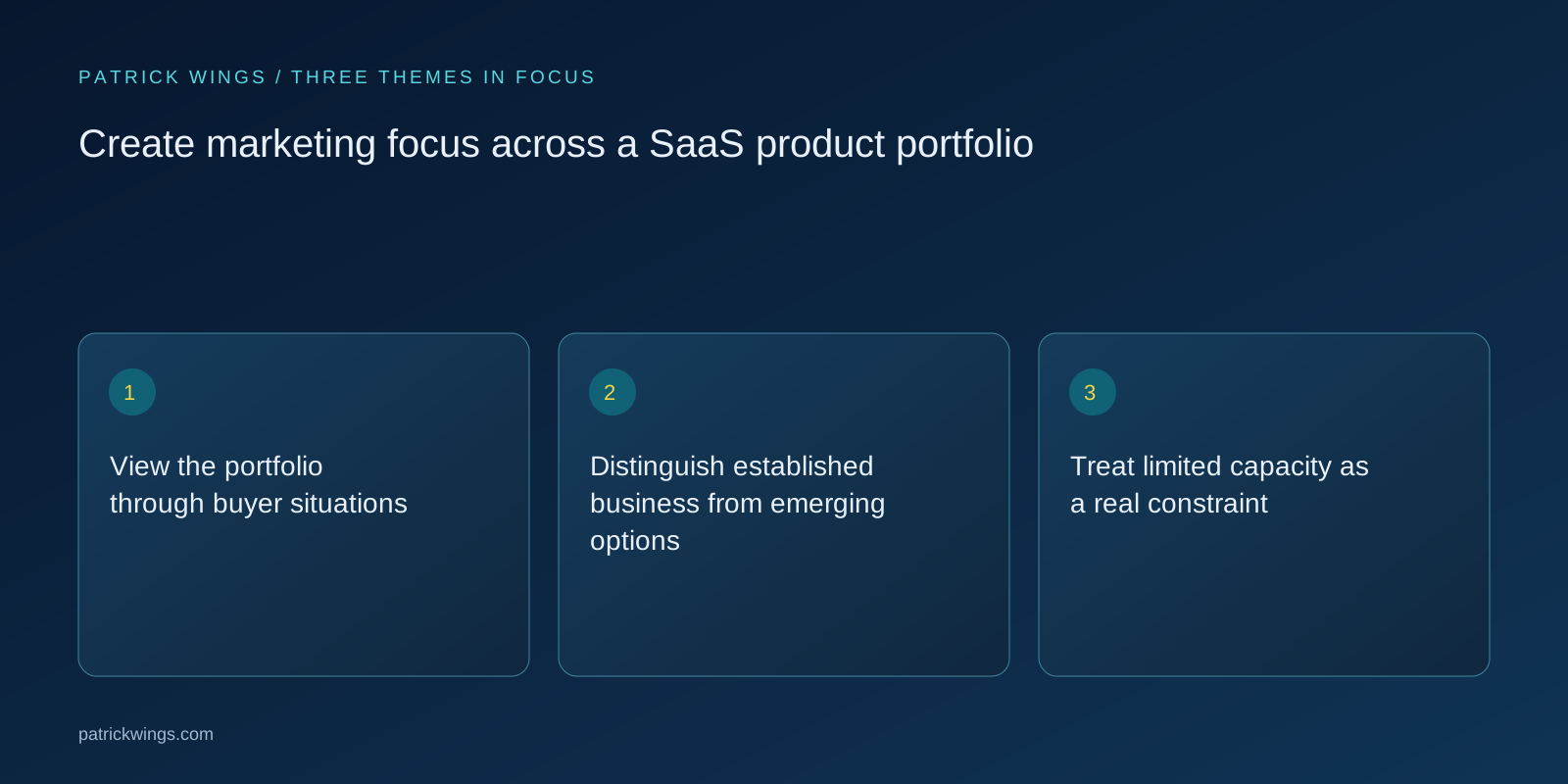
Treat limited capacity as a real constraint
Identify the resources required by each priority: subject expertise, content production, campaign management, sales, onboarding and support. Check whether the same people are expected to carry several initiatives simultaneously. A portfolio containing many top priorities often has no meaningful prioritisation. Choose a bounded active focus and explicitly describe support for other offers. That might mean a maintained product page, suitable sales referrals or a small research step. Account for dependencies. A campaign for an additional module may only make sense after the core product has been implemented, substantially changing the audience and the demand you can realistically address.
Compare a hypothetical portfolio
Imagine a SaaS provider with established resource planning, an additional reporting module and a relatively untested AI assistant. New customers first need reliable planning, while existing customers ask for better reporting. The assistant requires further data checks. One possible focus is resource planning for a clearly defined segment, alongside targeted reporting communication to existing customers. The assistant receives a bounded learning experiment. This is a hypothetical illustration rather than a client result. It assigns different marketing jobs instead of ranking technical excitement. Changing prerequisites may justify a different allocation later without forcing the team to renegotiate its entire direction every week.

Make offer pathways and connections understandable
Explain on the website and in sales material when each offer fits and which prerequisites apply. Avoid a homepage where every product demands equal attention. A clear entry question can guide buyers toward an appropriate path. Connect offers where they support a genuine next task, such as moving from implemented planning to deeper reporting. State when an add-on is not a standalone entry product. Cross-selling does not occur merely because products appear beside one another. Investigate with suitable users and buying stakeholders whether the structure makes sense and whether they can distinguish an essential foundation from an optional extension.
Attach priorities to explicit reconsideration conditions
Record why an offer has priority, which assumptions remain open and when the choice will be reviewed. A change may become sensible when an implementation obstacle is resolved or repeated suitable inquiries reveal another situation. One enthusiastic prospect does not automatically justify a strategic reversal. Compare market evidence and real delivery capacity rather than campaign clicks alone. Also check whether the allocation is answering the intended learning questions. The goal is not a permanent product ranking. It is an understandable focus that enables execution and accepts new evidence without spreading every available resource across every offer at the same time.
INTERACTIVE / FROM READING TO ACTION
Three checkpoints for your implementation
Choose a checkpoint and track your reading progress. Checks are neither saved nor sent and do not score your business.
CHECKPOINT 01
Treat limited capacity as a real constraint
Identify the resources required by each priority: subject expertise, content production, campaign management, sales, onboarding and support.
Explore in the article ↗CHECKPOINT 02
Compare a hypothetical portfolio
Imagine a SaaS provider with established resource planning, an additional reporting module and a relatively untested AI assistant.
Explore in the article ↗CHECKPOINT 03
Make offer pathways and connections understandable
Explain on the website and in sales material when each offer fits and which prerequisites apply.
Explore in the article ↗Frequently asked questions
Should every product receive equal marketing support?
Not automatically. Need, readiness, buyer pathway and execution capacity determine the appropriate support for each offer.
How should we handle a new AI product in the portfolio?
Separate unresolved suitability questions from established business. A bounded learning experiment may be more appropriate than an immediate broad campaign.
When should the focus change?
When relevant new evidence or delivery capability changes the original rationale. Define reconsideration conditions in advance.
How can I put “View the portfolio through buyer situations” into practice?
List more than product names and planned features. For each offer, describe the task it addresses, the role recognising the need and the trigger that makes action plausible. Two technically different modules may participate in the same buying decision.
What matters when working on “Distinguish established business from emerging options”?
Separate offers with demonstrated needs and repeatable implementation from options whose suitability remains under investigation. Strategyzer’s Portfolio Map considers existing business models and new ideas together while acknowledging different uncertainties. For your marketing choices, this does not require copying a particular diagram.