
THE SHORT ANSWER
Positioning helps suitable buyers understand why your offer may matter in their situation. It selects the context you explain and the expectations you exclude. The starting point is a real buying decision rather than the search for an unusually clever tagline.
To connect this decision with positioning, market entry and growth, read the pillar guide Go-to-market for B2B SaaS: turn market insight into an executable growth strategy.
Choose a concrete situation rather than every audience
Describe an application with sufficiently similar prerequisites. “Every company that needs digital transformation” is too broad. Ask what the audience wants to accomplish, what makes it difficult today and when it becomes important. An illustrative example could be SaaS for agencies coordinating shared capacity across multiple client projects. That context explains more than company size alone. Test it through actual conversations and product suitability. Additional segments can follow, but for each one you should explain why the same central value matters and which differences require a different argument. A practical starting context is a choice to learn clearly, not a claim that no other customer can ever benefit. Explore this further in the guide Planning a B2B SaaS launch: connect market communication with operational readiness.
Name the real alternative
Positioning becomes clearer when buyers understand what they would otherwise do. That may be another application, a combination of existing tools or a manual workflow. Sometimes the strongest alternative is making no change at all. Investigate its advantages fairly: familiar habits, low implementation effort or sufficiently good outcomes can matter to buyers. Making the alternative artificially weak produces a fragile argument. Describe the conditions under which your offer creates an explainable difference. Prospective customers should not need to reconstruct for themselves why a new product could improve an approach they currently consider acceptable, especially when switching introduces work and uncertainty of its own.
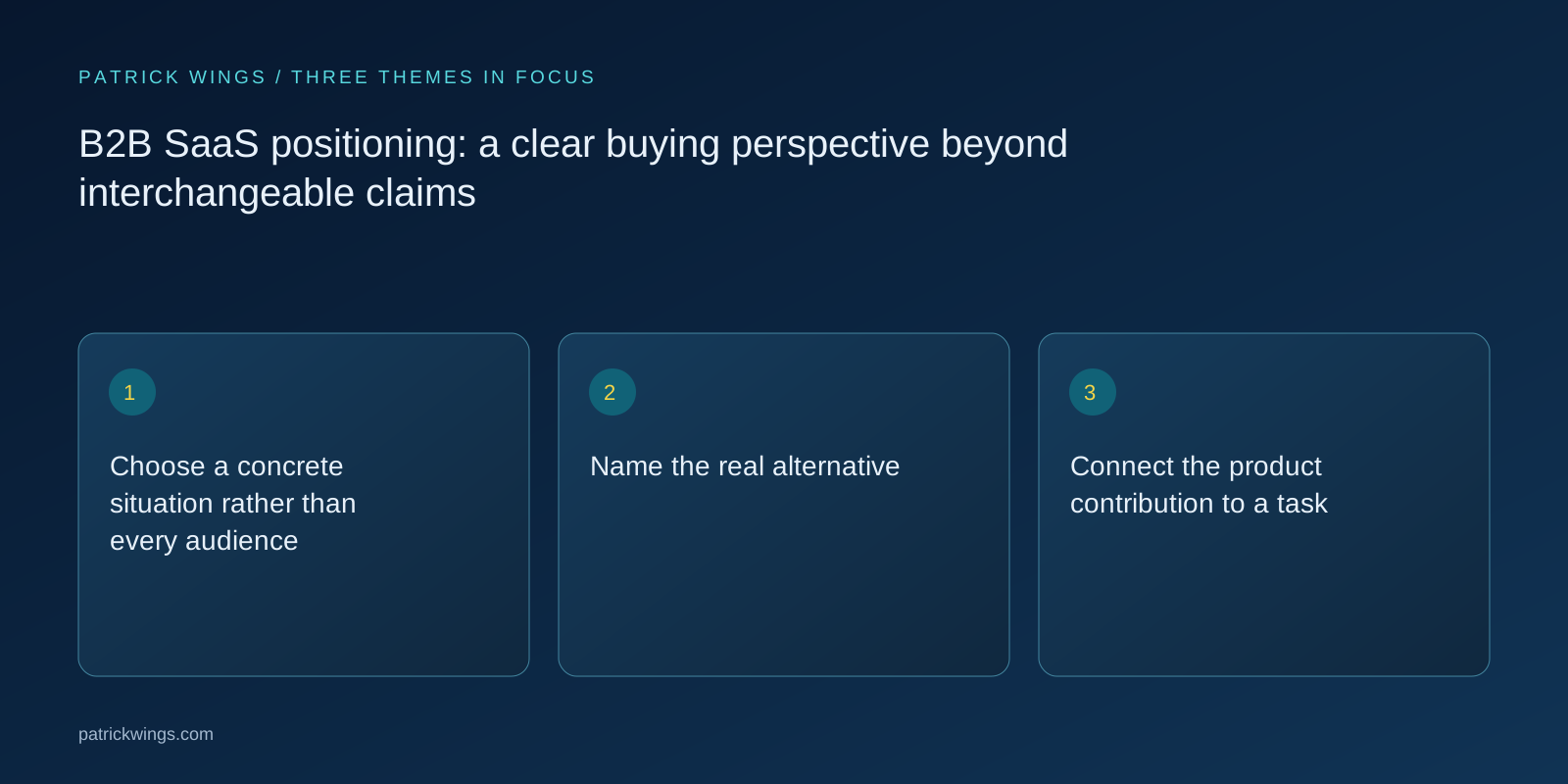
Connect the product contribution to a task
Do not merely name a capability. Explain which job it supports and under what conditions. An AI feature needs a clear account of its role and limitations, for example. “With AI” alone is not a defensible reason to buy. An illustrative product might structure recurring input information so a specialist can conduct the next review more easily. Whether that describes your capability must be verifiable in the product. Avoid extending the argument into business outcomes you cannot substantiate. A concrete, honest explanation of something available is often more useful than a sweeping promise whose connection to the customer's situation remains unclear or untested.
Write a simple messaging framework
Record the intended buyer, relevant situation, contribution and supporting evidence. Include limitations and prerequisites. Then develop a concise explanation and a longer conversation version. The framework does not need to appear publicly as a rigid sentence template. It should enable consistency while pages, advertisements and sales use different formats. Examine terms that appear obvious internally but may mean something else outside the company. A shared explanation should help a prospect describe your offer accurately to colleagues without unintentionally adding capabilities or guarantees. This is especially useful when your main contact needs to build an internal case without your team present in every discussion.

Test understanding separately from relevance
After a short introduction, first ask what the person understood and who they believe the offer suits. Then explore whether it matters in their own circumstances. A clear sentence can be irrelevant; an important problem can be explained badly. Those situations require different changes. Work with real target people and identifiable tasks rather than relying only on internal approval. A positive stylistic opinion is not a sufficient positioning test. Investigate confusion and objections as well. Record what people can actually repeat and where additional explanation becomes necessary. Avoid leading questions that reward polite agreement with the wording your team already prefers.
Bring the positioning into daily work
Approved positioning should influence product pages, content priorities, sales resources and qualification. Check whether important touchpoints explain the same relationship. Channels do not need identical wording, but their claims should not conflict. Assign ownership of the foundation and define which product or market changes trigger review. Use insights from won and lost conversations without making every individual opinion the new strategy. Useful positioning remains consistent enough for recognition and flexible enough for new evidence. Its practical contribution appears in clearer expectations and more appropriate conversations, rather than merely creating a more memorable phrase while the rest of the customer experience remains unchanged. Explore this further in the guide Product marketing in B2B SaaS: translate product knowledge into buying relevance.
INTERACTIVE / FROM READING TO ACTION
Three checkpoints for your implementation
Choose a checkpoint and track your reading progress. Checks are neither saved nor sent and do not score your business.
CHECKPOINT 01
Connect the product contribution to a task
Do not merely name a capability.
Explore in the article ↗CHECKPOINT 02
Write a simple messaging framework
Record the intended buyer, relevant situation, contribution and supporting evidence.
Explore in the article ↗CHECKPOINT 03
Test understanding separately from relevance
After a short introduction, first ask what the person understood and who they believe the offer suits.
Explore in the article ↗Frequently asked questions
Is a tagline already positioning?
No. A tagline may express part of it. Positioning defines the customer situation, alternative, contribution and evidence behind the words.
Should positioning list every benefit?
No. Explain the most important defensible relationship. Additional detail can follow as the buying decision develops.
How often should positioning change?
When important product or customer evidence justifies it. Changing personal preferences alone are not a sound basis.
How can I put “Choose a concrete situation rather than every audience” into practice?
Describe an application with sufficiently similar prerequisites. “Every company that needs digital transformation” is too broad. Ask what the audience wants to accomplish, what makes it difficult today and when it becomes important.
What matters when working on “Name the real alternative”?
Positioning becomes clearer when buyers understand what they would otherwise do. That may be another application, a combination of existing tools or a manual workflow. Sometimes the strongest alternative is making no change at all.