
THE SHORT ANSWER
A B2B beta programme should reduce specific uncertainty about use and market introduction. That requires suitable participants, distinguishable learning questions and a traceable response to feedback. This guide turns an informal early version into a bounded learning programme that serves product development, marketing and customer support without overstating what the results establish.
To connect this decision with positioning, market entry and growth, read the pillar guide Go-to-market for B2B SaaS: turn market insight into an executable growth strategy.
Define the decision before inviting participants
Write down the decision the beta should prepare. Are you investigating a new task, testing implementation or checking whether a message accurately explains an available capability? Separate these questions so a positive overall impression does not appear to answer all of them. Specify the observations required and the decision that could follow. A beta is not automatically evidence of demand or a source of early testimonials. It can show how selected participants use a limited version. Applicability to other businesses, later product versions and an ordinary purchase needs further investigation and should remain an explicit boundary of the programme rather than an assumption concealed in the final report.
Select participants by situation and prerequisites
Define the relevant working situation, required data and technical conditions. Include different experience levels where they belong to the target group. Recruiting only enthusiastic existing customers can hide problems new users encounter. An unsuitable group, however, cannot answer a useful product question either. Document recruitment routes and exclusions. GOV.UK's beta guidance emphasises varied users and the complete service, including support. For a SaaS programme, this means observing implementation and assistance as well as the interface. Explain the offer, its restrictions and the contribution requested from participants. A free early version does not establish an unlimited entitlement to someone's research time or permission to use their organisation publicly as a reference.
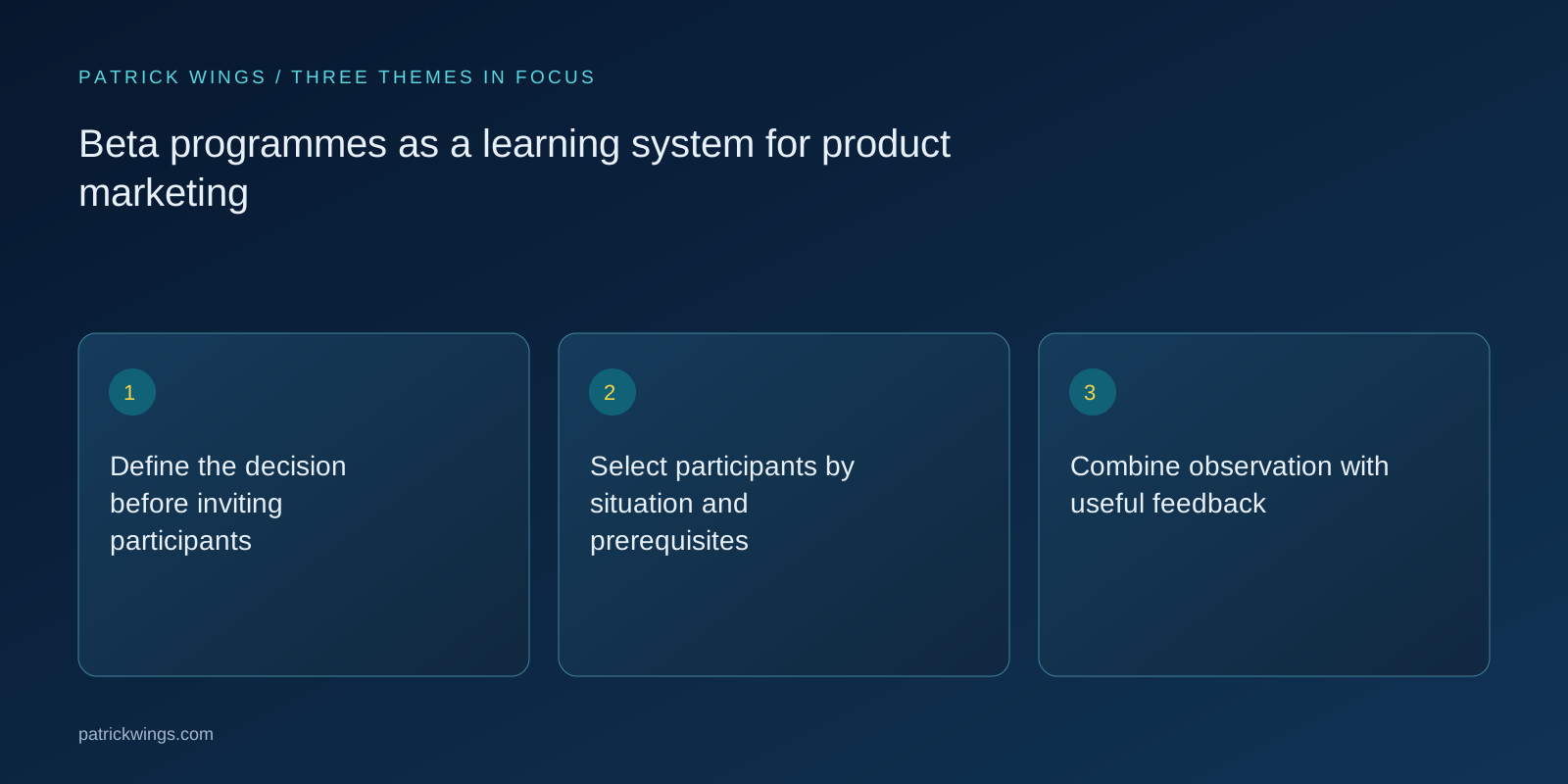
Combine observation with useful feedback
Observe actual task completion and follow it with open questions. A rating such as I like it does not explain whether someone completed the intended work successfully. Record the starting situation, actions, assistance and unresolved problems. Distinguish product faults, comprehension difficulties and missing prerequisites. When your team provides substantial help, document it: that help is part of the observed experience and must not later be described as independent use. Collect feedback in one place with a case reference and product version. A long wish list is insufficient. You need the connection between task, obstacle and consequence to justify the next product or content change instead of prioritising whichever suggestion sounds most appealing.
Bound an illustrative learning experiment
Suppose a SaaS team tests an approval capability with businesses that already have a defined authorisation process. The unresolved question is whether administrators can assign roles accurately without additional consulting. This scenario is hypothetical. Observe setup, ask participants to explain their choices and record every intervention required. Document an absent internal process separately from confusing interaction design. The result might justify clearer guidance or a different configuration flow. It does not establish demand across the entire market or prove how much time customers save after a long implementation. Keeping the original question visible prevents the team from turning a useful narrow observation into a much broader commercial claim.

Explain the response to findings
Connect each material finding with a learning question and a decision. Some feedback supports a correction, some requires further investigation and some requests do not fit the present scope. Assign an owner and tell participants what happened to their input. Avoid promises about future features before those features are approved. Marketing should receive a record of what was actually observed and under which conditions. That record limits later statements. Participant quotations require separate permission for their intended use. Joining a beta and approving a public case study are different decisions; the programme should preserve that distinction throughout recruitment, analysis and the eventual preparation of launch materials. Explore this further in the guide Running content reviews that produce decisions instead of preferences.
Close with a reasoned decision
Agree in advance when the beta will be assessed and which unanswered questions prevent a broader release. Afterwards, choose whether to continue, narrow the scope, revise the product or prepare a regular offer. Document remaining uncertainty and sampling limitations. Check what happens to data, access and support when the beta ends. Participants need a clear transition rather than an unexpected commercial continuation. The closing record should contain the questions, observations, changes and next tests. This makes the beta useful for a real release decision while preserving its limited evidential reach, instead of retrospectively presenting it as universal proof of readiness or a guarantee of customer outcomes. Explore this further in the guide Plan B2B pilots with clear decision criteria.
INTERACTIVE / FROM READING TO ACTION
Three checkpoints for your implementation
Choose a checkpoint and track your reading progress. Checks are neither saved nor sent and do not score your business.
CHECKPOINT 01
Combine observation with useful feedback
Observe actual task completion and follow it with open questions.
Explore in the article ↗CHECKPOINT 02
Bound an illustrative learning experiment
Suppose a SaaS team tests an approval capability with businesses that already have a defined authorisation process.
Explore in the article ↗CHECKPOINT 03
Explain the response to findings
Connect each material finding with a learning question and a decision.
Explore in the article ↗Frequently asked questions
How many participants does a B2B beta need?
That depends on the questions and relevant use cases. Suitable cases and explicit sampling limitations matter more than a universal participant count.
Can we use beta quotations in marketing?
Only with appropriate separate permission. Participation alone does not authorise a public reference.
Does a positive beta prove demand?
Not automatically. Use under beta conditions, purchasing and long-term customer value are separate questions.
How can I put “Define the decision before inviting participants” into practice?
Write down the decision the beta should prepare. Are you investigating a new task, testing implementation or checking whether a message accurately explains an available capability? Separate these questions so a positive overall impression does not appear to answer all of them.
What matters when working on “Select participants by situation and prerequisites”?
Define the relevant working situation, required data and technical conditions. Include different experience levels where they belong to the target group. Recruiting only enthusiastic existing customers can hide problems new users encounter.