
THE SHORT ANSWER
SaaS partners need knowledge, practical judgement and clear role boundaries. Onboarding should therefore do more than explain features: it should rehearse customer conversations, handoffs and difficult cases. This guide shows how to enable partners while preserving accurate product claims and a coherent customer experience across the work performed by different organisations.
To connect this decision with positioning, market entry and growth, read the pillar guide Go-to-market for B2B SaaS: turn market insight into an executable growth strategy.
Limit the actual partner role
Describe the work the partner will perform. Referrals, consulting, technical implementation and ongoing support require different capabilities. State what remains with the vendor. Someone who introduces relevant contacts does not need the same technical depth as an implementation team. Conversely, a general sales presentation is insufficient preparation for delivering an implementation. Derive the required knowledge and authorised actions from the role. This avoids allowing a label such as certified partner to suggest capabilities you have not assessed. If you issue a certificate, its scope should explain which tasks and product version were actually evaluated rather than implying unrestricted competence across the whole product and service portfolio. Explore this further in the guide Connect marketing and sales across borders.
Teach a usable description of the offer
Partners should explain the relevant customer situation, the contribution the product makes and the prerequisites for using it. Include common exclusions and misunderstandings. Use concrete, approved examples rather than a long list of attractive functions. The person needs to distinguish what is available today, what works only under particular conditions and what remains planned. Establish where the current product description lives. Copied presentations without version information quickly become outdated. Onboarding therefore needs a method for receiving changes and withdrawing obsolete materials. A central document only helps if people know when to check it and how to identify a change affecting the promises made in their next customer conversation.
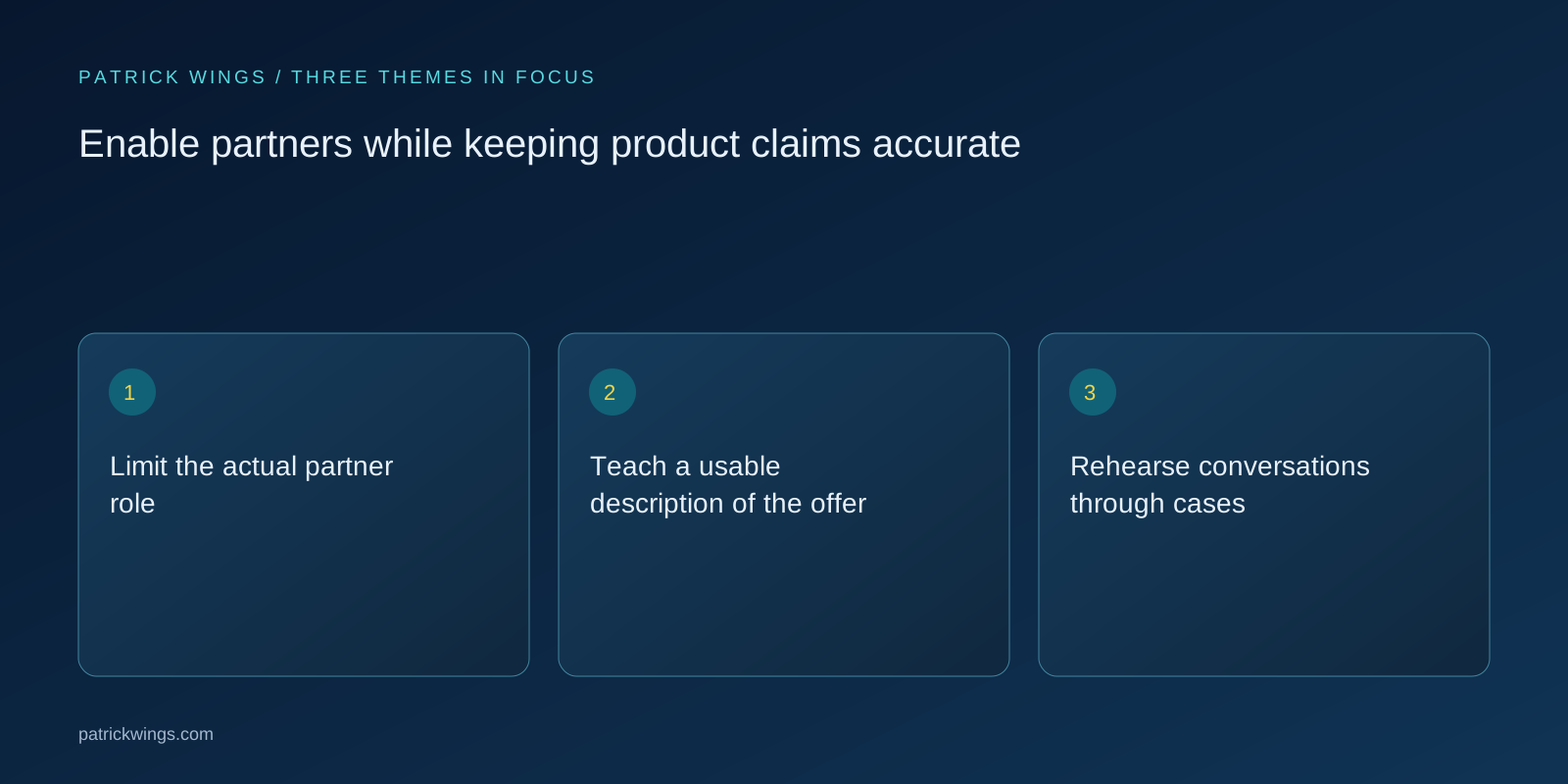
Rehearse conversations through cases
Ask partners to work through both a suitable and an unsuitable situation. They should ask questions, recognise prerequisites and suggest an appropriate next action. Do not assess only the recall of product vocabulary. What matters is whether the person labels an uncertain requirement as unresolved instead of inventing an additional capability. An expert can play the buyer and raise a difficult integration question. Define when the vendor must become involved. The outcome is observed behaviour rather than a self-rating after a webinar. Where important uncertainty remains, limit the authorised scope until another rehearsal or specialist discussion demonstrates that the partner can handle the relevant task responsibly.
Make the shared handoff operational
For each handoff type, define the context required, receiving role and confirmation. A partner enquiry should contain the trigger, specific question, known prerequisites and existing promises. Agree how to obtain missing information and return an enquiry with a reason. Run a simple rehearsal before customers depend on the process. Check availability and cover arrangements as well. The customer should understand whether they are speaking with the partner or vendor and who owns the next step. Avoid shared inboxes with no accountable person. A partner network becomes reliable through functioning collaboration on real tasks, rather than through displaying the same logos in many presentations and expecting coordination to follow automatically.

Rehearse an illustrative boundary conversation
Suppose a prospect asks a partner about an integration that has not been approved. This example is hypothetical. The appropriate response is a transparent statement about the current position followed by a specific technical investigation. Promising that it will probably work merely to continue the conversation is inappropriate. In the exercise, the partner documents the required system version and intended process without committing to implementation. The vendor then confirms what is actually supported. Marketing can incorporate repeated misunderstandings into the materials. This case reveals whether the partner can manage a boundary and whether escalation produces a usable answer rather than another ambiguous promise passed between the two organisations.
Continue enablement after the first session
Review early handoffs and questions together. Use repeated errors to improve examples, documentation and training. GOV.UK's beta guidance also considers the people who support users; that perspective is helpful when observing partners, although it does not prescribe a partner certification model. Decide which product changes require another briefing. Maintain a short history of approved roles and materials. A partner may be highly experienced in one task and still need assistance in another. This differentiated view protects customers and collaboration better than a single broad approval whose meaning is never reconsidered after the original onboarding session or checked against subsequent changes in the product. Explore this further in the guide SaaS partnerships: test the shared customer situation first.
INTERACTIVE / FROM READING TO ACTION
Three checkpoints for your implementation
Choose a checkpoint and track your reading progress. Checks are neither saved nor sent and do not score your business.
CHECKPOINT 01
Rehearse conversations through cases
Ask partners to work through both a suitable and an unsuitable situation.
Explore in the article ↗CHECKPOINT 02
Make the shared handoff operational
For each handoff type, define the context required, receiving role and confirmation.
Explore in the article ↗CHECKPOINT 03
Rehearse an illustrative boundary conversation
Suppose a prospect asks a partner about an integration that has not been approved.
Explore in the article ↗Frequently asked questions
What should a SaaS partner be able to do after onboarding?
Perform authorised tasks, recognise suitable customer situations and escalate unresolved requirements appropriately.
Is product training enough for partner onboarding?
Not for accountable customer work. Also rehearse conversations, handoffs, service boundaries and difficult cases.
How do partner materials stay current?
Use an authoritative source, version information, change ownership and a method for withdrawing outdated materials.
How can I put “Limit the actual partner role” into practice?
Describe the work the partner will perform. Referrals, consulting, technical implementation and ongoing support require different capabilities. State what remains with the vendor.
What matters when working on “Teach a usable description of the offer”?
Partners should explain the relevant customer situation, the contribution the product makes and the prerequisites for using it. Include common exclusions and misunderstandings. Use concrete, approved examples rather than a long list of attractive functions.