
THE SHORT ANSWER
A buying trigger is a change that makes a previously acceptable situation worth reconsidering. Funding announcements and job advertisements do not establish demand by themselves. What matters is whether the task, its consequences or the ability to act has changed. A testable trigger hypothesis prepares relevant conversations without treating public signals as reliable evidence of purchase intent.
To connect this decision with positioning, market entry and growth, read the pillar guide Go-to-market for B2B SaaS: turn market insight into an executable growth strategy.
Separate the signal from its effect
Start by distinguishing an observed event from the pressure you think it creates. A company opens another location: that may be observable. Its resulting need for planning software is a hypothesis. Record these statements separately and add an alternative explanation. The new location might already use the existing system successfully. A useful trigger links the event to a specific task for which the current approach is becoming difficult. Identify who experiences the consequences and who could authorise a change. This prevents premature personalisation based on a thin layer of public information. Explore this further in the guide Account engagement: distinguish activity from credible demand.
Reconstruct previous decisions
Ask customers about the period before they started looking. When did their existing approach first become difficult, what happened immediately beforehand and why did the issue receive attention then? Request the actual sequence: internal discussion, workaround, budget clarification and first supplier assessment. GOV.UK interview guidance supports open questions about concrete experiences. Applied to this GTM problem, the useful implication is to investigate the role of an event within a reconstructable decision rather than simply collecting events. Include organisations that experienced a similar change but did not subsequently purchase anything. Explore this further in the guide Build an ICP from evidence rather than idealised customers.
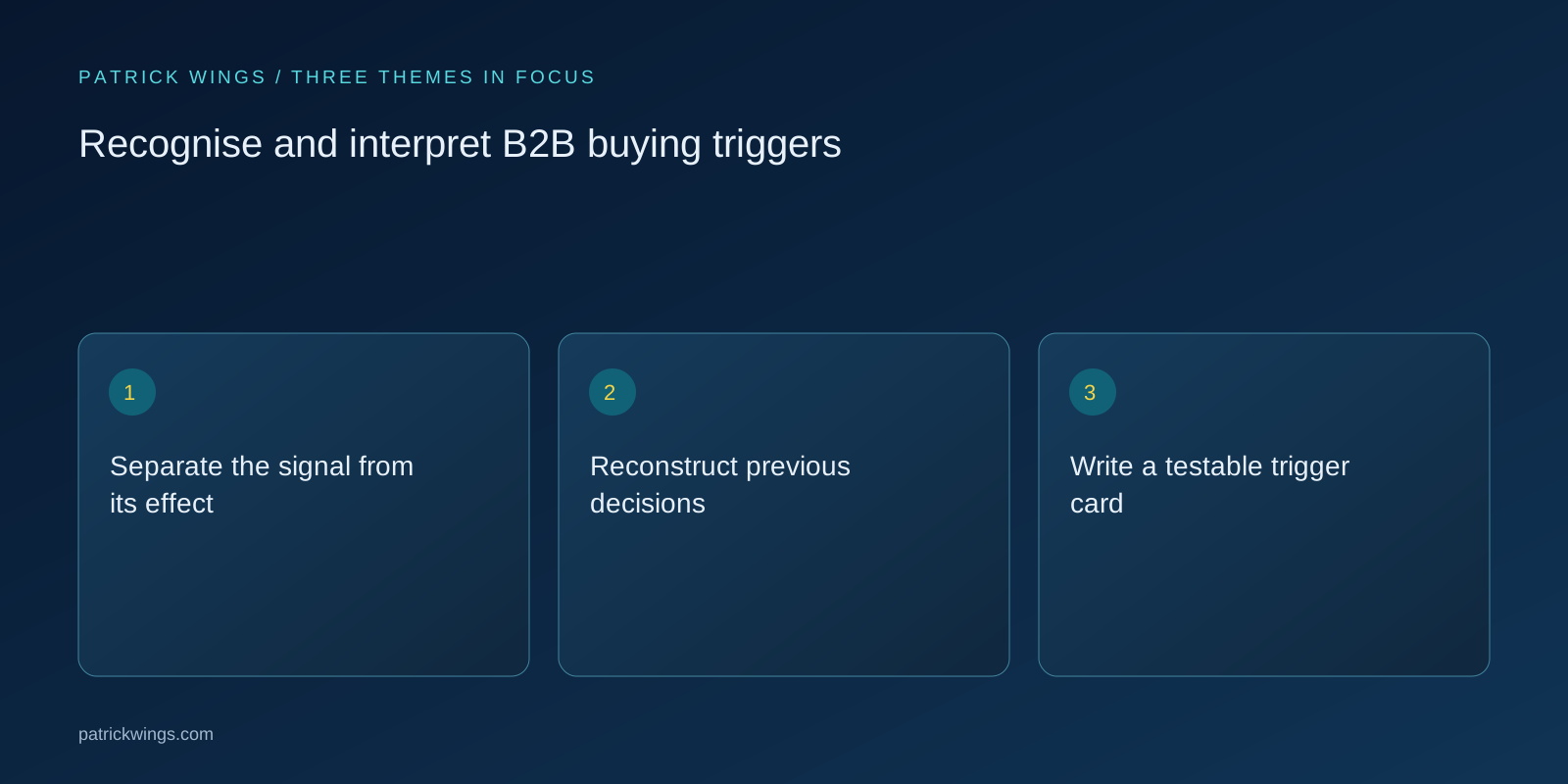
Write a testable trigger card
For each proposed trigger, record the event, affected task, expected consequence and unresolved question. Add the source, observation date and limits of interpretation. Then check whether you can actually address the task and whether the event provides a reasonable reason to start a conversation. A publicly announced leadership change does not justify claims about internal dissatisfaction. Ask a factual question about priorities instead. Before outreach, define the answer that would support your hypothesis, the answer that would contradict it and the circumstances under which you would stop pursuing that account.
Hypothetical example: additional reporting requirements
Imagine a fictional software supplier supporting project reporting. A prospective customer wins a contract requiring additional documentation. The supplier assumes manual report production will become burdensome. The conversation reveals a different situation: the department can already produce the documentation, but getting approval from external participants is difficult. The supplier therefore discards its original reporting message and investigates whether its approval workflow fits the situation. This example predicts no commercial outcome. It illustrates how an initially plausible hypothesis becomes useful only when it meets the actual sequence of work, responsibilities and remaining constraints.

Prioritise without false precision
Assess triggers through their demonstrated connection to the task, significance of consequences, recency and access to an appropriate owner. Begin with explicit categories rather than an elaborate numerical score. A documented workflow conflict with an unresolved decision deserves different treatment from a general growth announcement. Keep missing information visible. Salespeople should know whether they are following a concrete reason for change or conducting exploratory research. Update the assessment after each conversation. Repeatedly unsupported hypotheses call for better investigation, not more aggressive messaging or longer automated sequences directed at the same accounts.
Turn conversations into a learning system
Review which events actually corresponded to meaningful tasks and which were merely easy to observe. Record rejection, lack of ownership and problems that were already resolved. Do not infer that one positive meeting validates a whole trigger category. The appropriate next step might be a sharper question, a revised segment description or removal of a signal from your monitoring. Share these findings between sales and product marketing. The result is a reasoned set of conversation starters with visible limitations, assessed through actual customer responses rather than the attractiveness of the public news itself.
INTERACTIVE / FROM READING TO ACTION
Three checkpoints for your implementation
Choose a checkpoint and track your reading progress. Checks are neither saved nor sent and do not score your business.
CHECKPOINT 01
Write a testable trigger card
For each proposed trigger, record the event, affected task, expected consequence and unresolved question.
Explore in the article ↗CHECKPOINT 02
Hypothetical example: additional reporting requirements
Imagine a fictional software supplier supporting project reporting.
Explore in the article ↗CHECKPOINT 03
Prioritise without false precision
Assess triggers through their demonstrated connection to the task, significance of consequences, recency and access to an appropriate owner.
Explore in the article ↗Frequently asked questions
Is funding a buying trigger?
Initially it is a signal. A credible connection to an unresolved task is needed to turn it into a useful trigger hypothesis.
How old can a signal be?
That depends on the decision process. Check whether the change still has unresolved consequences rather than applying a universal expiry date.
What if our hypothesis is wrong?
Record the actual situation, correct the assessment and stop unsuitable outreach.
How can I put “Separate the signal from its effect” into practice?
Start by distinguishing an observed event from the pressure you think it creates. A company opens another location: that may be observable. Its resulting need for planning software is a hypothesis.
What matters when working on “Reconstruct previous decisions”?
Ask customers about the period before they started looking. When did their existing approach first become difficult, what happened immediately beforehand and why did the issue receive attention then? Request the actual sequence: internal discussion, workaround, budget clarification and first supplier assessment.