
THE SHORT ANSWER
Buyer research examines how people in suitable businesses recognise problems and make decisions. An actionable go-to-market strategy needs concrete experiences rather than a collection of encouraging opinions. Good interviews help confirm, revise or reject important assumptions.
To connect this decision with positioning, market entry and growth, read the pillar guide Go-to-market for B2B SaaS: turn market insight into an executable growth strategy.
Name the decision behind the research
Before the first interview, define which uncertainty you want to reduce. Are you investigating a buying trigger, a new audience or the clarity of an offer? A clear question guides recruitment and interpretation. Avoid a discussion guide that attempts to cover every product and marketing issue simultaneously. An illustrative objective could be understanding why businesses leave a spreadsheet approach to capacity planning. That suggests questions about the most recent project, involved roles and considered alternatives. Research becomes useful when findings connect to an upcoming decision rather than merely generating interesting quotations for presentations. Establish what evidence would challenge your current belief as well as what might support it. Explore this further in the guide B2B SaaS positioning: a clear buying perspective beyond interchangeable claims.
Recruit different real experiences
Do not speak only to satisfied favourite customers. Won buyers, lost prospects and suitable businesses that did not switch can reveal different parts of the process. Check whether participants actually experienced the decision in question. A general industry opinion is not a substitute for lived experience. Record the role, context and potential selection biases. Volunteers do not automatically represent an entire market. Deliberately seek counterexamples to the initial hypothesis. If you invite only people who already like the product, the answers may validate recruitment choices rather than the strength of the market assumption you intended to investigate.
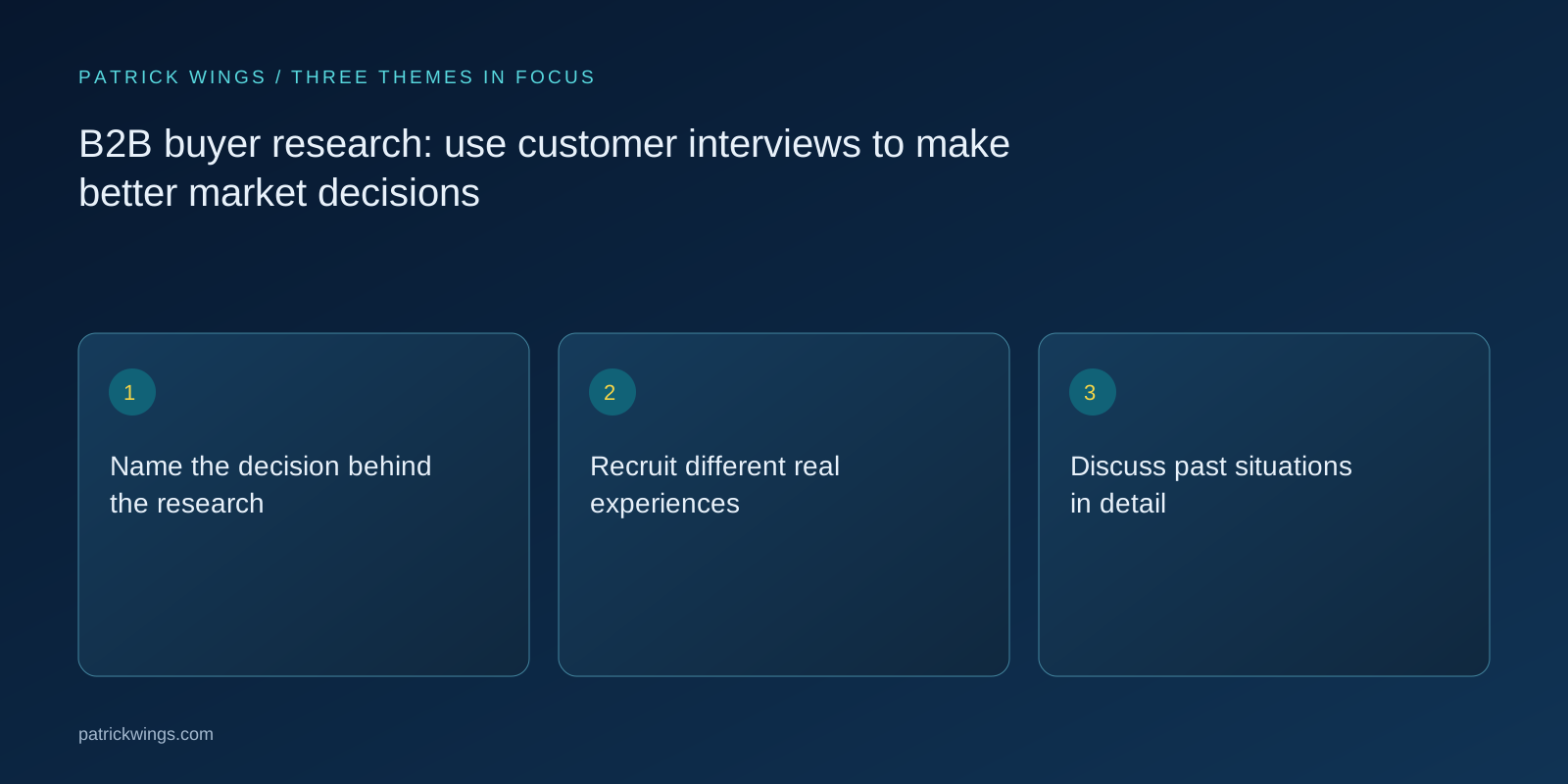
Discuss past situations in detail
Ask participants to describe a specific past situation step by step. What created the need? What did they try first? Who became involved? What delayed or changed the decision? Strategyzer likewise encourages focusing on actual customer experiences rather than moving too quickly into product opinions. Ask open questions and avoid wording that contains the desired answer. “How did you handle this most recently?” produces different information from “Would our automation be helpful?” Allow silence and clarify unfamiliar terms before translating the account into your internal product categories. The interview should reveal the buyer's sequence rather than guide them through your sales narrative. Explore this further in the guide Product marketing in B2B SaaS: translate product knowledge into buying relevance.
Understand alternatives and participants concretely
Buyers do not compare only suppliers within your software category. They may extend existing tools, perform work manually or postpone change. Ask why an alternative seemed acceptable at the time and which limitation later mattered. Explore who influenced the process and what questions different roles raised. An illustrative IT purchase may have business support yet stall over an unresolved integration concern. That does not automatically mean the marketing argument failed. These distinctions help align content, product evidence and sales assistance with actual decision questions rather than limiting the analysis to feature comparisons between competing vendors. They also reveal where no product purchase was seriously considered at all.

Separate observation from interpretation
First record what the participant actually described. Then label your interpretation and potential implications. Recurring patterns are useful, but a small qualitative sample does not establish a reliable market percentage. Avoid statements such as “most buyers want” when recruitment cannot support that generalisation. Look for differences between situations and consider alternative explanations. If two people express conflicting expectations, context may matter more than an imagined average persona. Organise findings by decision relevance and uncertainty. This creates an honest basis for hypotheses that can be examined through further conversations or behaviour, rather than promoting a memorable anecdote into a universal customer truth.
Turn findings into testable changes
Derive a limited number of concrete implications from the research. A target segment may need a clearer definition, an integration resource may be missing or the positioning may require revision. Document the observation behind each change and what remains unresolved. Share important findings with product, sales and customer success. Respect permissions and confidentiality when handling quotations or recordings. An interview is not automatically a publishable testimonial. Plan further investigation when an important commercial assumption has weak support. Buyer research succeeds when it improves decisions and can occasionally show that an attractive internal idea does not yet have an adequate basis for investment.
INTERACTIVE / FROM READING TO ACTION
Three checkpoints for your implementation
Choose a checkpoint and track your reading progress. Checks are neither saved nor sent and do not score your business.
CHECKPOINT 01
Discuss past situations in detail
Ask participants to describe a specific past situation step by step.
Explore in the article ↗CHECKPOINT 02
Understand alternatives and participants concretely
Buyers do not compare only suppliers within your software category.
Explore in the article ↗CHECKPOINT 03
Separate observation from interpretation
First record what the participant actually described.
Explore in the article ↗Frequently asked questions
How many interviews do we need?
That depends on the question and diversity of situations. Assess whether relevant patterns and counterexamples are understood rather than relying on a universal number.
Should we show the product idea?
Only after understanding past experience and establishing a clear test purpose. Otherwise the idea can influence the account too early.
Can interview quotations become website references?
Only with appropriate explicit permission and accurate context. Research participation does not automatically authorise publication.
How can I put “Name the decision behind the research” into practice?
Before the first interview, define which uncertainty you want to reduce. Are you investigating a buying trigger, a new audience or the clarity of an offer? A clear question guides recruitment and interpretation.
What matters when working on “Recruit different real experiences”?
Do not speak only to satisfied favourite customers. Won buyers, lost prospects and suitable businesses that did not switch can reveal different parts of the process. Check whether participants actually experienced the decision in question.