
THE SHORT ANSWER
A useful initial segment combines a relevant need, accessible buyers and an offer you can deliver reliably today. Prioritise specific customer situations rather than the largest industry. This method makes assumptions visible and helps you decide where the next learning investment belongs.
To connect this decision with positioning, market entry and growth, read the pillar guide Go-to-market for B2B SaaS: turn market insight into an executable growth strategy.
Bound the decision first
State what you are choosing a segment for. A new product requires different evidence from an established offer entering another sales model. Record the capacity available and the capabilities that already work reliably. Add a decision horizon. A segment can be attractive over several years and unsuitable for your next commercial step. Avoid asking which industry is universally best. Ask where a particular job matters now and under which conditions your current offer fits. This turns an abstract market discussion into a decision that can be investigated through customers, delivery teams and a clearly bounded experiment.
Describe segments through situations
Combine observable company characteristics with a shared job, a triggering change and similar buying conditions. Size or industry alone rarely explains urgency. Two IT service providers can have different coordination problems and procurement pathways. A useful segment might consist of companies combining several service teams while still planning capacity separately. Record exclusions, including required integrations you cannot support. Check whether your team can recognise suitable organisations in practice. A segment that only becomes identifiable after a lengthy consulting engagement creates a qualification problem before you have even tested the offer or reached the relevant decision makers.
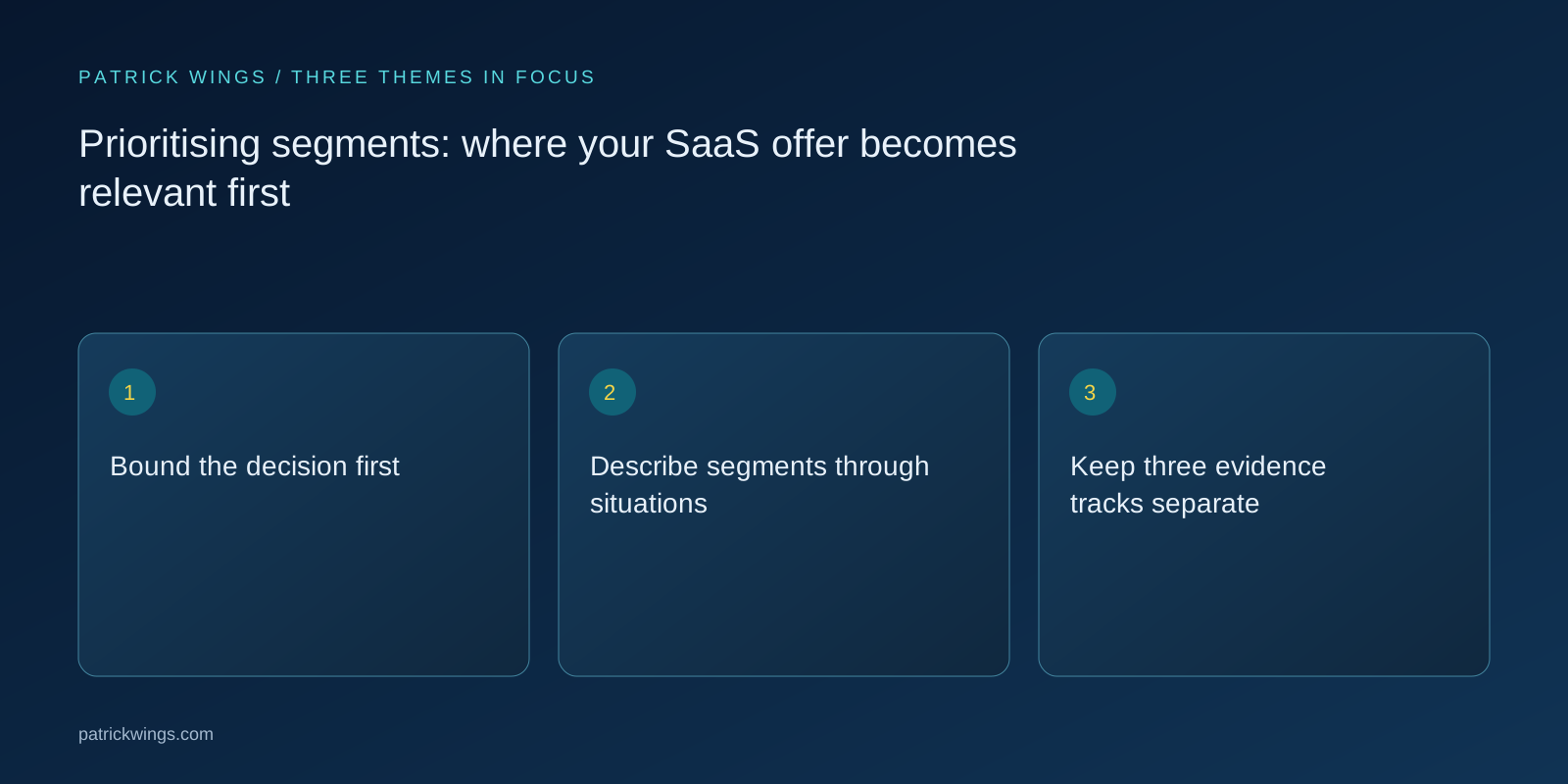
Keep three evidence tracks separate
Assess need, access and delivery ability independently. Evidence of need includes recent situations, existing workarounds and consequences that customers can describe. Access requires a plausible route to the relevant people; a large contact list is insufficient. Delivery includes the product, implementation and ongoing support. Mark each statement as observed, reported or assumed. Strategyzer’s work on customer jobs can help organise the need dimension. The three tracks proposed here are a practical decision aid rather than a standardised scoring system. A critical delivery gap should never disappear inside an appealing average across unrelated criteria.
Work through an illustrative comparison
Imagine a planning product comparing young agencies with established IT service businesses coordinating several teams. Agencies are easy to contact but rarely describe urgent allocation difficulties. The service businesses describe repeated handoffs and have an internal owner, yet require a data connection. This is an illustrative scenario, not a client result. The conclusion is not automatically to enter the second segment at scale. First investigate whether a limited connection permits a realistic initial workflow. If the prerequisite cannot be met, the need may remain interesting while the immediate route to market is still unsuitable for this product and team. Explore this further in the guide B2B growth strategy and KPI planning: turn objectives into testable decisions.

Choose the test from the uncertainty
Select the investigation that could change your decision. Uncertainty about urgency calls for conversations about actual decisions. Uncertainty about implementation calls for a technical and organisational walkthrough. Define beforehand what would weaken your assumption. A pleasant conversation or a general desire for better planning does not establish demand. Preserve contradictory cases instead of explaining them away. Your test should also expose the effort required from your team. Otherwise a seemingly accessible segment may depend on exceptional support that cannot become a repeatable offer. Keep the experiment focused on a named situation and one consequential uncertainty.
Attach focus to a review decision
Record the provisional priority, the conditions supporting it and the point at which it will be reviewed. Assign an owner and name the next unanswered question. Choosing a focus does not define your market forever. It protects current learning from unrelated exceptions. Change direction if central conditions fail, rather than inventing narrower subsegments to defend every assumption. Also notice whether excluded inquiries develop a consistent new pattern. This keeps the strategy open to evidence while preventing one attractive conversation from overturning the whole plan before the team has learned anything useful from its original choice. Explore this further in the guide Prioritise SaaS market entry by learning risk.
INTERACTIVE / FROM READING TO ACTION
Three checkpoints for your implementation
Choose a checkpoint and track your reading progress. Checks are neither saved nor sent and do not score your business.
CHECKPOINT 01
Keep three evidence tracks separate
Assess need, access and delivery ability independently.
Explore in the article ↗CHECKPOINT 02
Work through an illustrative comparison
Imagine a planning product comparing young agencies with established IT service businesses coordinating several teams.
Explore in the article ↗CHECKPOINT 03
Choose the test from the uncertainty
Select the investigation that could change your decision.
Explore in the article ↗Frequently asked questions
How many segments should we compare?
Few enough to investigate need, access and implementation concretely. A short comparison with evidence is more useful than a long ranking of assumptions.
Do we need a large market study?
Not for every initial choice. Resolve the questions that could change your next step, adding market sizing where the scale of the decision requires it.
Is an accessible segment automatically attractive?
No. Access without a relevant need or reliable delivery can produce many conversations without a suitable next step.
How can I put “Bound the decision first” into practice?
State what you are choosing a segment for. A new product requires different evidence from an established offer entering another sales model. Record the capacity available and the capabilities that already work reliably.
What matters when working on “Describe segments through situations”?
Combine observable company characteristics with a shared job, a triggering change and similar buying conditions. Size or industry alone rarely explains urgency. Two IT service providers can have different coordination problems and procurement pathways.