
THE SHORT ANSWER
A referral pathway helps a satisfied customer voluntarily introduce someone with a relevant need. Complex SaaS and IT offers require more than a referral button: a recognisable situation, an understandable invitation and a considerate handover. The useful outcome is a suitable introduction, rather than a growing collection of names.
To connect this decision with positioning, market entry and growth, read the pillar guide Go-to-market for B2B SaaS: turn market insight into an executable growth strategy.
Explain who genuinely benefits from an introduction
Start with a situation a customer could recognise at another company. Businesses needing digital transformation is too broad to guide an introduction. A clearer trigger might be several service teams coming together while still planning capacity separately. Add a relevant role and important exclusions. Someone seeking only calendar synchronisation may not fit your complex planning platform. Explain this without disclosing confidential project details. The referring customer needs enough guidance to recognise possible relevance, rather than becoming an unpaid qualification representative who must interrogate a colleague about budgets, contract length or buying authority before making any introduction.
Choose a suitable moment rather than a rigid trigger
A positive survey response can open a conversation but cannot explain the whole relationship. Ask when the customer has experienced value and the working relationship is stable. HubSpot’s referral guidance also emphasises experienced value and a personal request. Before approaching someone, check unresolved support issues, implementation difficulties and their immediate context. A satisfied customer may still prefer not to introduce contacts. Accept that choice without scheduling another request after an arbitrary delay. Providing good customer support remains worthwhile even where the relationship never produces an additional commercial opportunity for your business. Explore this further in the guide Technical one-pagers that connect value and prerequisites.
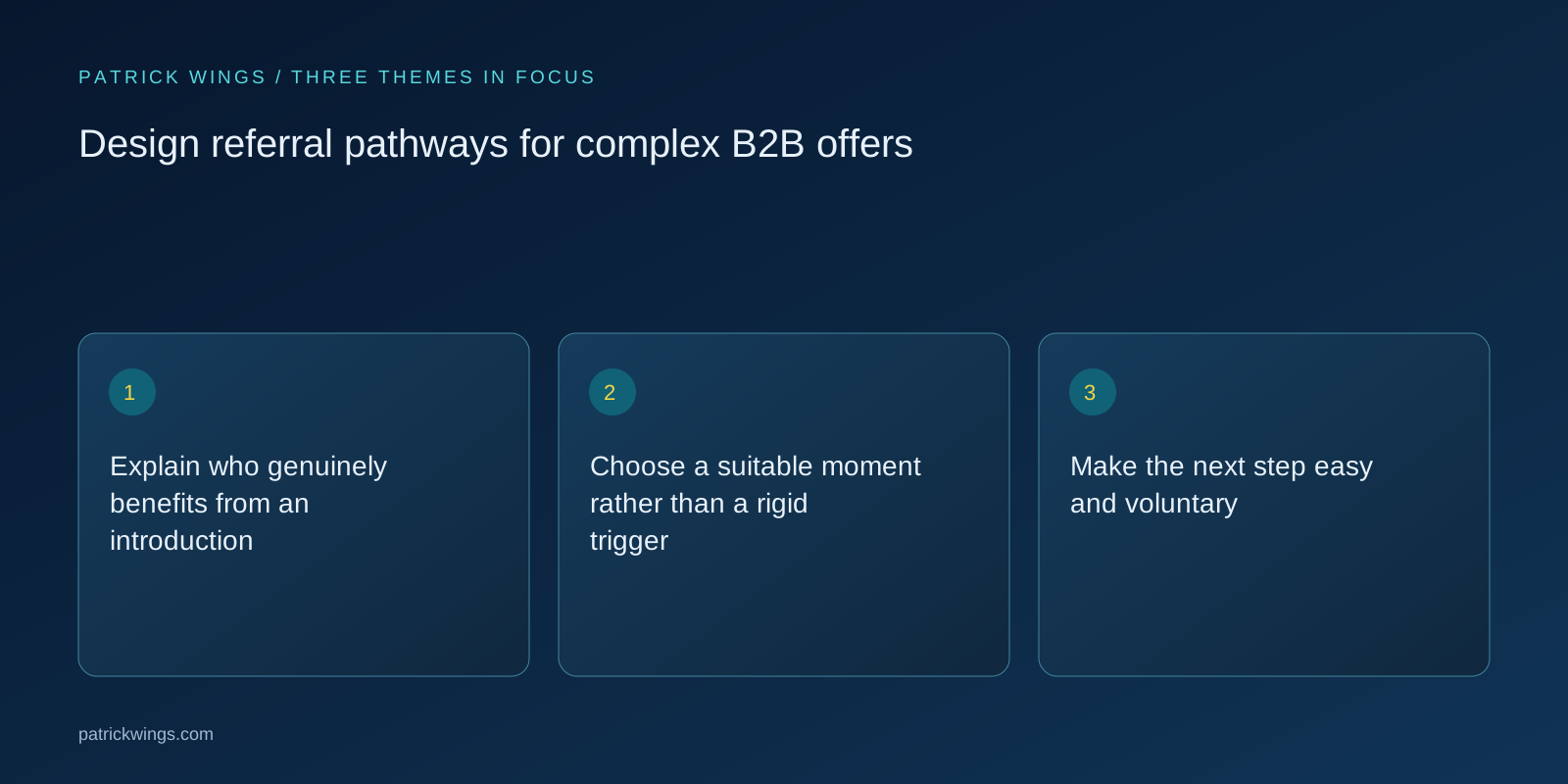
Make the next step easy and voluntary
Offer a short message the customer can adapt and forward themselves. Include the relevant situation, the potential value of a conversation and an optional next step. Ask the referrer to check whether their contact wants an introduction first. Do not import someone else’s address book or treat an introduction as automatic permission for an extended marketing sequence. Follow the contact processing procedures reviewed for your organisation. Also distinguish a private introduction from a public endorsement. Agreement to discuss a problem does not authorise publishing a logo, customer name, testimonial or quotation on your website. Explore this further in the guide Lead routing: assign every suitable enquiry an owner.
Work through a hypothetical handover
Imagine an IT director who has used your planning product to bring several teams into shared capacity discussions. She mentions a service business experiencing similar handover problems. You provide a brief invitation: if coordination between service teams is currently difficult, a conversation about the existing planning process may be useful. The director checks with her contact, then introduces both sides. Your first meeting investigates the situation and implementation prerequisites. This is an illustrative workflow rather than a client result. If the business only needs simple time recording, explain the mismatch and close the conversation considerately without manufacturing a larger problem.

Track transitions without treating relationships as inventory
Record the occasion, permitted contact route, responsible person and agreed next step. Then distinguish whether an introduction happened, a relevant need emerged and a useful continuation became possible. Lack of suitability and lack of interest in a conversation are different issues. Combining them encourages the same extra follow-up for unrelated problems. Thank the referring customer regardless of a sale. If you consider rewards, establish transparent conditions and have their suitability checked for the organisations involved. An introduction to a procurement stakeholder should never be compromised by a concealed personal benefit or an unexplained commercial arrangement.
Improve the pathway through actual breakdowns
Regularly review a few complete referral journeys with customer success and sales. Was the target situation understandable, the request appropriate and the initial discussion useful? Repeated unsuitable introductions suggest unclear fit criteria. Suitable contacts declining conversations suggest a weak invitation or an unhelpful next step. Neither calls for greater pressure on referring customers. Avoid extrapolating a handful of introductions into proof of general market demand. Networks differ in accessibility and often connect similar businesses. Referrals therefore complement other research and acquisition routes. They can transfer trust while still failing to establish a broad market or a predictably scalable channel.
INTERACTIVE / FROM READING TO ACTION
Three checkpoints for your implementation
Choose a checkpoint and track your reading progress. Checks are neither saved nor sent and do not score your business.
CHECKPOINT 01
Make the next step easy and voluntary
Offer a short message the customer can adapt and forward themselves.
Explore in the article ↗CHECKPOINT 02
Work through a hypothetical handover
Imagine an IT director who has used your planning product to bring several teams into shared capacity discussions.
Explore in the article ↗CHECKPOINT 03
Track transitions without treating relationships as inventory
Record the occasion, permitted contact route, responsible person and agreed next step.
Explore in the article ↗Frequently asked questions
Does a B2B referral programme need a reward?
No. Clear suitability and a useful conversation may be sufficient. Any rewards require transparent conditions appropriate for the organisations involved.
Will every happy customer refer someone?
No. Satisfaction and willingness to involve a professional network are different. Participation remains voluntary.
How should we measure referral quality?
Separate offered and accepted introductions, relevant needs and agreed next steps. Investigate specific reasons for unsuitable or abandoned conversations.
How can I put “Explain who genuinely benefits from an introduction” into practice?
Start with a situation a customer could recognise at another company. Businesses needing digital transformation is too broad to guide an introduction. A clearer trigger might be several service teams coming together while still planning capacity separately.
What matters when working on “Choose a suitable moment rather than a rigid trigger”?
A positive survey response can open a conversation but cannot explain the whole relationship. Ask when the customer has experienced value and the working relationship is stable. HubSpot’s referral guidance also emphasises experienced value and a personal request.