
THE SHORT ANSWER
AI is changing how marketing and sales teams work. A new tool alone does not create better positioning or a reliable process. What matters is the task you want to improve, the information it requires and who owns the result. This guide outlines a practical path from an initial assessment to appropriately bounded automation and agents. Its examples are illustrative planning scenarios, not claims of results already delivered for clients.
Start with a business question
“We need more AI” is not a useful project brief. Describe a specific bottleneck instead: expert information is scattered, campaign briefs require repeated clarification or research findings are difficult to verify. Ask which decision or deliverable becomes slower or weaker as a result. This produces a task with a benefit you can evaluate. Explore this further in the guide AI agents in marketing: which tasks can be bounded usefully.
Before the pilot, describe how work happens today. Record handling time, rework and factual mistakes across a small, understandable sample. Without a baseline, it is difficult to establish whether a new solution genuinely helps or simply makes a different part of the process more visible.
Distinguish assistance, workflows and agents
An assistant supports a task when asked, such as organising an interview. A workflow follows defined steps, for example reading a transcript, extracting themes and producing a draft. An agent can choose next steps and tools within established boundaries. This distinction describes freedom of action rather than automatically indicating quality.
A predefined workflow is often sufficient for recurring, well-understood tasks. Greater autonomy introduces additional requirements for permissions, observability and failure handling. Choose the simplest approach that performs your task reliably, rather than planning an agent system merely because the label sounds more advanced.
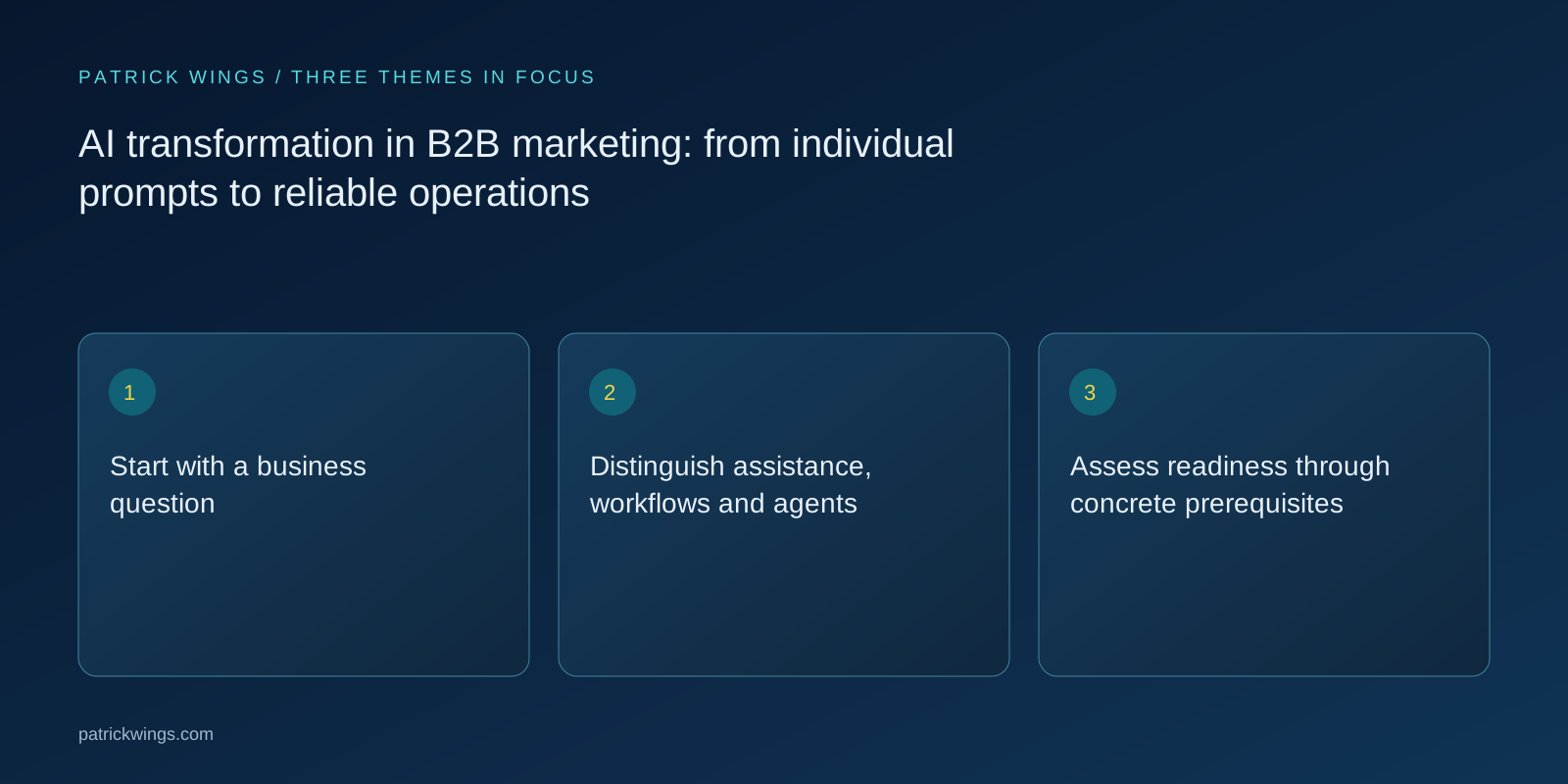
Assess readiness through concrete prerequisites
A useful readiness review examines processes, knowledge, data access, ownership and skills. Do you have approved product information? Is it clear which statements may be used externally? Can employees recognise an acceptable output? When those foundations are missing, a model will not automatically fill the gap. Explore this further in the guide AI readiness in marketing: is your team ready for a first pilot?.
Turn the review into a short list of preparation tasks. A dependable source for service descriptions or an improved briefing form may matter more than another tool. Assign owners so that readiness does not end as an abstract score. Its purpose is to remove specific obstacles to implementation and clarify what the team can responsibly attempt next.
Choose pilots with a bounded scope of action
A strong pilot has a clear input, an assessable output and manageable consequences if something goes wrong. An internal research draft is often a more appropriate starting point than an autonomous agent with advertising budget access. Select a recurring task where your team can recognise differences in quality.
A fictional SaaS team might first turn approved webinar transcripts into topic suggestions. The workflow returns drafts with source passages and unresolved questions, without publishing anything. The team checks whether important claims remain accurate and whether the suggestions fit its audience. Only then does it decide whether additional actions are justified.

Design knowledge access and permissions deliberately
AI needs relevant context, not unrestricted access to every company record. Specify which sources a task requires and which people or systems may use them. Record version information and subject owners. Outdated documents can create problems just as missing information can.
Distinguish permission to read from permission to modify. An agent allowed to analyse campaign reports does not consequently need permission to launch campaigns. Confidential information should be processed only in an environment approved for that purpose. Vendor terms and the actual configuration must fit the use case rather than being assumed safe because the product carries a business label.
Place human review where it can make a difference
Requiring approval after every minor step can make a process unusable. One approval after a long, opaque chain can hide mistakes. Put review points where important judgments or difficult-to-reverse actions occur. Give reviewers the result, supporting evidence and unresolved uncertainty.
A content workflow may require expert review before publication. Sales assistance may require approval before an external message is sent. Define which defects call for revision and when a person should take over. Approval is meaningful only when the reviewer has sufficient context, an understandable choice and responsibility for assessing the actual consequence of proceeding.
Test quality against realistic edge cases
One successful example is not an operational acceptance test. Build a collection of common tasks and difficult cases: missing details, conflicting documents, unsuitable audiences and plausible false statements. Assess both output quality and unwanted actions. Sometimes the correct behaviour is to decline a task or transfer it to a person.
Run the same cases after changes. Record the instruction version, knowledge sources and tool configuration used. Automated grading can help but does not always replace subject expertise. For positioning and complex product information in particular, a competent person should inspect samples and investigate unusual findings rather than accepting a single aggregate score.
Make operating costs and rework visible
Costs extend beyond model usage and licences. Include setup, integration, knowledge maintenance, expert review and incident handling. A quick first draft can make the overall task more expensive when many hidden errors need correction afterwards. Compare the complete process with the previous way of working.
Benefits also take different forms: less searching, more consistent briefs and quicker feedback can all be valuable. They do not automatically equal additional revenue. Specify what you actually measure and what you merely expect plausibly. This makes investment decisions understandable and prevents pilot outcomes from being turned into exaggerated rollout commitments.
Enable the team to improve the system together
Workshops should use real tasks rather than simply demonstrate impressive prompts. Employees need shared expectations for useful inputs, source checking, approved data use and escalation. Ask them to identify failures and justify improvements. That develops a more durable skill than competing to write the longest prompt.
Embed useful practices in templates and ordinary routines. Otherwise a successful pilot remains dependent on one person’s knowledge. Document purpose, permitted data, boundaries and ownership so another colleague can take over. Also record when AI provides no advantage for a particular task. Choosing not to automate can be a well-supported operational decision.
Scale only what you can explain and control
Expand access, user groups and autonomy gradually. Each expansion changes the requirements. An internally reviewed draft differs from an external customer answer or a CRM update. Before each step, check whether tests, ownership and fallback arrangements still cover the consequences.
A credible AI transformation consists of a sequence of justified decisions. Not every task needs an agent, not every agent needs several specialists and not every pilot deserves a rollout. When benefits and limitations are understandable, AI can become a practical addition to marketing operations instead of another system with unclear ownership and an impressive demonstration that nobody can maintain.
INTERACTIVE / FROM READING TO ACTION
Three checkpoints for your implementation
Choose a checkpoint and track your reading progress. Checks are neither saved nor sent and do not score your business.
CHECKPOINT 01
Assess readiness through concrete prerequisites
A useful readiness review examines processes, knowledge, data access, ownership and skills.
Explore in the article ↗CHECKPOINT 02
Choose pilots with a bounded scope of action
A strong pilot has a clear input, an assessable output and manageable consequences if something goes wrong.
Explore in the article ↗CHECKPOINT 03
Design knowledge access and permissions deliberately
AI needs relevant context, not unrestricted access to every company record.
Explore in the article ↗Go deeper: 49 practical articles
Each article addresses a specific question. Use this guide for orientation and the supporting articles for implementation.
- AI readiness in marketing: is your team ready for a first pilot?
Assess AI readiness through processes, knowledge sources, ownership and skills before choosing a practical pilot.
- AI workflow automation: clarify the process before connecting tools
Improve recurring marketing work with AI by defining inputs, checks, handoffs and failure handling clearly.
- Choosing marketing AI tools: compare against the task you actually need
Choose AI tools using your own tasks: evaluate quality, data access, integrations, control and operating effort together.
- AI governance in marketing: meaningful ownership and human review
Practical AI governance for marketing teams: permitted data, bounded permissions, meaningful review and traceable handoffs.
- AI agents in marketing: which tasks can be bounded usefully
Plan marketing agents for research, briefs and campaign checks with explicit sources, permissions and quality review.
- B2B sales agents: improve preparation while keeping relationships accountable
Bound sales agents sensibly for account research, meeting preparation and CRM drafts with fact checking and explicit sending permissions.
- AI research and competitive intelligence: verify sources and separate conclusions
Use AI for market and competitor research with clear questions, credible sources, explicit uncertainty and repeatable reviews.
- SaaS knowledge and support agents: reliable answers need maintained foundations
Plan knowledge agents with current sources, appropriate permissions, verifiable answers and a working handover to human support.
- Multi-agent systems in marketing: when several specialists make sense
Plan multi-agent orchestration through clear task boundaries, handoffs and control of quality, effort and permissions.
- Prompt engineering and AI workshops: improve the work, not prompt length
Practical AI workshops and prompt engineering for marketing teams: clarify tasks, use examples, test outputs and embed learning in daily work.
- Selecting AI processes: an inventory built from work samples
Prioritise recurring tasks through actual handoffs and consequences of error.
- The AI pilot charter: objectives, boundaries and stop criteria
Write a pilot charter that can be reviewed.
- Measuring AI value: establish a usable baseline
Compare handling time, rework and quality fairly.
- Rule, workflow or agent: choose the right automation
Derive autonomy from the task.
- Standardising AI inputs: a working contract for the process
Organise required fields, missing data and clarification.
- Routing AI tasks: send uncertain cases to the right place
Define categories, exceptions and human escalation.
- Recording agent state: what has actually been completed?
Structure intermediate states, evidence and completion conditions.
- Describing agent tools: clear inputs and verifiable results
Make tool boundaries and failure responses understandable.
- Read, draft, change: permissions for marketing agents
Bound access by action and data domain.
- Designing AI approvals: review what will actually happen
Connect approval to evidence, a concrete action and ownership.
- Retries without duplicate actions: resilient AI workflows
Handle retries, ambiguous states and duplicate changes.
- Bounding agents: runtime, tool calls and stopping
Limit effort and hand over partial results usefully.
- Building AI test cases: turn real failures into an evaluation set
Collect representative normal work and edge cases.
- Evaluating AI outputs: rubrics reviewers can use consistently
Translate quality into observable criteria.
- Using AI as a judge: calibrate evaluations with people
Test automated judgments against expert review.
- Testing AI changes: catch regressions before rollout
Compare model, instruction and source changes.
- Monitoring operational AI: signals rather than activity noise
Observe quality, errors and human takeovers in production.
- When an AI workflow fails: a practical incident response
Contain failures, retain evidence and resume deliberately.
- A RAG source register: knowledge with owners and expiry dates
Organise source approval, ownership and refresh.
- Preparing RAG documents: meaningful sections rather than fragments
Preserve document structure and context for retrieval.
- Evaluating RAG search: missing knowledge or failed retrieval?
Investigate retrieval quality separately from answer quality.
- Conflicting AI sources: authority before majority opinion
Handle version conflicts and source precedence.
- Sources in AI answers: verify evidence claim by claim
Expose evidence relationships and unsupported conclusions.
- Prompt injection in marketing workflows: contain untrusted content
Treat external content as data and constrain actions.
- Reducing AI context: share only the data a task needs
Limit AI context to necessary fields: assess data needs, design bounded handoffs and test quality with reduced inputs.
- Briefing research agents: questions, evidence and search boundaries
Brief research agents precisely: define questions, permitted sources, evidence formats and search limits for reviewable B2B research.
- Refreshing market research: identify and verify changes
Compare new evidence against a documented baseline.
- AI interview analysis: separate observation from interpretation
Preserve statements, patterns and qualitative limits.
- AI CRM enrichment: evidence suggestions and protect core records
Provide field suggestions with provenance, timing and review.
- Checking CRM data with AI: handle duplicates and conflicts carefully
Inspect similar records without premature merging.
- From conversation to CRM task: dependable AI handoffs
Transfer decisions, ownership and unresolved issues clearly.
- AI reporting: calculate figures and verify explanations
Separate deterministic calculation from verbal interpretation.
- AI for reporting anomalies: turn unusual results into review tasks
Distinguish data defects from possible business changes.
- Prioritising AI automation: a backlog for clear decisions
Weigh dependencies, benefits and operational effort together.
- AI team ownership: who decides, reviews and operates?
Assign roles around actual decisions.
- Everyday AI adoption: identify friction rather than force usage
Investigate work friction, trust and actual usefulness.
- AI office hours: learn together through real cases
Establish recurring practical help and documented decisions.
- Writing AI runbooks: operate beyond the original builders
Document restart, diagnosis and human takeover.
- Retiring AI workflows: when maintenance outweighs value
Plan orderly retirement and return to a manual process.
Frequently asked questions
Must AI transformation start with agents?
No. A focused assistant or defined workflow may be a better starting point. The task determines the necessary freedom of action.
How should we choose our first pilot?
Choose a recurring task with available sources, assessable quality and manageable failure consequences. Establish the current baseline first.
Can you promise fixed efficiency gains?
No. Effort, data quality and review needs differ. A pilot provides stronger evidence than a generic percentage promise.
How can I put “Start with a business question” into practice?
“We need more AI” is not a useful project brief. Describe a specific bottleneck instead: expert information is scattered, campaign briefs require repeated clarification or research findings are difficult to verify. Ask which decision or deliverable becomes slower or weaker as a result.
What matters when working on “Distinguish assistance, workflows and agents”?
An assistant supports a task when asked, such as organising an interview. A workflow follows defined steps, for example reading a transcript, extracting themes and producing a draft. An agent can choose next steps and tools within established boundaries.