
THE SHORT ANSWER
A marketing agent can select steps and tools within a defined task. That makes it more flexible than a fixed workflow, but not automatically reliable. For SaaS, IT and technology teams, bounded preparation tasks are often a useful starting point. The key question is which decisions the agent may make and where subject-matter responsibility remains with people.
To connect individual AI applications with reliable marketing operations, read the pillar guide AI transformation in B2B marketing: from individual prompts to reliable operations.
Check whether the task needs flexible steps
When every request follows the same sequence, an ordinary workflow may be sufficient. An agent becomes more interesting when it needs different sources or follow-up questions depending on the situation. Describe that variability explicitly. Finding missing briefing information may require several documents; renaming a file does not. Additional flexibility should offer an identifiable benefit. Also define step and retry limits so a small assignment does not become an uncontrolled investigation with no clear stopping point. Autonomy should solve a problem, rather than introduce an attractive new label.
Use briefing support as a bounded scenario
A fictional SaaS team wants to turn a product update into a campaign brief. An agent could read approved product information, identify relevant customer questions and flag missing evidence. The result contains audience, central message, suggestions and open questions with source passages. The agent does not determine final positioning. An accountable marketer checks whether proposed statements fit the offer and actual sales context. This is an illustrative working design, not a claim of an existing integration or achieved client outcomes. The scope remains preparation for an informed decision.
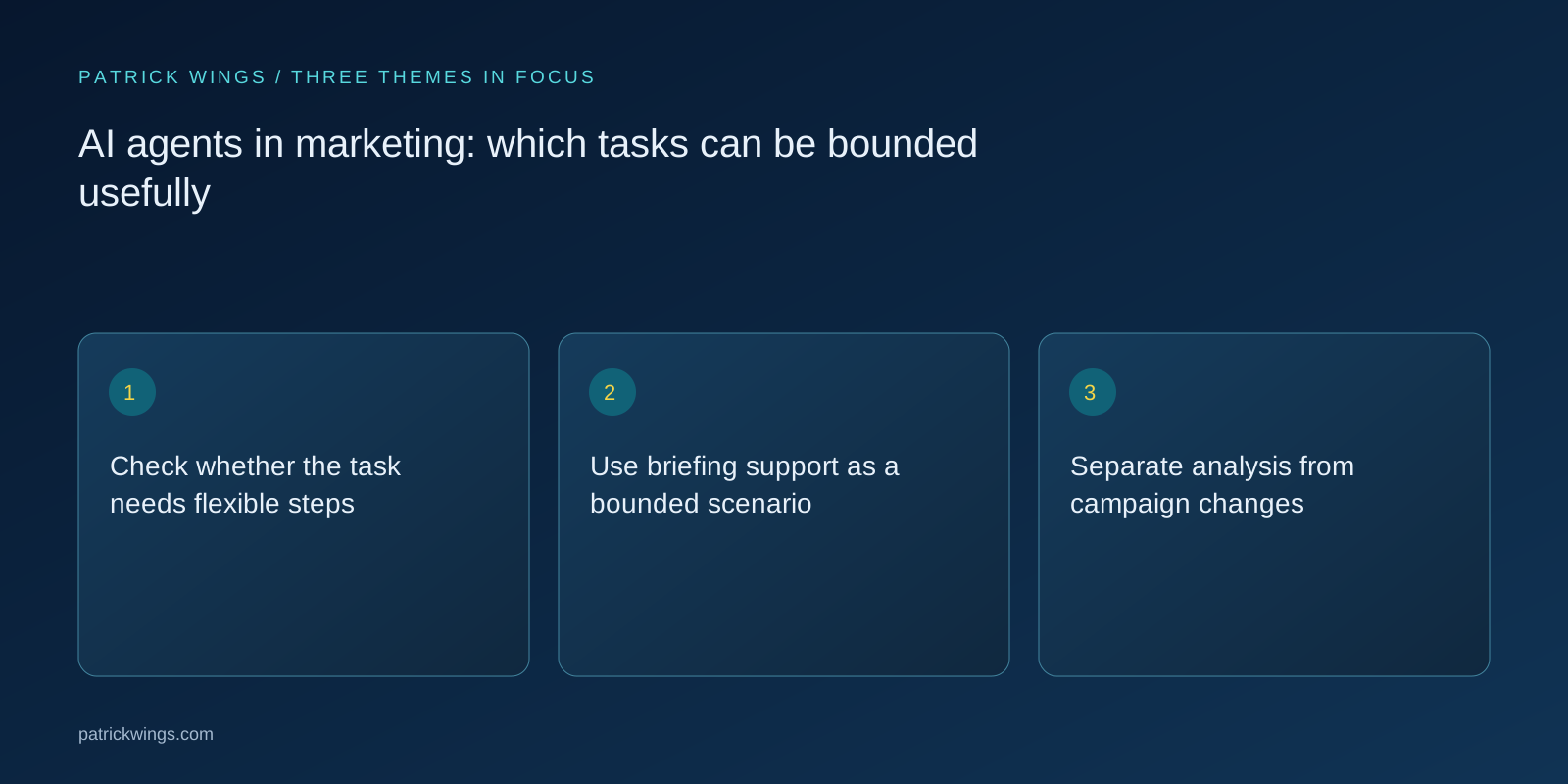
Separate analysis from campaign changes
An agent with read access could summarise unusual patterns in reports and suggest checks. That does not automatically authorise changes to budgets or targeting. Specify which data is complete and which comparison periods are appropriate. One metric rarely explains its own cause. Ask the agent to identify alternative explanations and information still needed. A proposed change then receives expert review. This keeps a substantiated observation distinct from a plausible hypothesis built from incomplete reporting and reduces the chance of acting on an attractive but unsupported explanation.
Bound tools and knowledge access
Provide only the sources and actions required for the assignment. Product materials, approved audience descriptions and selected reports may be sufficient. Broad access to customer records or every advertising account is usually unnecessary for an initial test. Check freshness and consistent terminology. External pages and uploaded documents may contain misleading material. Their text must not become new authority for changing the task. Technical boundaries and controls should support that distinction rather than leaving it solely as an instruction inside a prompt that the system might mishandle.

Define subject-specific acceptance criteria
For a brief, criteria might include substantiated product claims, clear audience fit, distinct messages and explicit uncertainty. Also assess whether the agent stops appropriately when information is missing. Test outdated sources, conflicting details and requests outside the offer. Fluent writing can still fail all those checks. Compare with the previous process and include rework. The useful standard is an acceptable work product with an understandable basis, rather than the number of steps executed independently or how convincingly the agent narrates its own progress. Explore this further in the guide AI workflow automation: clarify the process before connecting tools.
Expand according to observed reliability
Start internally with a limited user group. Observe recurring clarification needs and failures requiring expert review. Improve sources or task definitions before adding permissions. If the task becomes more dependable without flexible planning, simplify the design. Greater autonomy is not a requirement for a successful project. Document ownership and fallback arrangements so the process remains understandable without its original developer. Only then consider further channels, knowledge sources or consequential actions. Expansion should reflect demonstrated usefulness under known conditions, rather than enthusiasm generated by one impressive example. Explore this further in the guide AI governance in marketing: meaningful ownership and human review.
INTERACTIVE / FROM READING TO ACTION
Three checkpoints for your implementation
Choose a checkpoint and track your reading progress. Checks are neither saved nor sent and do not score your business.
CHECKPOINT 01
Separate analysis from campaign changes
An agent with read access could summarise unusual patterns in reports and suggest checks.
Explore in the article ↗CHECKPOINT 02
Bound tools and knowledge access
Provide only the sources and actions required for the assignment.
Explore in the article ↗CHECKPOINT 03
Define subject-specific acceptance criteria
For a brief, criteria might include substantiated product claims, clear audience fit, distinct messages and explicit uncertainty.
Explore in the article ↗Frequently asked questions
Can an agent run all our marketing?
That is not a responsible general promise. Individual tasks can be supported, while strategy, quality and accountability need clear ownership.
Which use case is suitable first?
An internally reviewed brief or bounded research task using approved sources can be a sensible starting point.
Should an agent immediately change advertising budgets?
That should not be the default assumption. Analysis and consequential changes are separate permissions requiring appropriate control.
How can I put “Check whether the task needs flexible steps” into practice?
When every request follows the same sequence, an ordinary workflow may be sufficient. An agent becomes more interesting when it needs different sources or follow-up questions depending on the situation. Describe that variability explicitly.
What matters when working on “Use briefing support as a bounded scenario”?
A fictional SaaS team wants to turn a product update into a campaign brief. An agent could read approved product information, identify relevant customer questions and flag missing evidence. The result contains audience, central message, suggestions and open questions with source passages.