
THE SHORT ANSWER
In B2B sales, agents can gather information, organise meeting notes and prepare drafts. They quickly encounter sensitive data and external relationships, so useful deployment starts with a clear task boundary. The objective is better preparation for relevant conversations. More automatically generated outreach is not by itself a measure of quality or a dependable business outcome.
To connect individual AI applications with reliable marketing operations, read the pillar guide AI transformation in B2B marketing: from individual prompts to reliable operations.
Start with internal preparation
A bounded assignment might gather public company information before a scheduled conversation. The agent returns supported facts, open questions and possible discussion points. It does not claim certain knowledge of current buying needs. Mark which statements are documented and which are hypotheses. A new office may justify a question but does not prove a specific software requirement. This distinction improves preparation and prevents personalisation based on confidently presented assumptions. Salespeople should understand why a suggested question might be relevant without mistaking the suggestion for confirmed account intelligence. Explore this further in the guide AI research and competitive intelligence: verify sources and separate conclusions.
Use CRM context selectively
An agent does not automatically need the entire contact history or every customer record. Define which fields and approved notes matter for the preparation task. Check the executing user’s permissions and the data path into the AI environment. Old entries and duplicate accounts should not silently become current truth. Make uncertainty visible. If a system drafts a CRM update, separate that draft from the actual modification. Incorrect notes can otherwise influence later conversations and internal decisions long after the initial AI interaction has been forgotten.
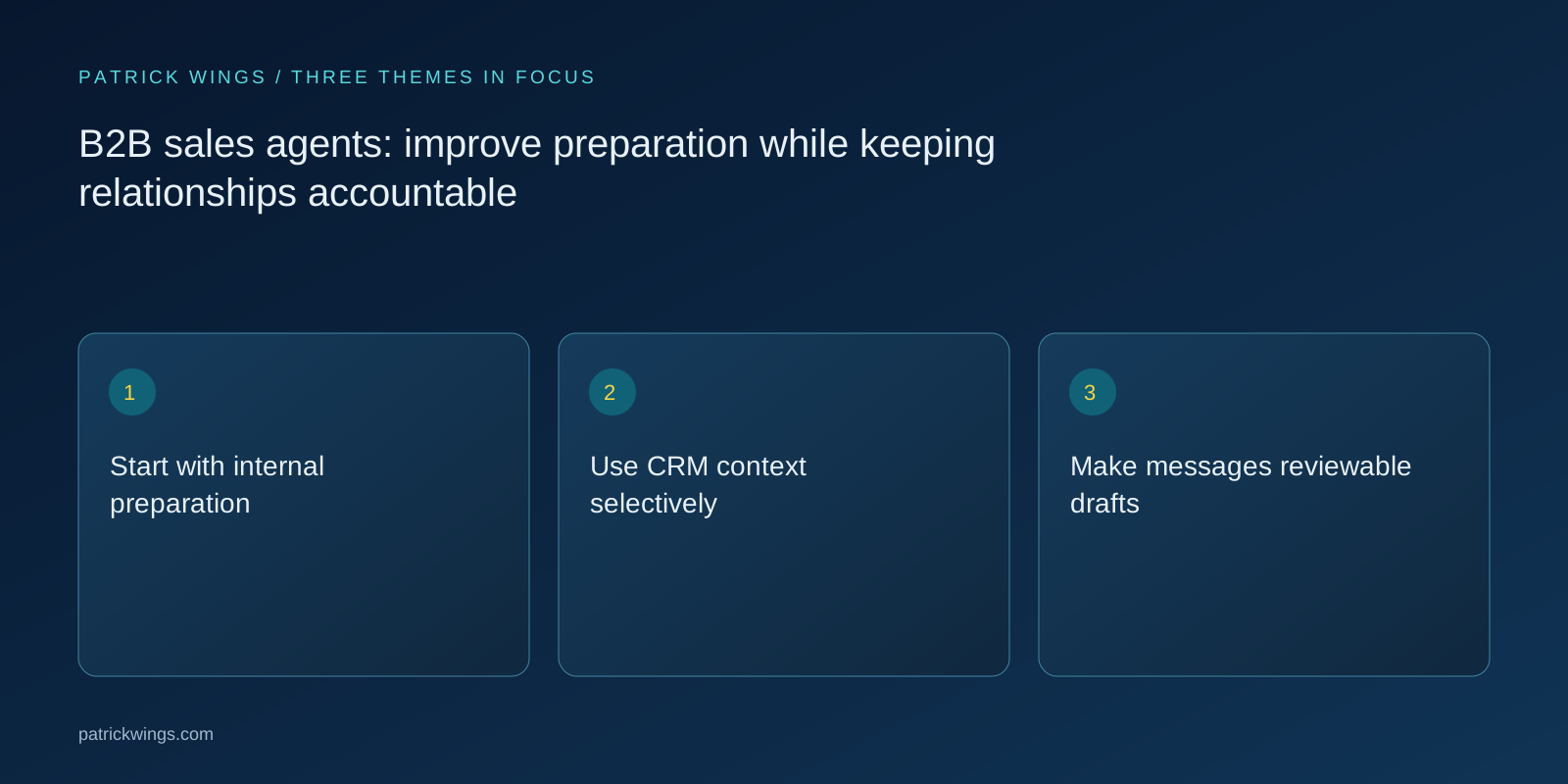
Make messages reviewable drafts
A useful draft gives an understandable reason for contact and reflects the actual offer. It does not invent personal connections or supposed insight into internal problems. Review facts, tone and recipient before sending. Approval of a template does not automatically approve every individual message or contact list. Channel requirements and legal conditions belong with the responsible specialists. The operating process should enable that review rather than scaling on the assumption that every prepared contact is appropriate and permitted. Quality depends on relevance and accuracy as well as speed.
Support meeting follow-up without adding facts
From approved notes, an agent can extract decisions, agreed actions and open issues. It should distinguish an actual commitment from something merely discussed. Assumed buying interest is not a confirmed next step. Where possible, connect each statement to the underlying note. Establish the relevant conditions with responsible owners before recording or processing conversations. The output supports verifiable follow-up. It must not turn an ambiguous statement into a binding customer promise or a stronger qualification status than the conversation actually supports.

Test errors that can damage relationships
Include confused company names, incorrect recipients, conflicting CRM entries and an explicit request not to be contacted. Assess whether the agent stops, asks appropriate questions and presents the right information for review. Fluent messaging is not a sufficient acceptance criterion. Record factual corrections and the time needed to produce usable preparation. Also observe whether salespeople rely too heavily on the output. A system whose mistakes remain hidden may require more oversight than one that communicates its limits clearly and lets the reviewer challenge its assumptions.
Evaluate meaningful work products
Measure preparation quality, completeness of agreed actions and rework. Qualified conversations and opportunities matter commercially, but many factors influence them. Do not automatically attribute a change to the agent. Compare a bounded deployment with the previous process and record the conditions. Expand permissions only when suitable controls exist. An internally useful sales agent does not need autonomous sending rights to be valuable. Its best long-term role may remain careful support for an accountable salesperson who understands the customer relationship and can judge the implications of each action. Explore this further in the guide AI governance in marketing: meaningful ownership and human review.
INTERACTIVE / FROM READING TO ACTION
Three checkpoints for your implementation
Choose a checkpoint and track your reading progress. Checks are neither saved nor sent and do not score your business.
CHECKPOINT 01
Make messages reviewable drafts
A useful draft gives an understandable reason for contact and reflects the actual offer.
Explore in the article ↗CHECKPOINT 02
Support meeting follow-up without adding facts
From approved notes, an agent can extract decisions, agreed actions and open issues.
Explore in the article ↗CHECKPOINT 03
Test errors that can damage relationships
Include confused company names, incorrect recipients, conflicting CRM entries and an explicit request not to be contacted.
Explore in the article ↗Frequently asked questions
Should sales agents send messages independently?
That requires a separate decision about permissions, channel rules and oversight. Internal preparation remains a useful starting point.
Can an agent infer buying intent from company news?
It can label a reasoned conversation hypothesis. That is not a confirmed need and should not become one in the CRM.
How should we measure value?
Assess preparation quality, rework and relevant business outcomes separately. Activity volume is not sales quality.
How can I put “Start with internal preparation” into practice?
A bounded assignment might gather public company information before a scheduled conversation. The agent returns supported facts, open questions and possible discussion points. It does not claim certain knowledge of current buying needs.
What matters when working on “Use CRM context selectively”?
An agent does not automatically need the entire contact history or every customer record. Define which fields and approved notes matter for the preparation task. Check the executing user’s permissions and the data path into the AI environment.