
THE SHORT ANSWER
The best AI tool is not automatically the one with the longest feature list. Your team needs something that supports a specific task reliably and fits its operating environment. A useful selection process starts with requirements and test cases. Vendor demonstrations can provide ideas, but your decision should rest on observable suitability for the work you actually perform.
To connect individual AI applications with reliable marketing operations, read the pillar guide AI transformation in B2B marketing: from individual prompts to reliable operations.
Write requirements as observable behaviour
“Good writing” is too vague for comparison. Specify that a tool should produce a draft from approved sources, identify unsupported claims and follow a required structure. Include languages, output formats and team collaboration. Separate indispensable prerequisites from convenient extras. An unapproved data path may be a disqualifier; an additional design option need not be. This clarity prevents an impressive demonstration from becoming a substitute for the actual requirements. It also makes disagreements easier to resolve because colleagues can point to the behaviour they need. Explore this further in the guide AI readiness in marketing: is your team ready for a first pilot?.
Test the same realistic tasks across candidates
Give each candidate a comparable task set and the same permitted context. Include straightforward and difficult cases: an incomplete brief, conflicting sources and a request outside your offer. Evaluate against criteria agreed in advance and record the rework required. One strong output demonstrates potential, not dependable performance. Repeat important cases when results vary substantially. Use subject reviewers and separate judgments about factual accuracy from personal preferences for a writing style. The comparison should show which solution handles your work, rather than which produces the most flattering first impression.
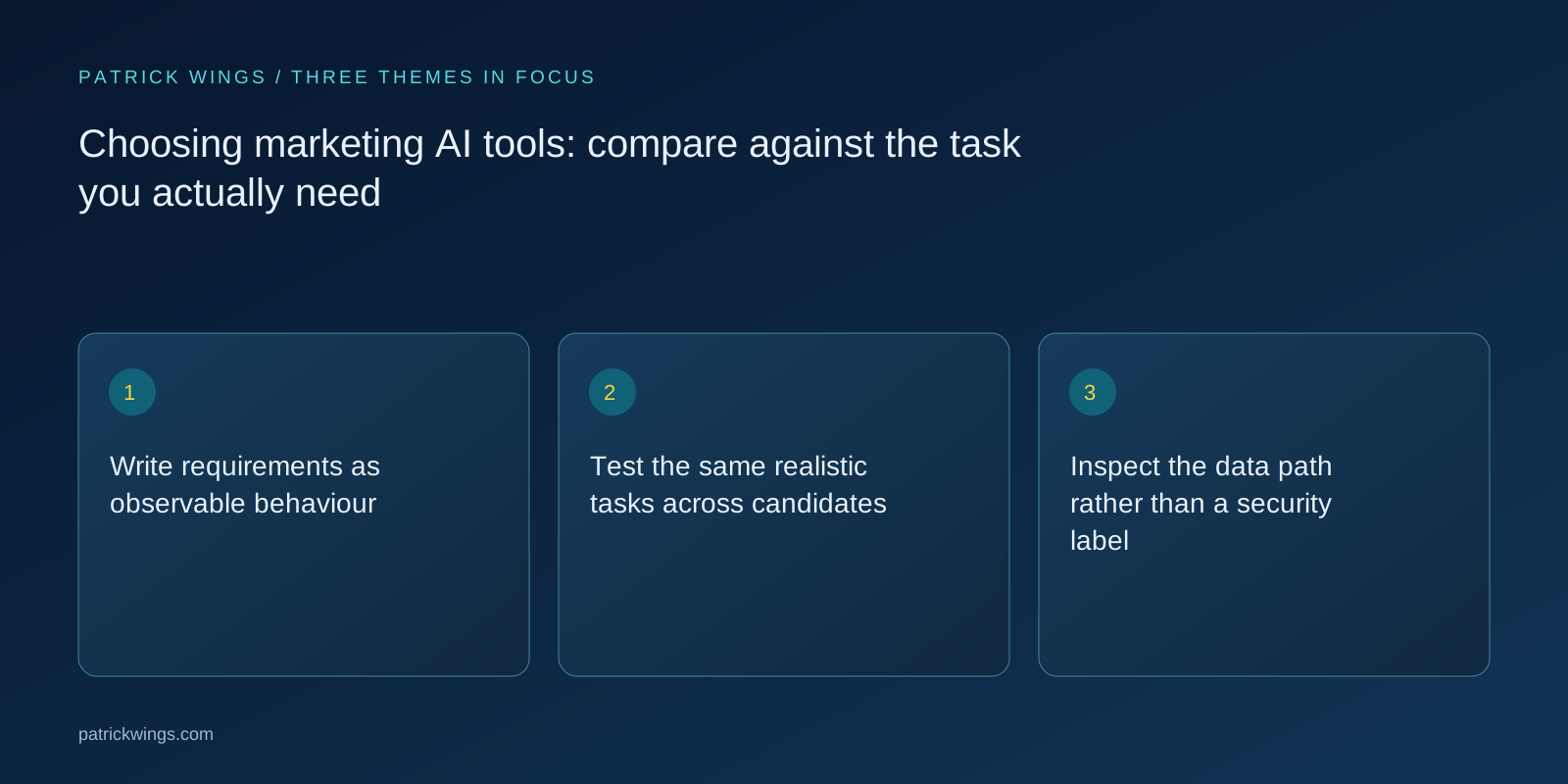
Inspect the data path rather than a security label
Which data is transferred, where does it originate and who can see it? Review account settings, retention, permissions and connected systems with the appropriate owners. Vendors often distinguish products and contractual variants. Do not automatically apply a business-account statement to a different offering. Even an approved tool may be unsuitable for a particular dataset. Document the actual configuration so that the decision can be reconsidered after a plan or integration changes. Responsible selection depends on the use case, not simply on recognising a familiar vendor name. Explore this further in the guide AI governance in marketing: meaningful ownership and human review.
Test integration and everyday operation
A useful draft has limited value if employees must copy it awkwardly between systems and repair formatting. Test the complete route from input to storage or approval. Check whether roles, permissions and traceability fit existing routines. An available interface does not by itself establish a suitable integration. Test missing permissions and outages as well as the normal case. This shows whether your team can understand and operate the process without continuous technical help, and whether the tool removes work or introduces another fragile handoff.

Compare total effort rather than licence prices alone
Include onboarding, training, integration, expert review and ongoing maintenance. Usage charges and testing effort may also matter. Use your own trial data as the starting point and state assumptions openly. An apparently inexpensive solution may require extensive correction, while a comprehensive platform may be unnecessary for a small pilot. Avoid generic savings calculations without a baseline. The useful question is the total effort required for an acceptable result and how that effort may change as usage grows. Pricing is one input, not the complete business case.
Plan switching and exit during selection
Check whether your content, instructions and important records can be retained in a usable form. Keep central process logic understandable rather than storing it only inside an opaque interface. Define what can continue if the tool fails or the supplier changes. A selection decision need not last forever. Establish a review point and consider changes in quality, requirements and conditions. A documented comparison makes later adjustments more objective because the team evaluates the same task instead of defending earlier enthusiasm for a product.
INTERACTIVE / FROM READING TO ACTION
Three checkpoints for your implementation
Choose a checkpoint and track your reading progress. Checks are neither saved nor sent and do not score your business.
CHECKPOINT 01
Inspect the data path rather than a security label
Which data is transferred, where does it originate and who can see it?
Explore in the article ↗CHECKPOINT 02
Test integration and everyday operation
A useful draft has limited value if employees must copy it awkwardly between systems and repair formatting.
Explore in the article ↗CHECKPOINT 03
Compare total effort rather than licence prices alone
Include onboarding, training, integration, expert review and ongoing maintenance.
Explore in the article ↗Frequently asked questions
Should we compare vendors first?
Start with the task, requirements and test cases. That gives the comparison a meaningful and defensible basis.
Is the cheapest plan usually sufficient?
That depends on approved data use, roles, integration and usage. Assess the actual configuration rather than price alone.
Can we use several tools?
Yes, when additional value justifies integration and maintenance. A longer tool list is not a benefit in itself.
How can I put “Write requirements as observable behaviour” into practice?
“Good writing” is too vague for comparison. Specify that a tool should produce a draft from approved sources, identify unsupported claims and follow a required structure. Include languages, output formats and team collaboration.
What matters when working on “Test the same realistic tasks across candidates”?
Give each candidate a comparable task set and the same permitted context. Include straightforward and difficult cases: an incomplete brief, conflicting sources and a request outside your offer. Evaluate against criteria agreed in advance and record the rework required.