
THE SHORT ANSWER
A marketing agent needs relevant working context, not a complete export of every available customer record. Define the decision or output first, then identify the fields required to produce it. This guide proposes a practical method for assembling and testing task-specific input packages. It does not replace assessment of your particular processing by the responsible privacy and security specialists. Less context is useful when the task can still be completed reliably and necessary qualifications remain visible.
To connect individual AI applications with reliable marketing operations, read the pillar guide AI transformation in B2B marketing: from individual prompts to reliable operations.
Start with a specific output
Describe the expected output precisely enough to inspect its information requirements. A draft for a general webinar reminder needs different details from an individual response to an unresolved support question. For every requested field, record which part of the result it enables. Reasons such as “might be useful later” are not testable requirements. Separate necessary information from optional improvements and mere availability. Also state what the agent should expressly not receive. This creates an inspectable input specification before an existing export format is passed to a model without scrutiny. Have a responsible subject-matter owner review that initial specification and its exclusions. Explore this further in the guide Describing agent tools: clear inputs and verifiable results.
Build a field list rather than a full export
Assemble the task package through an explicit list of allowed fields. It might contain the topic, language, approved offer wording and requested format. A person’s name does not belong automatically when it makes no difference to the task. Examine free text carefully: an ordinary notes field can contain personal details that the current step does not need. Inspect structured columns and embedded content alike. An internal identifier may support later reconciliation without repeating the complete record throughout the process. Still assess whether that identifier or the remaining field combinations can be linked to an individual; replacing a name is not automatically anonymisation.
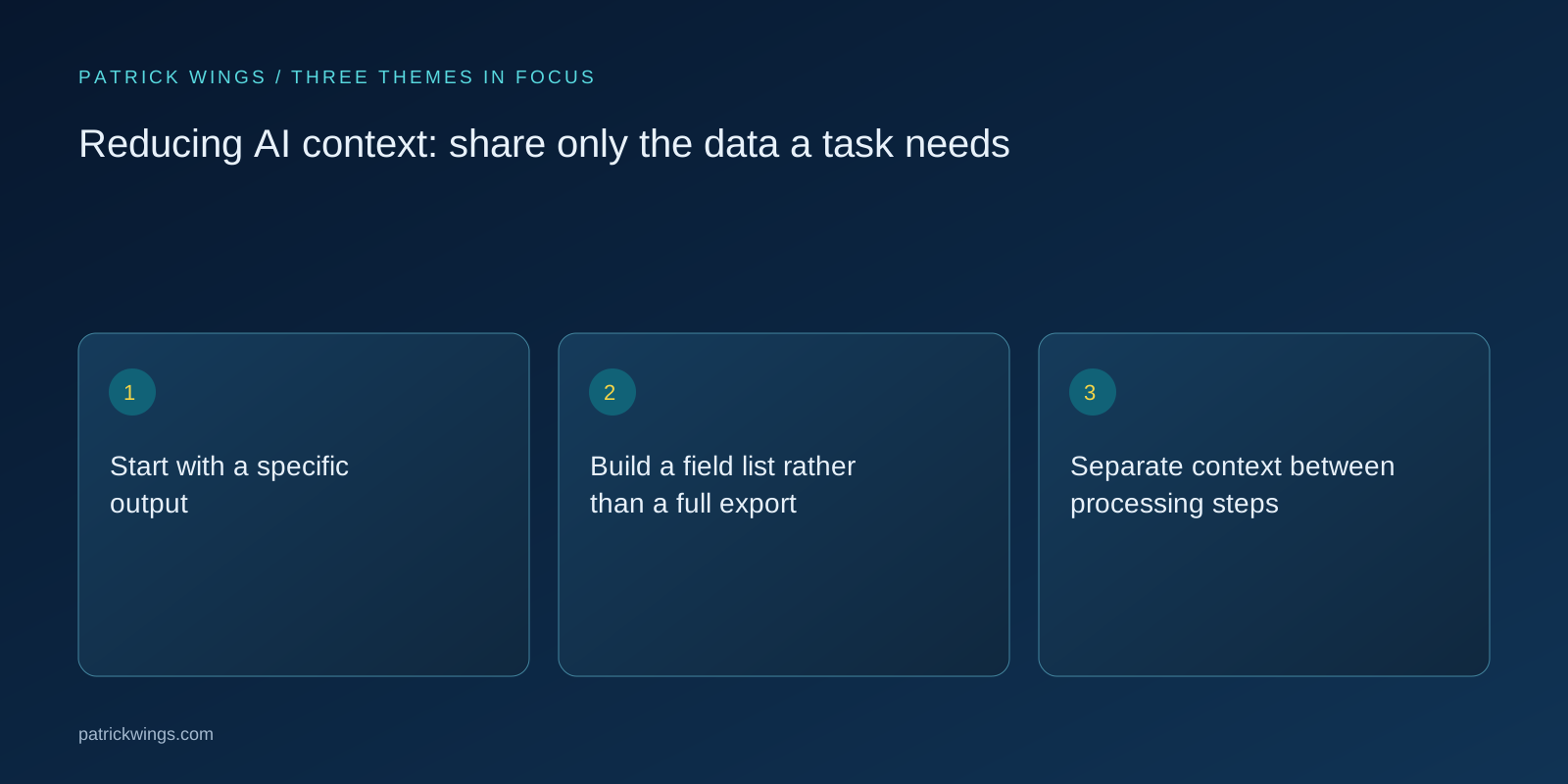
Separate context between processing steps
Do not give every step the same conversation history. A component producing a neutral draft may need only an approved factual summary. A separate delivery component can resolve the recipient under existing rules later. This is an architectural proposal, not an automatic security guarantee: summaries can still carry unnecessary details. Define permitted handoff fields and inspect their contents. The next step should not compensate for missing information by independently retrieving an unrestricted dataset. When a necessary detail is absent, provide a bounded request or stop path with a clear owner. Record what information each component actually sees rather than relying on the intended design alone. Explore this further in the guide Standardising AI inputs: a working contract for the process.
Compare full and reduced test packages
Test the proposed field list against representative, approved cases. Compare factual correctness, necessary qualifications and practical usefulness of the outputs. Do not remove context indiscriminately until only a shorter input remains. Without contract status, an agent might produce an incorrect message despite fluent wording. If reduction damages quality, identify the information genuinely missing and restore that specific field. Where practical, use controlled or synthetic development cases. Those cases must reflect relevant dependencies; on their own, they do not establish reliability for every real-world combination. Document the trade-off so a shorter prompt is not mistaken for evidence that the task still works.

Inspect an explicitly hypothetical campaign case
A fictional SaaS team wants subject-line variants for a product announcement. Its first input proposal includes the whole contact database and conversation notes. In this hypothetical task, the approved product brief, a description of the audience and the requested language are sufficient for general variant development. Individual personal records are unnecessary. The team reviews the resulting text against stated criteria and transfers selected variants into its ordinary delivery process. If a later task requires individual contract information, that changed purpose needs separate assessment. This example reports no measured improvement and does not claim a universally correct field list for every marketing campaign or operating environment.
Watch for copies and changing requirements
Trace where input packages appear beyond the model call: execution logs, error messages, caches and transferred drafts all matter. A small model input does not automatically remove unnecessary copies elsewhere. Agree suitable access and retention rules with the responsible specialists and inspect their implementation. Revisit the allowed field list when the task or its sources change. Record the purpose, affected fields and review outcome of each revision. If the agent repeatedly asks for more context, investigate the cause. It may lack a necessary detail, or the assignment itself may be unclear. Do not expand access simply because a broad export is easier to provide.
INTERACTIVE / FROM READING TO ACTION
Three checkpoints for your implementation
Choose a checkpoint and track your reading progress. Checks are neither saved nor sent and do not score your business.
CHECKPOINT 01
Separate context between processing steps
Do not give every step the same conversation history.
Explore in the article ↗CHECKPOINT 02
Compare full and reduced test packages
Test the proposed field list against representative, approved cases.
Explore in the article ↗CHECKPOINT 03
Inspect an explicitly hypothetical campaign case
A fictional SaaS team wants subject-line variants for a product announcement.
Explore in the article ↗Frequently asked questions
What data does a marketing agent actually need?
It depends on the output. Justify each input by its necessary role and test whether a smaller task package is sufficient.
Does replacing a name automatically anonymise the data?
No. Identifiers or combinations of remaining details may still allow identification. Assess the particular workflow.
Can less context reduce quality?
Yes. Test relevant cases and restore specifically missing information instead of passing the entire dataset by default.
How can I put “Start with a specific output” into practice?
Describe the expected output precisely enough to inspect its information requirements. A draft for a general webinar reminder needs different details from an individual response to an unresolved support question. For every requested field, record which part of the result it enables.
What matters when working on “Build a field list rather than a full export”?
Assemble the task package through an explicit list of allowed fields. It might contain the topic, language, approved offer wording and requested format. A person’s name does not belong automatically when it makes no difference to the task.