
THE SHORT ANSWER
AI-assisted CRM enrichment should help fill information gaps transparently. It should not turn a plausible guess into an apparently verified master-data change. Separate research, field proposals and acceptance. Marketing and sales need information that belongs to the correct organisation, is current enough and improves a particular decision. A completely populated record is not sufficient evidence of quality.
To connect individual AI applications with reliable marketing operations, read the pillar guide AI transformation in B2B marketing: from individual prompts to reliable operations.
Name the purpose of each enriched field
Start by asking which decision a missing field obstructs. A verified product category may help prepare a conversation; an estimated headcount does not automatically improve qualification. Document acceptable sources, required freshness and an allowed empty state for every field. If the team cannot explain how a value will be used, it should not be collected merely because the technology can find it. This boundary also reduces research effort and the number of inconsistently maintained details that colleagues must reconcile later. Explore this further in the guide Sources in AI answers: verify evidence claim by claim.
Identify the organisation before its attributes
A similar company name is insufficient for matching. Check the known domain, existing CRM relationship and organisational context. Subsidiaries and brands can have different buying responsibilities. HubSpot’s company API distinguishes record IDs, domains and properties. Use stable record identifiers in the handoff instead of searching again by name during the write step. A public domain can support research, but it does not replace checking whether the business unit being investigated actually corresponds to the company record your team intends to enrich. Explore this further in the guide Checking CRM data with AI: handle duplicates and conflicts carefully.
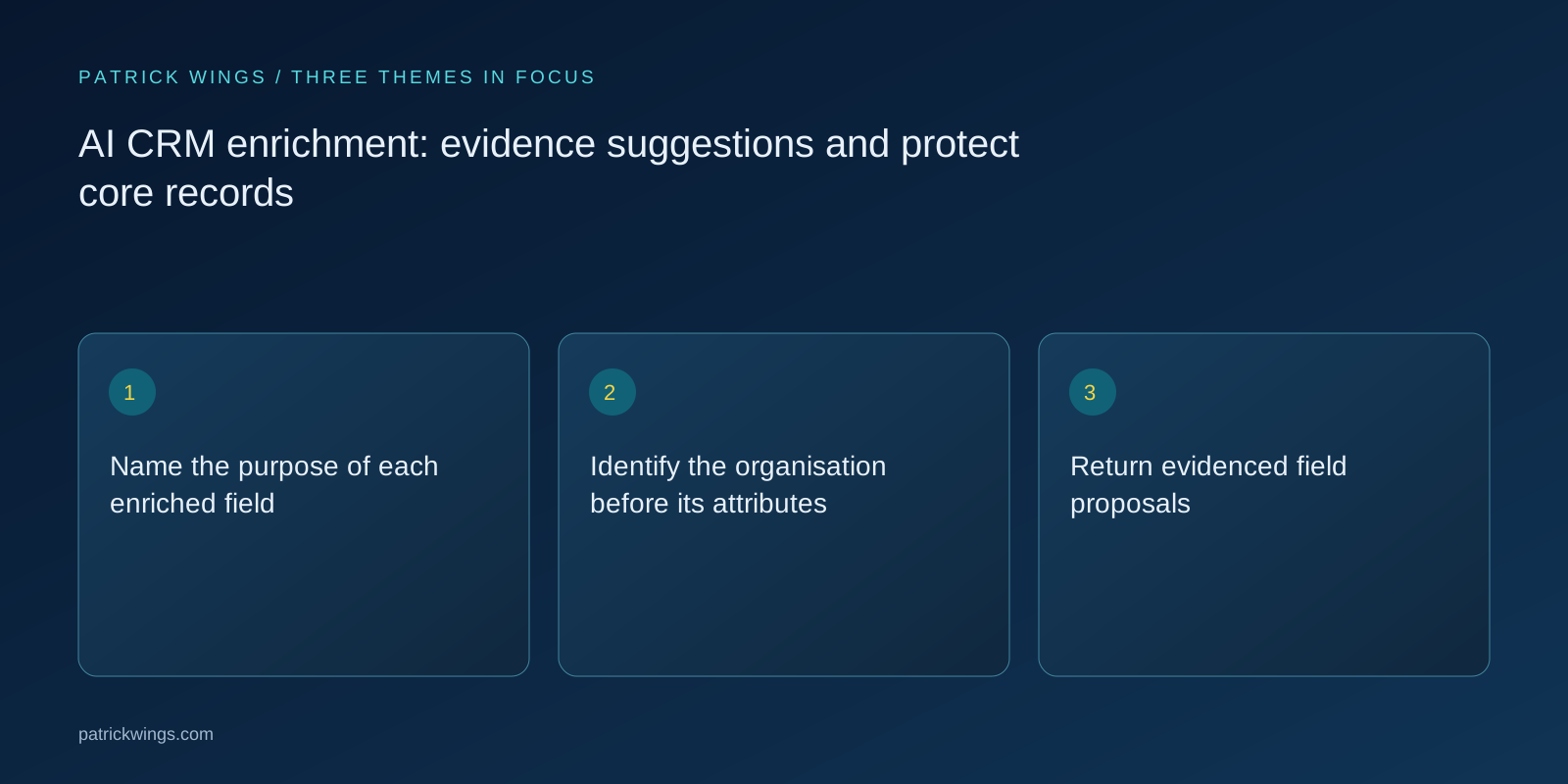
Return evidenced field proposals
Each proposal should contain the field name, suggested value, supporting passage, observation date and a short explanation. Explicitly distinguish direct statements from inferred classifications. A website may describe several solutions without supplying an unambiguous industry category for the provider. A categorical field value may therefore be inappropriate. Ask AI for an unresolved review note instead. A separate not-found status prevents missing evidence from being replaced by an invented default or a general assumption about the sector in which the company operates.
Protect existing values from replacement
Define precedence rules before enabling any write access. Information confirmed by the responsible salesperson may outweigh a new public summary. A newer source does not automatically take priority when it describes a different entity. Show the existing value beside the proposal and explain the conflict. Limit automatic acceptance initially to explicitly defined low-risk fields if testing justifies it. Qualification criteria, customer status and information from individual conversations need their own ownership and should never change incidentally through general enrichment logic or a broad company-classification task.

Check a hypothetical corporate-group example
Imagine a German software company recorded in CRM. The agent finds an international group website and proposes its total headcount as the company size. The source is genuine, but its relevance to the local sales record is unclear. The correct output is a group-level figure found, with scope requiring review. The existing value remains in place. After clarification, decide whether a separate group field is useful. This demonstrates that source quality is insufficient by itself: the subject and meaning of the target field must also match the evidence.
Test acceptance with a mixed collection
Include known companies, identical names, brands with multiple domains and deliberately outdated sources. Ask subject reviewers which proposals can be accepted and why. Measure incorrect matching and unjustified replacement alongside correct additions. Check the entire workflow too: is a rejected change actually prevented from being written? Does an already handled proposal keep appearing? An attractive preview does not establish dependable operation. For an initial pilot, proposal-only access can reveal the important quality problems without granting permission to modify the core CRM record.
Follow updates and contradictions over time
Enrichment is not a permanent completed state. Decide when a field should be checked again and how users can report a problematic value. Retain provenance and the acceptance decision so later corrections are not overwritten by the same obsolete source. Stop researching when the information benefit does not justify the review effort. An explicitly empty field with a documented reason can be a valid outcome. Dependable incompleteness is often more useful for a sales decision than an apparently perfect database assembled from uncertain guesses.
INTERACTIVE / FROM READING TO ACTION
Three checkpoints for your implementation
Choose a checkpoint and track your reading progress. Checks are neither saved nor sent and do not score your business.
CHECKPOINT 01
Return evidenced field proposals
Each proposal should contain the field name, suggested value, supporting passage, observation date and a short explanation.
Explore in the article ↗CHECKPOINT 02
Protect existing values from replacement
Define precedence rules before enabling any write access.
Explore in the article ↗CHECKPOINT 03
Check a hypothetical corporate-group example
Imagine a German software company recorded in CRM.
Explore in the article ↗Frequently asked questions
Which fields suit an initial pilot?
Fields with a clear purpose, verifiable public evidence and bounded consequences if matching fails. The specific choice depends on your CRM.
Should a newer source replace an old value?
Only under defined precedence rules. Recency alone establishes neither entity fit nor subject reliability.
What if dependable evidence is unavailable?
Leave the field empty or unchanged and record the unresolved research need instead of inventing a value.
How can I put “Name the purpose of each enriched field” into practice?
Start by asking which decision a missing field obstructs. A verified product category may help prepare a conversation; an estimated headcount does not automatically improve qualification. Document acceptable sources, required freshness and an allowed empty state for every field.
What matters when working on “Identify the organisation before its attributes”?
A similar company name is insufficient for matching. Check the known domain, existing CRM relationship and organisational context. Subsidiaries and brands can have different buying responsibilities.