
THE SHORT ANSWER
AI governance defines who may use an AI application for which task and with which data. Marketing teams need rules that make sense in daily work. A long policy without practical decision support is insufficient, as is an approval button nobody can assess meaningfully. The following approach concerns operational design rather than legal advice for an individual situation.
To connect individual AI applications with reliable marketing operations, read the pillar guide AI transformation in B2B marketing: from individual prompts to reliable operations.
Describe applications through purpose and boundaries
Keep a short record for each relevant use: purpose, users, required data, permitted outputs and owner. “AI for content marketing” is too broad. “Internal drafts based on approved product documents” defines an assessable task. State what is excluded, such as individual customer records or external publication. Employees can then recognise whether a new request fits the agreed scope. Changes should be deliberate and traceable rather than emerging silently through additional tools or knowledge sources that nobody has reviewed against the original purpose.
Limit permissions to the actual task
A research assistant usually needs different permissions from an agent that edits records. Separate reading, drafting, saving suggestions and external actions. Use bounded accounts and explicit ownership where possible. Avoid broad permissions merely for convenience. Check connected systems too: a narrow agent brief can be undermined by a connector with extensive access. Effective protection comes from real technical boundaries rather than a polite prompt instruction. Test those boundaries with deliberately inappropriate requests so the team can verify what the system genuinely prevents. Explore this further in the guide B2B sales agents: improve preparation while keeping relationships accountable.
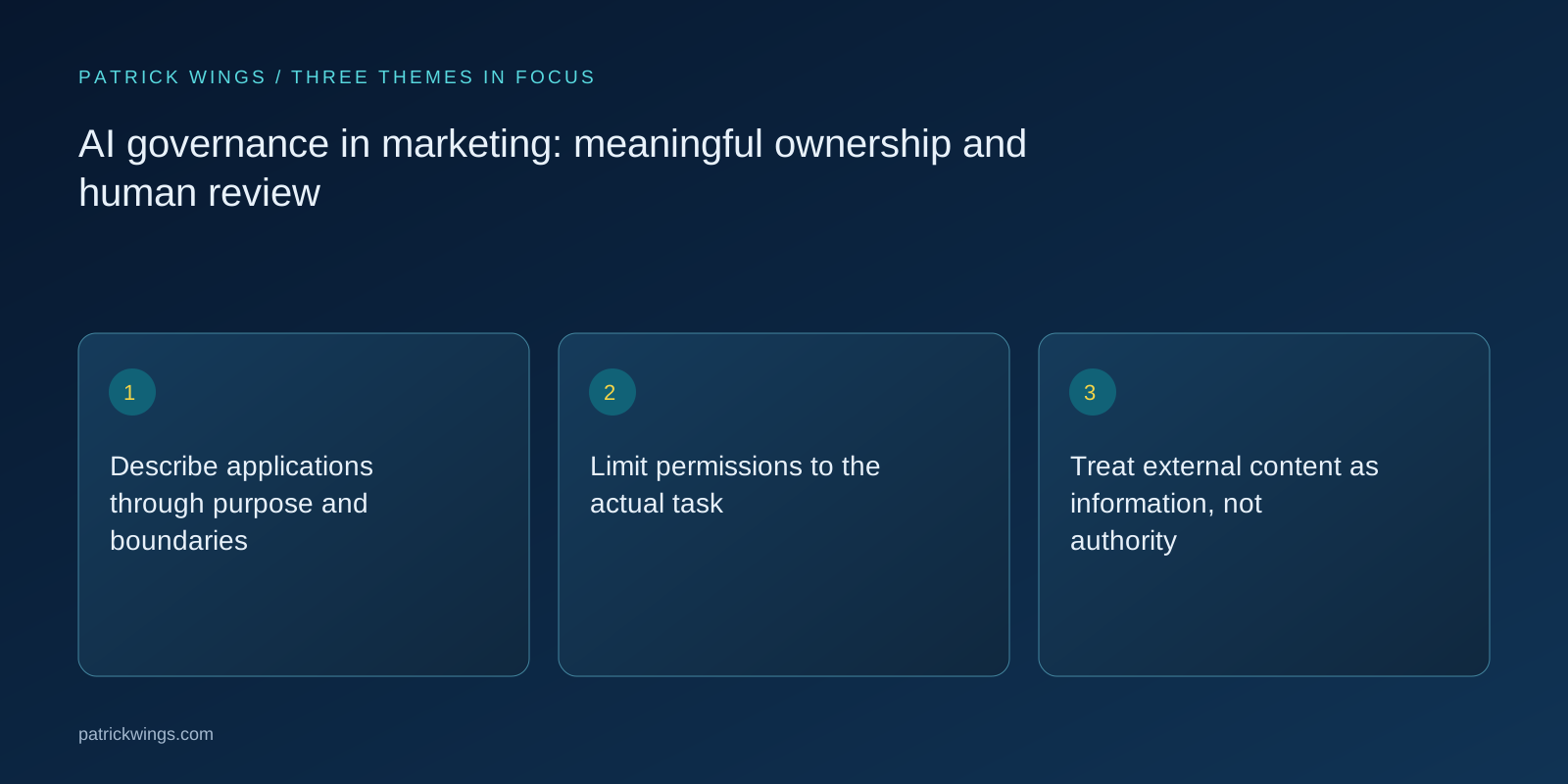
Treat external content as information, not authority
Agents may read pages, documents or messages containing unexpected instructions. Content could attempt to redirect the task or request confidential information. Separate source material from authoritative system instructions and restrict downstream actions. Technical checks, defined data fields and bounded tools can help, but do not eliminate the risk entirely. Do not assume that “ignore dangerous instructions” is sufficient protection. Pay particular attention to processes where third-party text could directly cause an external action, because the consequences extend beyond an inaccurate paragraph in a draft.
Make human review capable of changing the decision
Show reviewers the actual output, intended action and relevant supporting evidence. Identify unresolved questions and deviations. A generic “continue?” after many hidden steps provides little real control. Define what must be checked and what requires correction. Approval should refer to a particular result. If that result changes materially afterwards, an appropriate new review is necessary. Useful governance reduces unnecessary interruptions while preserving meaningful control before consequential actions. It does not equate the number of approval clicks with the quality of oversight. Explore this further in the guide Multi-agent systems in marketing: when several specialists make sense.

Plan stopping, handover and correction
A process needs retry limits and an understandable transfer to a person. Specify how an employee can stop it and what information they receive when taking over. Retain necessary records so errors can be investigated without distributing sensitive information unnecessarily. Decide how incorrect drafts can be withdrawn or changed records corrected. Some actions cannot be fully reversed. That limitation must be understood before deployment and influence the permitted scope of action, rather than becoming a surprise after something has already affected a customer or public channel.
Test the rules against real situations
Have employees work through ordinary and difficult cases: a confidential file, conflicting product claims or an unauthorised sending request. Observe whether responsibilities and guidance actually work. Use incidents and near misses to improve the process instead of merely counting approvals. Reassess after changes to sources, users or tools. Relevant subject, security and, where appropriate, legal owners should participate in decisions that require their expertise. Governance then becomes a maintained part of operations rather than a policy document completed once and forgotten.
INTERACTIVE / FROM READING TO ACTION
Three checkpoints for your implementation
Choose a checkpoint and track your reading progress. Checks are neither saved nor sent and do not score your business.
CHECKPOINT 01
Treat external content as information, not authority
Agents may read pages, documents or messages containing unexpected instructions.
Explore in the article ↗CHECKPOINT 02
Make human review capable of changing the decision
Show reviewers the actual output, intended action and relevant supporting evidence.
Explore in the article ↗CHECKPOINT 03
Plan stopping, handover and correction
A process needs retry limits and an understandable transfer to a person.
Explore in the article ↗Frequently asked questions
Must every minor action be approved manually?
Not universally. Place effective checks according to consequences and permissions. The framework must fit the particular use.
Is a safety instruction in the prompt sufficient?
No. Combine instructions with actual access limits, testing, observability and a working handover route.
Does this approach provide legal approval?
No. It concerns operational design. Specific privacy, contractual and legal questions require the appropriate specialists.
How can I put “Describe applications through purpose and boundaries” into practice?
Keep a short record for each relevant use: purpose, users, required data, permitted outputs and owner. “AI for content marketing” is too broad. “Internal drafts based on approved product documents” defines an assessable task.
What matters when working on “Limit permissions to the actual task”?
A research assistant usually needs different permissions from an agent that edits records. Separate reading, drafting, saving suggestions and external actions. Use bounded accounts and explicit ownership where possible.