
THE SHORT ANSWER
An AI backlog begins after the process inventory has produced concrete candidates. The next decision is which initiatives deserve investigation or implementation now and which should deliberately wait. Promised benefits and a sorted idea list are insufficient. You need visible uncertainty, dependencies and available capacity. The result is a defensible sequence of decisions with clear next steps and reviewable boundaries for investment.
To connect individual AI applications with reliable marketing operations, read the pillar guide AI transformation in B2B marketing: from individual prompts to reliable operations.
Turn inventory candidates into decision records
Carry forward the process descriptions, work samples and error consequences already established by the inventory. Do not collect them again in another workshop. Add only information missing for prioritisation: intended outcome contribution, decision owner, next uncertainty and resources required. A backlog card should enable a concrete decision, such as approving a bounded test or waiting for a data prerequisite. If the process boundary remains unclear, return a specific question to the inventory rather than making an immature candidate look ready through a better score. Explore this further in the guide Selecting AI processes: an inventory built from work samples.
Show benefit assumptions separately from uncertainty
Estimate the expected contribution from observed work and expose the range. Substantial possible savings are different from demonstrated value. Microsoft’s strategy guidance connects AI use cases with business problems and expected outcomes. In your backlog, the benefit assumption therefore needs a verifiable connection, but it does not replace evidence. Record which assumption could most change the expected advantage. A small learning test may then be more valuable than immediately implementing the initiative with the largest claimed benefit, especially when its success depends on an untested interpretation of the process.
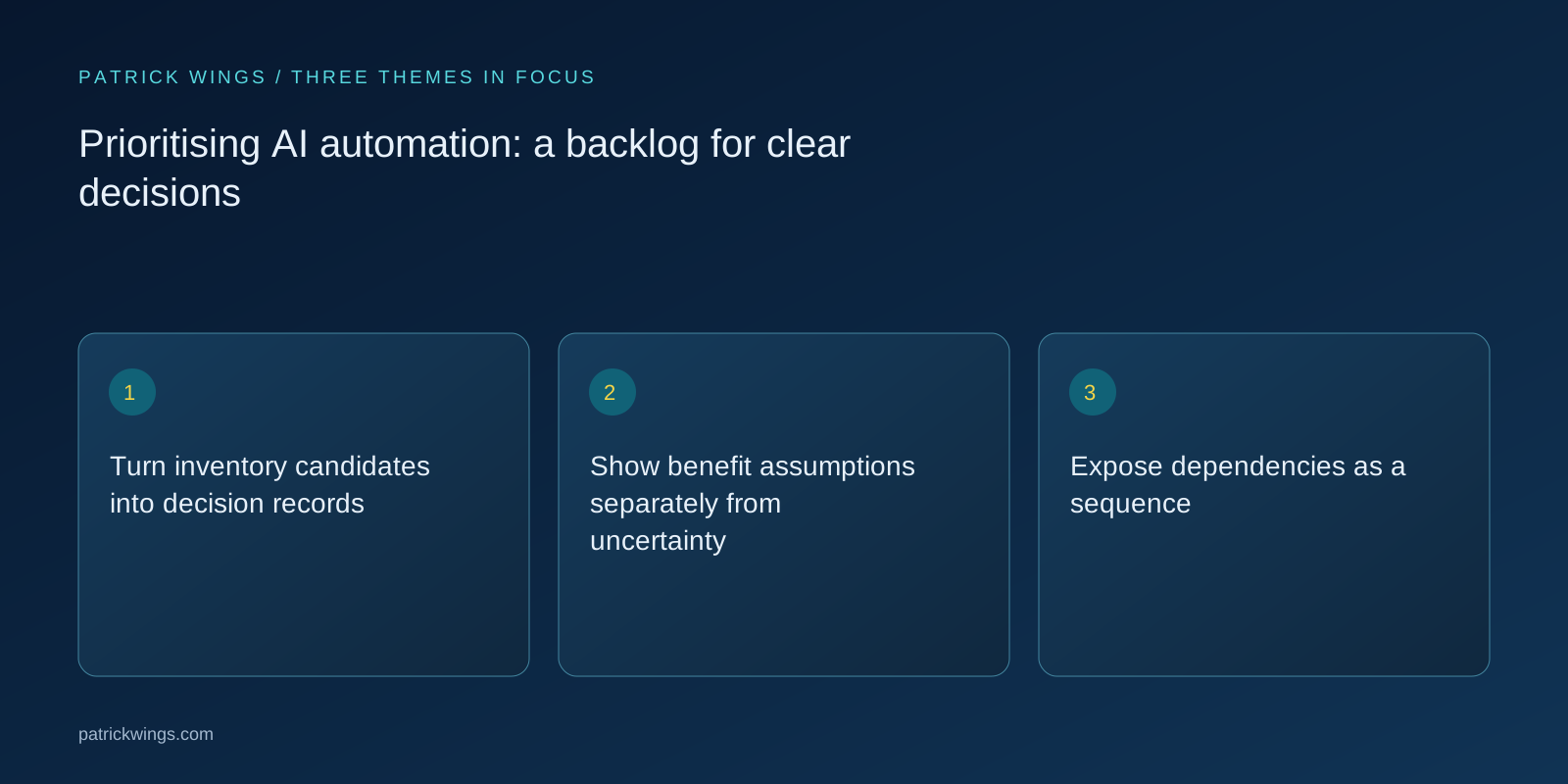
Expose dependencies as a sequence
Show source approvals, input contracts, review criteria and integration work as genuine prerequisites. Two candidates may need the same technical foundation, making a shared preparatory step more useful than separate pilot budgets. Do not confuse shared prerequisites with a mandate to build a large platform first. Identify the smallest workable dependency for the next concrete decision. Also flag initiatives whose value depends on another untested pilot. Those cards should not enter planning simultaneously as independent opportunities when their likely benefits rely on the same unresolved outcome.
Plan capacity for operation and review too
Reserve more than development time. Subject review, support, testing and later source maintenance also require available people. A technically simple candidate can still fail because review capacity is unavailable. Give the sequence a capacity constraint: how many initiatives can the same reviewers genuinely support at once? Establish which current initiative would need to wait if another begins. That makes priority concrete. A backlog that marks everything important and allocates the same people repeatedly describes aspirations rather than a workable plan that the team can actually execute and maintain.

Compare a hypothetical three-item portfolio
Imagine three candidates: research refresh, CRM enrichment and automated reporting. The CRM idea promises substantial value but requires unresolved write permissions. Reporting has stable source data and available reviewers. Research relies on the same experts currently preparing a launch. You start the bounded reporting test, investigate only the CRM permission question in parallel and postpone the research pilot. This order is not a universal ranking of the topics. It follows the current evidence, dependencies and genuinely available capacity of the hypothetical team facing those particular decisions.
Define the next decision for every card
Use states such as missing evidence, blocked prerequisite, test ready, in testing and decision due. A test-ready card needs a bounded scope, an observable assessment result and a stopping criterion. A blocked card instead needs an owner for the missing prerequisite. Set reviewable decision dates rather than arbitrary delivery promises. Record when an initiative should leave the backlog as well. Without that option, old ideas accumulate after their original context disappears, yet continue demanding attention at every review alongside the initiatives that still matter to current business goals. Explore this further in the guide Bounding agents: runtime, tool calls and stopping.
Change the sequence explicitly when evidence changes
Review the backlog after meaningful test results, resource changes or new business priorities. Briefly record why a card rises, falls or ends. Assess whether the previous sequence improved decisions: were critical assumptions resolved early, unnecessary integrations avoided and operating workflows supported reliably? The number of pilots launched is insufficient. A useful backlog reduces concurrent uncertainty and explains deliberate decisions not to start. It helps concentrate limited learning and delivery capacity on the next sensible steps, while preserving the reasoning needed when colleagues later revisit a postponed or rejected candidate.
INTERACTIVE / FROM READING TO ACTION
Three checkpoints for your implementation
Choose a checkpoint and track your reading progress. Checks are neither saved nor sent and do not score your business.
CHECKPOINT 01
Expose dependencies as a sequence
Show source approvals, input contracts, review criteria and integration work as genuine prerequisites.
Explore in the article ↗CHECKPOINT 02
Plan capacity for operation and review too
Reserve more than development time.
Explore in the article ↗CHECKPOINT 03
Compare a hypothetical three-item portfolio
Imagine three candidates: research refresh, CRM enrichment and automated reporting.
Explore in the article ↗Frequently asked questions
Do we need a numerical priority score?
Not necessarily. Visible evidence, dependencies, capacity and a reasoned sequence may be more useful for a small backlog.
How does the backlog differ from inventory?
Inventory describes real processes and candidates. The backlog then decides sequencing, next tests and resource allocation.
What about permanently blocked cards?
Name the missing prerequisite and owner, set a decision date and deliberately remove the card if its value or context no longer holds.
How can I put “Turn inventory candidates into decision records” into practice?
Carry forward the process descriptions, work samples and error consequences already established by the inventory. Do not collect them again in another workshop. Add only information missing for prioritisation: intended outcome contribution, decision owner, next uncertainty and resources required.
What matters when working on “Show benefit assumptions separately from uncertainty”?
Estimate the expected contribution from observed work and expose the range. Substantial possible savings are different from demonstrated value. Microsoft’s strategy guidance connects AI use cases with business problems and expected outcomes.