
THE SHORT ANSWER
AI can make reports easier to read and prepare questions for the next review. Metrics and explanations require different checks. Figures come from defined queries and calculations, while narrative interpretations must refer to those results. Handing over these layers separately helps the team distinguish a measured observation from a proposed cause that has not yet been investigated or established.
To connect individual AI applications with reliable marketing operations, read the pillar guide AI transformation in B2B marketing: from individual prompts to reliable operations.
Define the reporting question before the prose
Establish the decision the report should support. Adjusting a campaign requires different comparisons from planning sales capacity. Name the audience, reporting period and expected action explicitly. Summarising every available metric often produces substantial text without a clear consequence. Agree on a small set of concrete questions, such as which cohort generates fewer qualified conversations at comparable maturity. This wording also establishes which data can remain unavailable and which information is essential before the report can make a defensible statement about performance.
Supply a versioned data package
Pass defined measures, units, periods, filters and retrieval times. The Google Analytics Data API, for example, separates metrics, dimensions and date ranges in a report request. Your internal handoff should also contain definitions and known data gaps. Supply the calculated change rather than asking AI to estimate it from a sprawling table. Keep absolute values visible alongside percentage changes. A formally correct percentage can imply a scale that has little operational importance when the starting quantity is small or the underlying definition has changed.
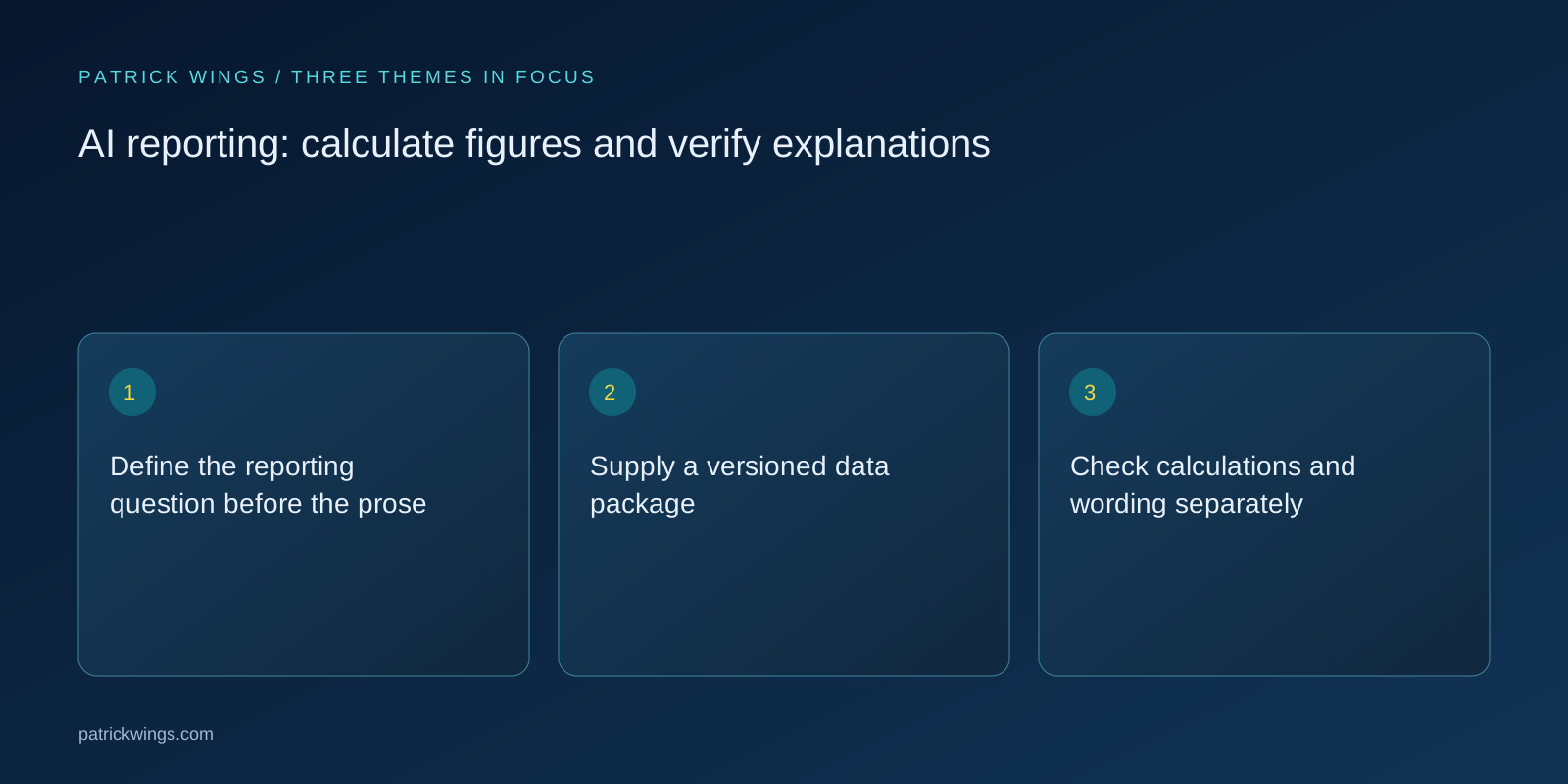
Check calculations and wording separately
Produce totals, ratios and time comparisons through traceable calculations or a reviewed spreadsheet model. AI receives a bounded facts package from which to write. Link every number in the draft to an entry in that package and mark unavailable values. Check rounding and signs as well. A sentence about a falling rate can be wrong despite correct individual numbers when the numerator and denominator use different filters. Narrative review therefore begins only after the comparison definitions have been aligned and the mathematical result can be reproduced independently.
Distinguish observations from possible explanations
The narrative should first describe what was measured. Possible causes and the checks needed to investigate them come afterwards. A new campaign and increased pipeline during the same month do not establish causation. Set an explicit writing rule: hypotheses require labels and must not appear as confirmed drivers. Mention relevant alternatives, including changed data imports or a different cohort mix. A readable report then leads to an investigation rather than prematurely establishing the most convenient story as a conclusion that the data does not actually support. Explore this further in the guide AI for reporting anomalies: turn unusual results into review tasks.

Work through a hypothetical channel example
Imagine qualified enquiries rising from ten to fifteen in one channel while the CRM classification rule also changes. An AI explanation credits the new advertising message. Your facts package, however, includes the rule change as a limitation. The reviewed text describes the observed increase and requests a comparison using an unchanged classification. Only that comparison can usefully support or weaken the campaign hypothesis. These figures are illustrative, not benchmarks, and expose the boundary between a calculated result and an explanation of why the result occurred.
Test drafts with targeted counterexamples
Use test packages containing zeros, unavailable prior periods, small quantities and contradictory trends. Check whether AI preserves caveats or discards them in favour of a smoother story. Ask one reviewer to trace every figure to the data package and another to assess the decision logic. These require different kinds of attention. Repeat important cases after changes to the reporting template or data model. Success means more than producing one good paragraph: it includes reliably avoiding misleading explanations when inputs make a confident narrative especially tempting.
Finish with a reviewable work assignment
Every material observation needs an appropriate consequence: inspect data, investigate a hypothesis or deliberately continue monitoring. Name the owner, comparison required and expected decision point. Optimise the channel is not an executable assignment. Retain the facts package beside the approved narrative so later corrections remain traceable. The value of AI reporting lies in decisions that become easier to understand and check. An impressive volume of automatically generated paragraphs says little about whether the team acts more precisely after the review or understands the limits of the evidence. Explore this further in the guide Measuring B2B marketing: from channel metrics to pipeline decisions.
INTERACTIVE / FROM READING TO ACTION
Three checkpoints for your implementation
Choose a checkpoint and track your reading progress. Checks are neither saved nor sent and do not score your business.
CHECKPOINT 01
Check calculations and wording separately
Produce totals, ratios and time comparisons through traceable calculations or a reviewed spreadsheet model.
Explore in the article ↗CHECKPOINT 02
Distinguish observations from possible explanations
The narrative should first describe what was measured.
Explore in the article ↗CHECKPOINT 03
Work through a hypothetical channel example
Imagine qualified enquiries rising from ten to fifteen in one channel while the CRM classification rule also changes.
Explore in the article ↗Frequently asked questions
Should AI calculate the metrics itself?
For recurring reports, traceable calculations should supply the figures. AI writes from the checked facts package.
How should missing prior periods be handled?
Mark them unavailable. Missing values are neither zero nor evidence of growth.
Can the report explain causes?
State confirmed causes only with supporting evidence. Label other explanations as hypotheses with a concrete investigation task.
How can I put “Define the reporting question before the prose” into practice?
Establish the decision the report should support. Adjusting a campaign requires different comparisons from planning sales capacity. Name the audience, reporting period and expected action explicitly.
What matters when working on “Supply a versioned data package”?
Pass defined measures, units, periods, filters and retrieval times. The Google Analytics Data API, for example, separates metrics, dimensions and date ranges in a report request. Your internal handoff should also contain definitions and known data gaps.