
THE SHORT ANSWER
Bound agents with enforceable runtime, tool-use and effort budgets plus explicit business stopping conditions. A budget is not a quality guarantee. It prevents indefinite work when information is missing or attempts stop producing progress. Also design a usable handoff of partial results so a controlled stop does not discard every confirmed outcome or conceal operations that may still be running elsewhere.
To connect individual AI applications with reliable marketing operations, read the pillar guide AI transformation in B2B marketing: from individual prompts to reliable operations.
Derive limits from the task and consequences
An internal research draft needs different boundaries from a time-critical data check. State when the result is needed, which costs are acceptable and which actions remain permitted. Use several limits: maximum runtime does not necessarily limit parallel requests, while a cost cap does not bound waiting on a blocked tool. Record business prerequisites separately. If a decisive source is unavailable, another writing attempt may be pointless even with budget left. The process should report the missing prerequisite instead of treating unused budget as an instruction to continue regardless of usefulness.
Count effort where it actually occurs
Track model calls, tool requests and active subtasks at the level of the overall work order. Starting a subprocess must not quietly create a fresh unrestricted budget. State which costs are estimated and which are reported by the service. Where appropriate, reserve some capacity for status checks and a closing handoff. Otherwise a hard limit may arrive before the process can preserve its latest results. For external tools, determine whether cancellation merely stops waiting or also stops the operation already submitted to the destination. Those are materially different outcomes for subsequent recovery.
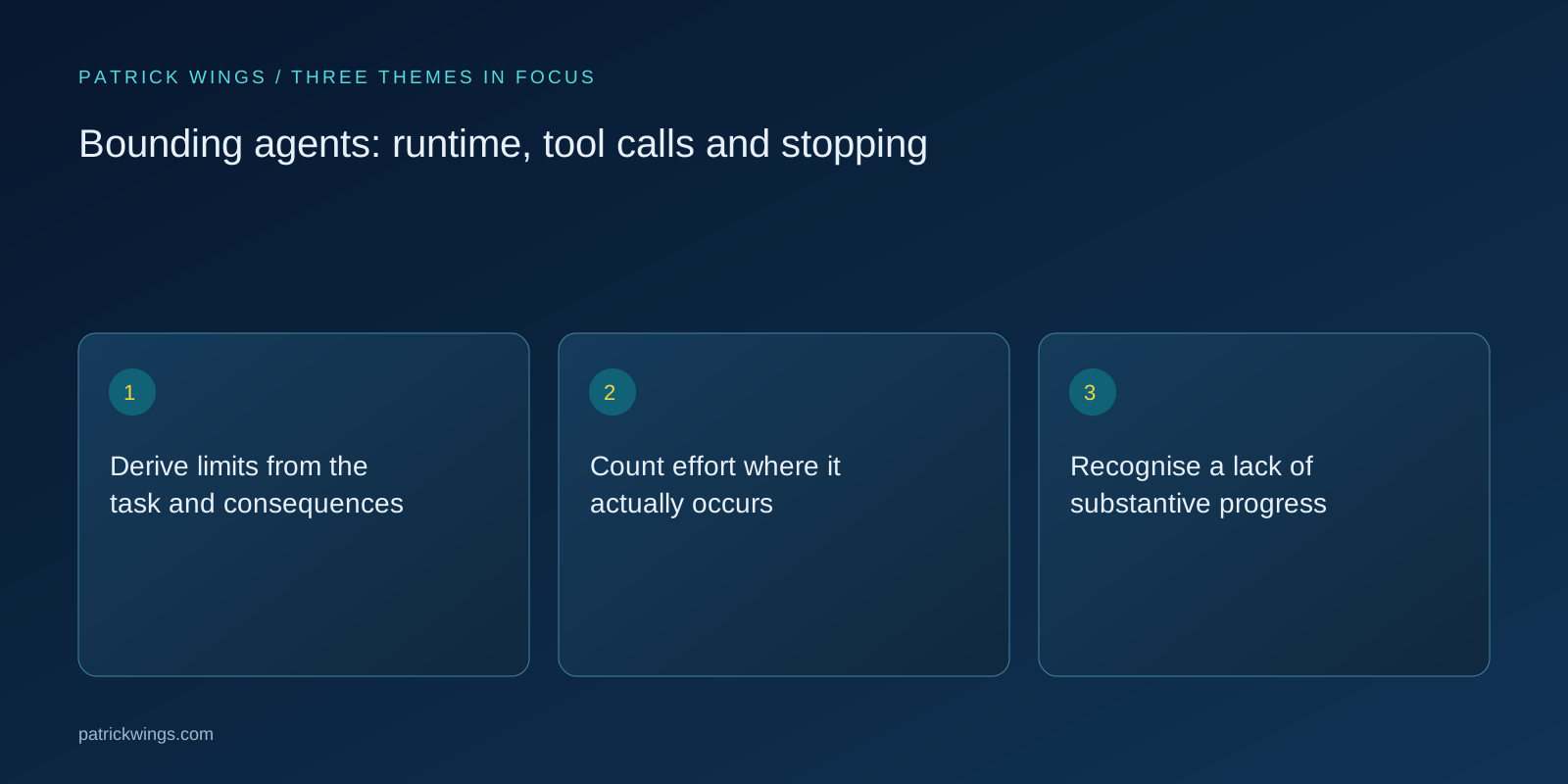
Recognise a lack of substantive progress
Repeated similar searches are not automatically progress. Define observable signs such as new relevant evidence, resolved contradictions or confirmed intermediate outputs. If several attempts produce the same inadequate information, the process needs another route or clarification. Do not rely only on the agent’s own claim that it is nearly finished. Inspect the actual work products. A fixed cap can constrain endless loops; a business-level progress check additionally prevents the agent from consuming its whole permitted budget without useful improvement. Record why further work would change the result before allowing an extension. Explore this further in the guide Recording agent state: what has actually been completed?.
Specify a controlled stopping handoff
A stop report should contain confirmed results, remaining gaps, actions already executed and the stopping reason. Distinguish budget exhaustion from missing permission, inadequate sources and technical failure. Each calls for a different next step. A person should be able to narrow the request, supply information or deliberately authorise more effort. Do not automatically increase limits after every unsuccessful run. Otherwise a boundary becomes a temporary notice while the original cause of limited progress or an unclear task persists. Preserve enough context for a decision without dumping every intermediate message into the handoff.

Consider an explicitly hypothetical research task
A fictional agent must answer three competitor questions using official sources. In this hypothetical design, the team permits twelve search calls and a bounded runtime. After eight searches, two questions are supported but the third has no reliable public answer. The agent records that limitation and stops instead of inventing an answer or necessarily consuming the remaining requests. These limits are illustrative design values, not recommended defaults. Other tasks may need substantially different effort and review conditions. The important behaviour is recognising the source boundary and returning usable supported work without overstating completeness. Explore this further in the guide AI agents in marketing: which tasks can be bounded usefully.
Test boundaries and their side effects
Create controlled cases that stop at each boundary: during search, before a change and after an ambiguous tool response. Check that active operations remain visible and the handoff makes no false completion claim. Test nested tasks, concurrent calls and later resumption as well. Professional acceptance should confirm that partial results are usable and unresolved issues are clear. Monitor which limits are frequently reached in production. Repeated stopping may mean budgets are too tight, but it can also reveal poor inputs, unsuitable tools or an unnecessarily open-ended instruction that more spending will not repair.
INTERACTIVE / FROM READING TO ACTION
Three checkpoints for your implementation
Choose a checkpoint and track your reading progress. Checks are neither saved nor sent and do not score your business.
CHECKPOINT 01
Recognise a lack of substantive progress
Repeated similar searches are not automatically progress.
Explore in the article ↗CHECKPOINT 02
Specify a controlled stopping handoff
A stop report should contain confirmed results, remaining gaps, actions already executed and the stopping reason.
Explore in the article ↗CHECKPOINT 03
Consider an explicitly hypothetical research task
A fictional agent must answer three competitor questions using official sources.
Explore in the article ↗Frequently asked questions
What default budget is appropriate?
There is no universal value. Derive limits from the task, cost, deadline and consequences of failure.
Should an agent always use its full budget?
No. It should stop earlier when the result is sufficient or a business prerequisite blocks progress.
Does cancellation stop external operations?
That depends on the integration and must be explicitly tested and documented.
How can I put “Derive limits from the task and consequences” into practice?
An internal research draft needs different boundaries from a time-critical data check. State when the result is needed, which costs are acceptable and which actions remain permitted. Use several limits: maximum runtime does not necessarily limit parallel requests, while a cost cap does not bound waiting on a blocked tool.
What matters when working on “Count effort where it actually occurs”?
Track model calls, tool requests and active subtasks at the level of the overall work order. Starting a subprocess must not quietly create a fresh unrestricted budget. State which costs are estimated and which are reported by the service.