
THE SHORT ANSWER
An unusual figure is initially a reason to investigate. It may reflect a business change, delayed data or simply small quantities. AI can gather context and formulate a clear review task. Establishing the cause and deciding how to respond requires dependable data, an appropriate comparison and somebody who will actually investigate the observation rather than merely acknowledge an alert.
To connect individual AI applications with reliable marketing operations, read the pillar guide AI transformation in B2B marketing: from individual prompts to reliable operations.
Assess unusualness and business significance separately
First define which deviation could justify action. An unfamiliar value may be statistically unusual but commercially unimportant. A small shift in a critical handoff may deserve attention. For every metric, identify the affected process and possible consequence. Connect a notification to a responsible reviewer. Without these boundaries, unusual numbers accumulate faster than the team can investigate them meaningfully. Selection should protect decisions rather than maximise the number of patterns displayed. It should also recognise that the same numerical change can matter differently across stages of a buying process.
Account for comparison periods and data maturity
Compare similar weekdays, campaign phases and maturity levels where they matter. Fresh pipeline data is only partly comparable with a fully qualified earlier period. Label data snapshots and expected late arrivals. Check whether filters, event definitions or CRM stages changed between periods. If the comparison is unstable, the first task is to establish coverage. A sophisticated explanation of possible market causes is premature at that point and may conceal a technical or organisational change in the measurement process itself rather than any change in buyer behaviour.
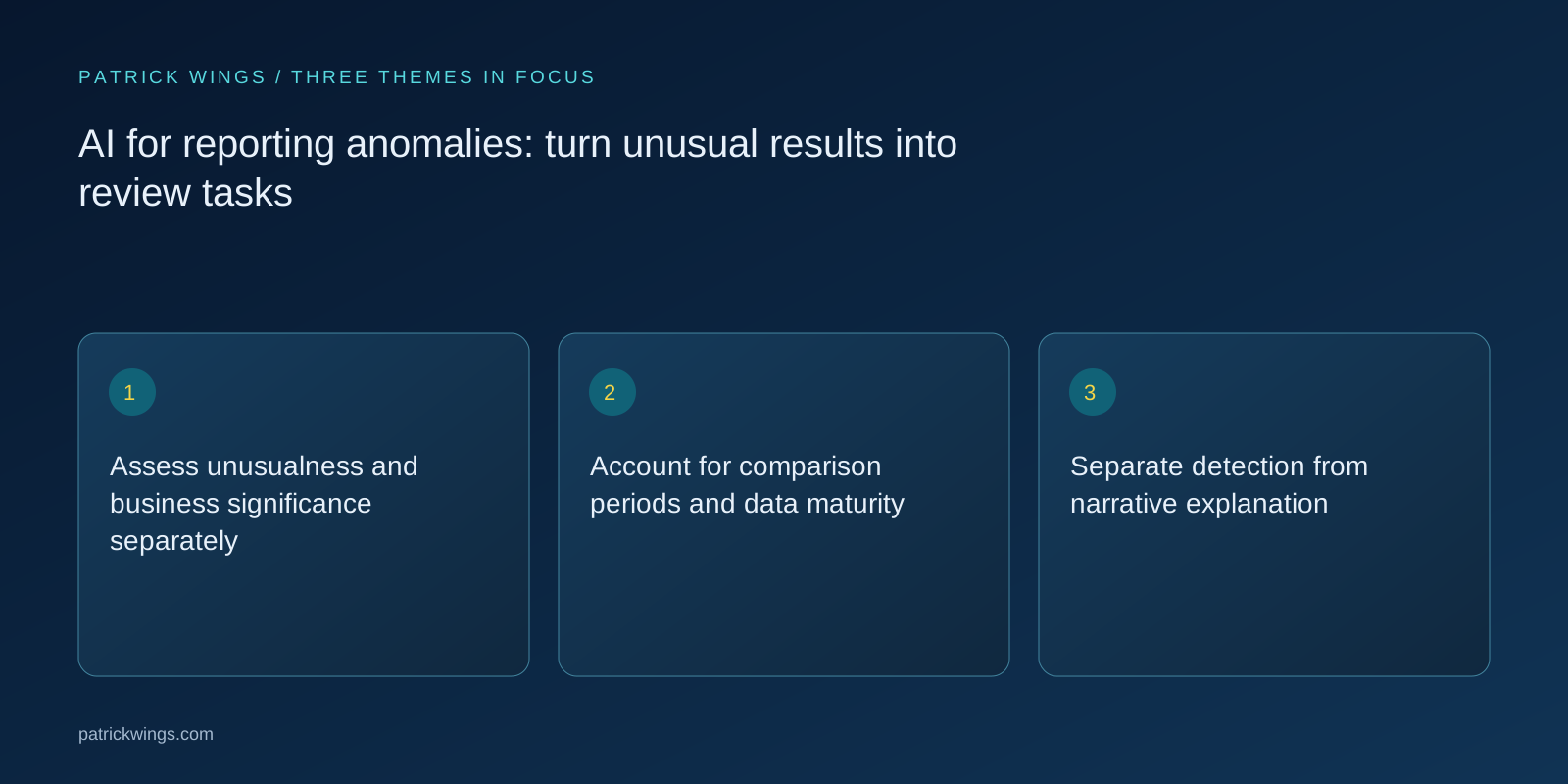
Separate detection from narrative explanation
A traceable rule or appropriate analytical method should determine which values are unusual. AI receives the value, reference, period and known caveats for description. Supply documented changes too, such as an import replacement or a campaign pause. It may formulate investigation paths but should not invent a cause. Google SRE distinguishes alert precision and detection time, among other attributes. For marketing reporting, this suggests asking which important cases you detect promptly and how much unnecessary review effort those detection rules create for colleagues. Explore this further in the guide AI reporting: calculate figures and verify explanations.
Start by checking the data
Check completeness, freshness, duplicate events and unexpected zeros before suggesting operational changes. Where useful, compare the unusual metric with an independent control measure. A falling form-event count with unchanged CRM enquiries could indicate an instrumentation problem. Document the investigation order and stopping conditions. When a known data defect explains the finding, the agent should not generate an additional campaign-optimisation task. If the checks reveal no defect, pass the business investigation forward together with the results already established, so the next owner does not repeat the same preliminary work.

Interpret a hypothetical weekend example
Imagine a daily report showing substantially fewer qualified leads on Sunday. Its automatic explanation blames weak advertising creative. In reality, your team qualifies enquiries on the next working day. The comparison measures a delay in status transitions. You adjust the review time and comparison logic instead of changing campaigns prematurely. If incoming enquiries and available CRM data also fell unusually, a different investigation would be appropriate. This example shows why several process stages should be considered together before treating one metric as evidence of a commercial problem.
Design notifications as investigable assignments
A useful notification states the observation, the meaning of the comparison and the next bounded test. Add an owner, urgency and the information that should be returned after checking. Distinguish an immediate interruption from an item for the next review. Combine connected deviations into one investigation where possible, so a single data defect does not occupy several teams independently. Give AI a clear rule for unresolved cases: document uncertainty and escalate specifically, rather than presenting a broad recommendation as though it already solves the underlying issue. Explore this further in the guide Routing AI tasks: send uncertain cases to the right place.
Review detection against confirmed cases
Build a historical collection of confirmed data defects, genuine business changes and harmless fluctuations. Check which cases are found in time and which notifications generate unnecessary work. Add the confirmed outcome and the genuinely useful follow-up after each investigation. Changes to thresholds or templates should be checked against this collection again. Assess handling time and missed critical cases as well. The number of warnings sent indicates activity only; their value lies in earlier, better-supported decisions about actual problems, with enough context for the responsible person to act.
INTERACTIVE / FROM READING TO ACTION
Three checkpoints for your implementation
Choose a checkpoint and track your reading progress. Checks are neither saved nor sent and do not score your business.
CHECKPOINT 01
Separate detection from narrative explanation
A traceable rule or appropriate analytical method should determine which values are unusual.
Explore in the article ↗CHECKPOINT 02
Start by checking the data
Check completeness, freshness, duplicate events and unexpected zeros before suggesting operational changes.
Explore in the article ↗CHECKPOINT 03
Interpret a hypothetical weekend example
Imagine a daily report showing substantially fewer qualified leads on Sunday.
Explore in the article ↗Frequently asked questions
Is an anomaly already an error?
No. It is unusual relative to a chosen reference. Investigation establishes its meaning and cause.
Should AI change campaigns after every alert?
No. Separate detection, investigation and approved response. Check data defects before business conclusions.
How should thresholds be chosen?
Use historical cases, review capacity and the consequences of missed events. One percentage threshold rarely suits every metric.
How can I put “Assess unusualness and business significance separately” into practice?
First define which deviation could justify action. An unfamiliar value may be statistically unusual but commercially unimportant. A small shift in a critical handoff may deserve attention.
What matters when working on “Account for comparison periods and data maturity”?
Compare similar weekdays, campaign phases and maturity levels where they matter. Fresh pipeline data is only partly comparable with a fully qualified earlier period. Label data snapshots and expected late arrivals.