
THE SHORT ANSWER
AI readiness does not mean every employee already knows every tool. It means your team can responsibly test AI for a specific task and assess the result. Rather than an abstract maturity label, you need understandable answers to a few foundational questions. Those answers become a preparation plan that removes obstacles and identifies suitable pilot projects.
To connect individual AI applications with reliable marketing operations, read the pillar guide AI transformation in B2B marketing: from individual prompts to reliable operations.
Describe the process as it currently operates
Choose a concrete task such as producing a webinar brief. Record who provides information, which files are used, what checks take place and where clarification becomes necessary. Describe actual work rather than an idealised diagram. If nobody knows who approves a product claim, AI will not resolve that ownership issue. A simple process log with real examples is sufficient initially. It should reveal waiting, searching and rework, and distinguish which of those problems an AI-assisted approach could realistically influence. Explore this further in the guide AI workflow automation: clarify the process before connecting tools.
Check the reliability of your knowledge sources
Do you have approved descriptions of the product and its limitations? Are target customers, service scope and current claims documented somewhere dependable? Contradictory presentations will also produce contradictory AI drafts. Assign an authoritative source and subject owner to important information. You do not have to clean every company file before starting. A pilot does need a bounded collection whose accuracy and freshness someone owns. Explicitly identify materials that should not yet be used, rather than assuming the system will recognise which slide deck is obsolete.
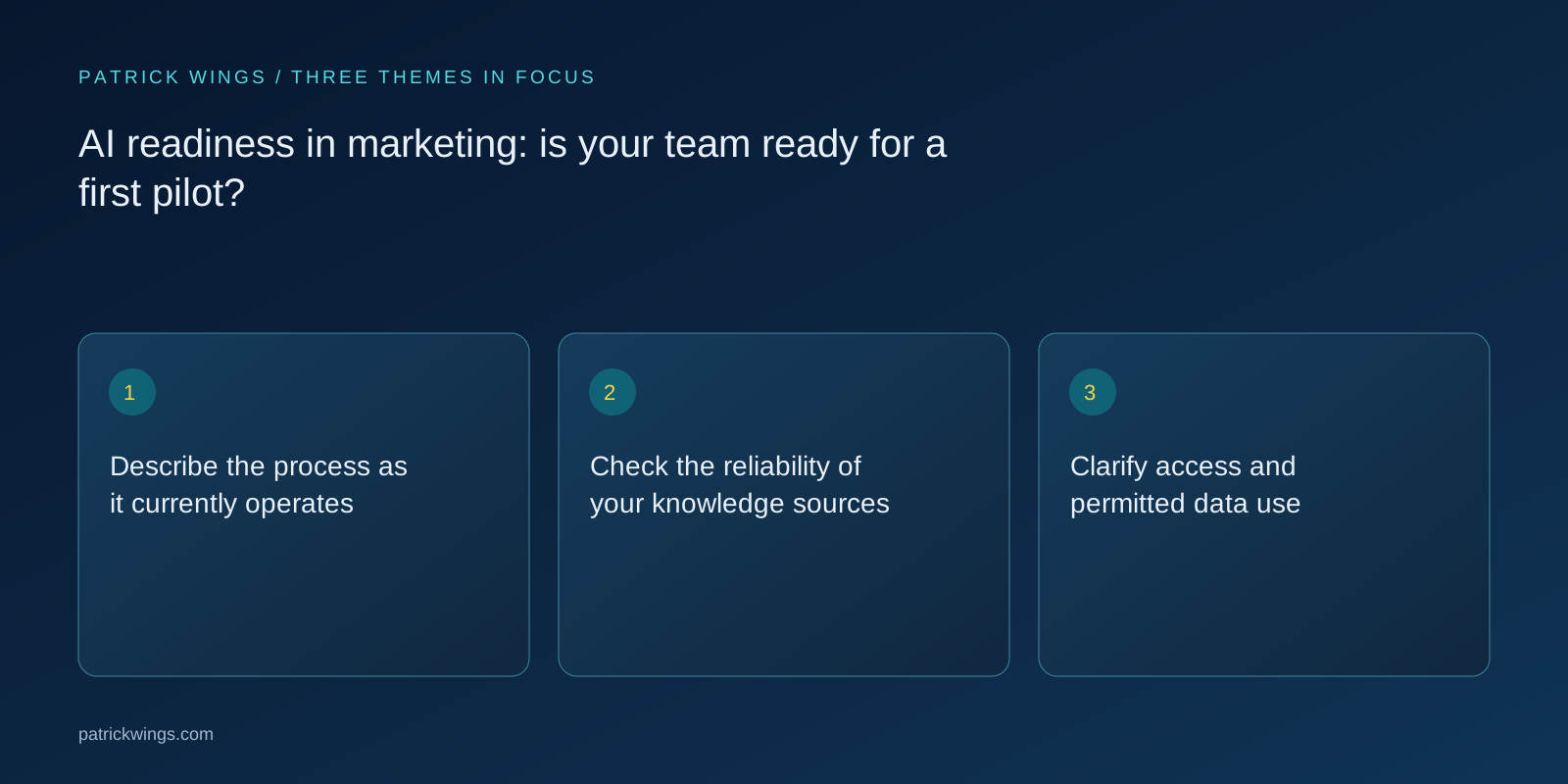
Clarify access and permitted data use
List the data the task actually needs. Distinguish public information, internal working material and sensitive content. Ask the appropriate owners which environment is approved and what permissions are necessary. A vendor’s general business-data statement does not replace this assessment. Initial tests can use synthetic or anonymised examples when appropriate. Make sure the substitution does not remove every meaningful difficulty. Testing on perfectly prepared fictional data reveals little about how the process will handle the inconsistent documents your team encounters in ordinary work.
Assess whether people can recognise acceptable results
The team does not need to develop models, but it should recognise factual errors, missing evidence and unsuitable conclusions. Ask colleagues to assess an example draft against explicit criteria. Can they explain what needs changing and why? If evaluation depends only on whether the prose sounds good, shared quality standards may be missing. Create a short review aid covering accuracy, audience fit and permitted claims. Training then closes a visible skill gap instead of delivering a generic tour of software features that may not matter to the task. Explore this further in the guide Choosing marketing AI tools: compare against the task you actually need.

Make ownership and effort explicit
Name a pilot owner, a subject reviewer and a contact for technical problems. Decide who can change instructions and knowledge sources. Reserve time for testing and evaluation. A pilot handled informally without ownership rarely produces a clear decision. Include questions from colleagues and necessary rework in the plan. Readiness includes the ability to allocate that effort. Buying licences alone does not establish that the team can adopt a new process, maintain it or investigate problems when an output looks convincing but is factually wrong.
Produce a small preparation plan
Turn each obstacle into an executable task: reconcile product information, define the permitted dataset, test review criteria or appoint a process owner. Prioritise prerequisites for the chosen pilot and postpone unrelated transformation projects. Give each task an owner and an observable completion criterion. Then decide whether the pilot can start or whether a simpler task would be preferable. The value of the assessment lies in that decision. Three specific gaps resolved are more useful than an impressive readiness score that changes nothing about how work will be carried out.
INTERACTIVE / FROM READING TO ACTION
Three checkpoints for your implementation
Choose a checkpoint and track your reading progress. Checks are neither saved nor sent and do not score your business.
CHECKPOINT 01
Clarify access and permitted data use
List the data the task actually needs.
Explore in the article ↗CHECKPOINT 02
Assess whether people can recognise acceptable results
The team does not need to develop models, but it should recognise factual errors, missing evidence and unsuitable conclusions.
Explore in the article ↗CHECKPOINT 03
Make ownership and effort explicit
Name a pilot owner, a subject reviewer and a contact for technical problems.
Explore in the article ↗Frequently asked questions
Do we need perfect data before a pilot?
No. A bounded collection with clear ownership may be enough, but the information essential to the task must be dependable.
Who should participate in the assessment?
The process owner, subject users and, where necessary, IT or the relevant data owners. The task determines the group.
How long does an assessment take?
That depends on scope. Start with one task and explicit deliverables rather than trying to score the whole company immediately.
How can I put “Describe the process as it currently operates” into practice?
Choose a concrete task such as producing a webinar brief. Record who provides information, which files are used, what checks take place and where clarification becomes necessary. Describe actual work rather than an idealised diagram.
What matters when working on “Check the reliability of your knowledge sources”?
Do you have approved descriptions of the product and its limitations? Are target customers, service scope and current claims documented somewhere dependable? Contradictory presentations will also produce contradictory AI drafts.