
THE SHORT ANSWER
Ongoing market research should identify relevant changes without generating the same summary every week. That requires a documented baseline and a clear definition of what might have changed. AI can sort potential differences. Establishing whether a difference represents a new market condition, an editorial adjustment or a retrieval failure requires a separate verification step.
To connect individual AI applications with reliable marketing operations, read the pillar guide AI transformation in B2B marketing: from individual prompts to reliable operations.
Store the baseline as verifiable claims
Start with individual claims rather than a long competitor profile. Each claim needs an organisation, subject, scope, source and review date. One claim might say that a particular integration is available only in a named package. Retain the evidence actually read and its surrounding context. Without that baseline, you may compare two differently worded summaries even though the offer has not changed. Mark uncertain claims in the existing record so another uncertain observation cannot accidentally become a confirmed development. Explore this further in the guide Sources in AI answers: verify evidence claim by claim.
Observe sources according to how they change
A pricing page, product documentation and a corporate announcement serve different purposes. Avoid imposing the same review schedule on every source. Time-sensitive offer questions may justify frequent checks, while foundational material needs less attention. Record sources that cannot provide a dependable signal because access is restricted or updates are irregular. A temporarily unavailable source does not demonstrate that a feature has been discontinued. Separate source availability from the state of the offer under investigation and expose both in the change log.
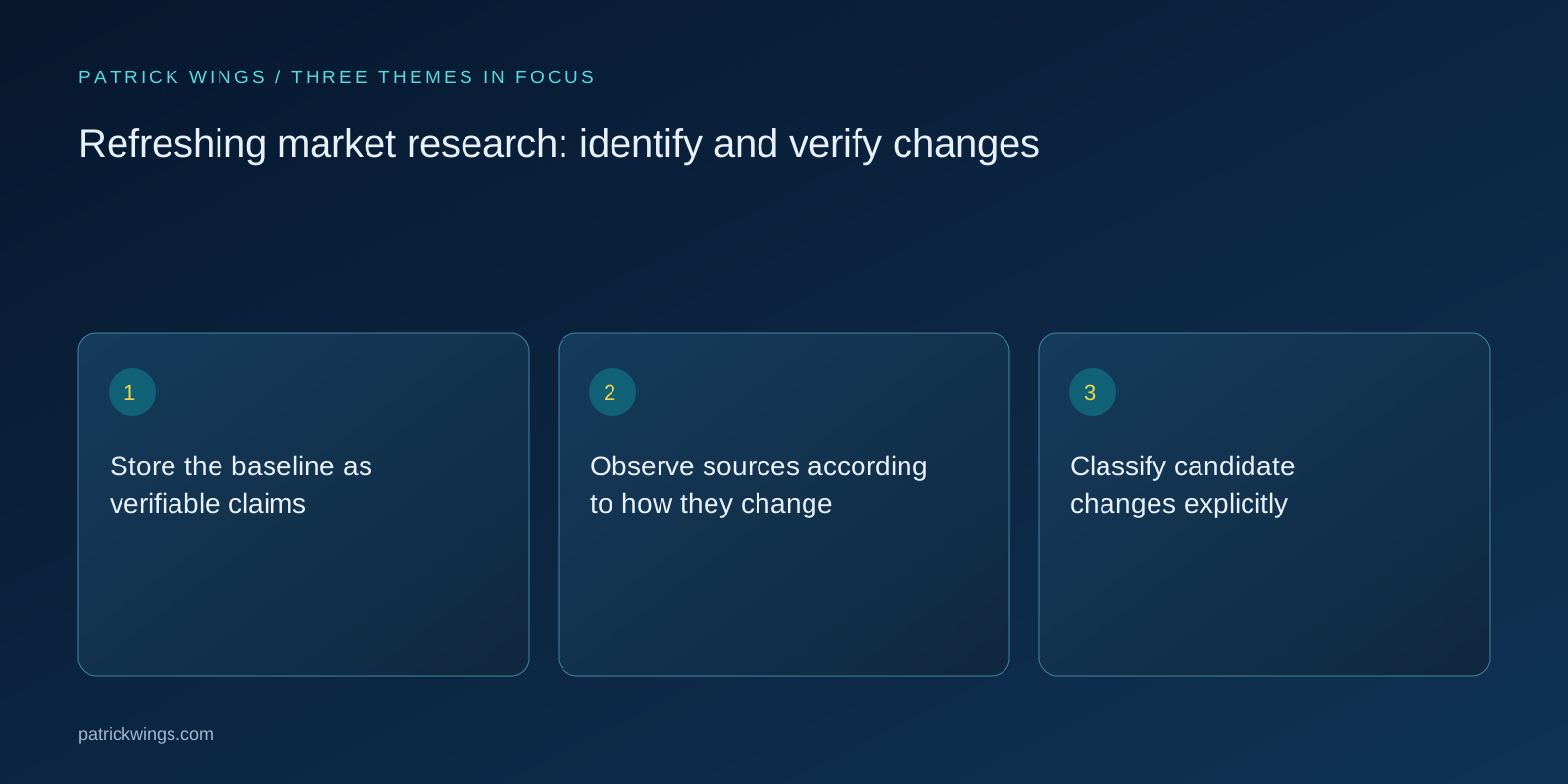
Classify candidate changes explicitly
Ask AI to flag candidates first: a new claim, a removed claim, changed scope, conflicting information or unchanged meaning with different wording. Include the previous and current evidence for every candidate. A general novelty score hides the comparison you need to inspect. Check prerequisites and exceptions as well. An apparently unchanged feature description may mean something different after a regional restriction is added. When context is unavailable, leave the candidate unresolved rather than automatically inserting it into the market overview.
Check the significance of confirmed findings
Assess confirmed changes against the decision your team actually faces. A changed comparison claim may require an updated sales asset. A new integration description does not automatically justify repositioning the whole product. Name the affected assumption and the information still missing. Distinguish announcement date, observation date and actual availability, since these can differ. The working record should show what can safely be revised and which interpretation remains a reasonable question for further investigation rather than an established market conclusion.

Work through a hypothetical package example
Imagine a SaaS supplier whose public overview suddenly lists an additional connector. The agent reports a new standard feature. Detailed documentation reveals that the connector requires separate approval for selected customers. You revise the change record to limited availability and add the source supporting that condition. The appropriate consequence is a more precise comparison note. This example shows why a visible text change, an underlying product change and its strategic significance deserve three separate checks in the research workflow.
Test detection against known changes
Build a small test collection from previous source versions. Include genuine scope changes, layout-only updates, removed pages and conflicting dates. Assess which relevant changes are missed and how many unnecessary review tasks are generated. Anthropic discusses separate groundedness and coverage checks for research agents; your process particularly needs a traceable evidence chain. A useful test also requires unchanged facts to remain unchanged. Otherwise an apparently diligent research process mostly creates extra editorial work without improving understanding of the competitive situation. Explore this further in the guide Conflicting AI sources: authority before majority opinion.
Hand over change decisions with ownership
Every confirmed finding needs a responsible recipient and a concrete consequence: update a comparison, revisit an assumption or deliberately leave things unchanged. Retain the earlier statement alongside the new version so colleagues can reconstruct when a recommendation was valid. Provide a status for unresolved conflicts and a date for checking them again. The purpose of refresh work is better decisions about offers and communication, rather than the longest possible list of apparent developments produced by each research run.
INTERACTIVE / FROM READING TO ACTION
Three checkpoints for your implementation
Choose a checkpoint and track your reading progress. Checks are neither saved nor sent and do not score your business.
CHECKPOINT 01
Classify candidate changes explicitly
Ask AI to flag candidates first: a new claim, a removed claim, changed scope, conflicting information or unchanged meaning with different wording.
Explore in the article ↗CHECKPOINT 02
Check the significance of confirmed findings
Assess confirmed changes against the decision your team actually faces.
Explore in the article ↗CHECKPOINT 03
Work through a hypothetical package example
Imagine a SaaS supplier whose public overview suddenly lists an additional connector.
Explore in the article ↗Frequently asked questions
How often should sources be checked?
Use decision relevance and expected change frequency. A daily sweep is rarely appropriate for every source.
Does a removed page mean a product changed?
No. Check redirects, replacement documentation and confirmed availability before drawing product conclusions.
Can AI update comparisons directly?
Start with evidenced change proposals. Published claims still need the subject review defined for your workflow.
How can I put “Store the baseline as verifiable claims” into practice?
Start with individual claims rather than a long competitor profile. Each claim needs an organisation, subject, scope, source and review date. One claim might say that a particular integration is available only in a named package.
What matters when working on “Observe sources according to how they change”?
A pricing page, product documentation and a corporate announcement serve different purposes. Avoid imposing the same review schedule on every source. Time-sensitive offer questions may justify frequent checks, while foundational material needs less attention.