
THE SHORT ANSWER
AI can organise interview material and make relevant passages easier to find. It does not automatically understand the full conversation context or the limits of your sample. Dependable analysis therefore preserves the relationship between statements, observations and interpretation. Use assistance to create a reviewable working record, then decide together which conclusions the interviews can actually support.
To connect individual AI applications with reliable marketing operations, read the pillar guide AI transformation in B2B marketing: from individual prompts to reliable operations.
Define the analysis assignment before summarising
Describe the decision the interviews should inform. Assessing comprehension of a value proposition requires different categories from investigating failed implementations. State which questions the material cannot answer. If you interviewed only existing customers, broad claims about non-buyers are unsupported. Put that limit in the assignment. Give AI a bounded coding framework while leaving room for unexpected observations, so new findings are not forced into predetermined answers. The framework should help reviewers examine the material rather than dictate what they are supposed to find. Explore this further in the guide Sources in AI answers: verify evidence claim by claim.
Treat transcripts as fallible working sources
Label speakers, conversation segments and uncertain passages. An automatic transcript can confuse technical terms or misrepresent a negative statement. Check passages on which important conclusions depend. Process only material approved for analysis and remove identifying information that the task does not need. A pseudonymous interview code is often sufficient for comparison. Retain the original connection where authorised reviewers need it. This keeps the statement verifiable without distributing every participant detail to everyone who works with the findings or reads the summary.
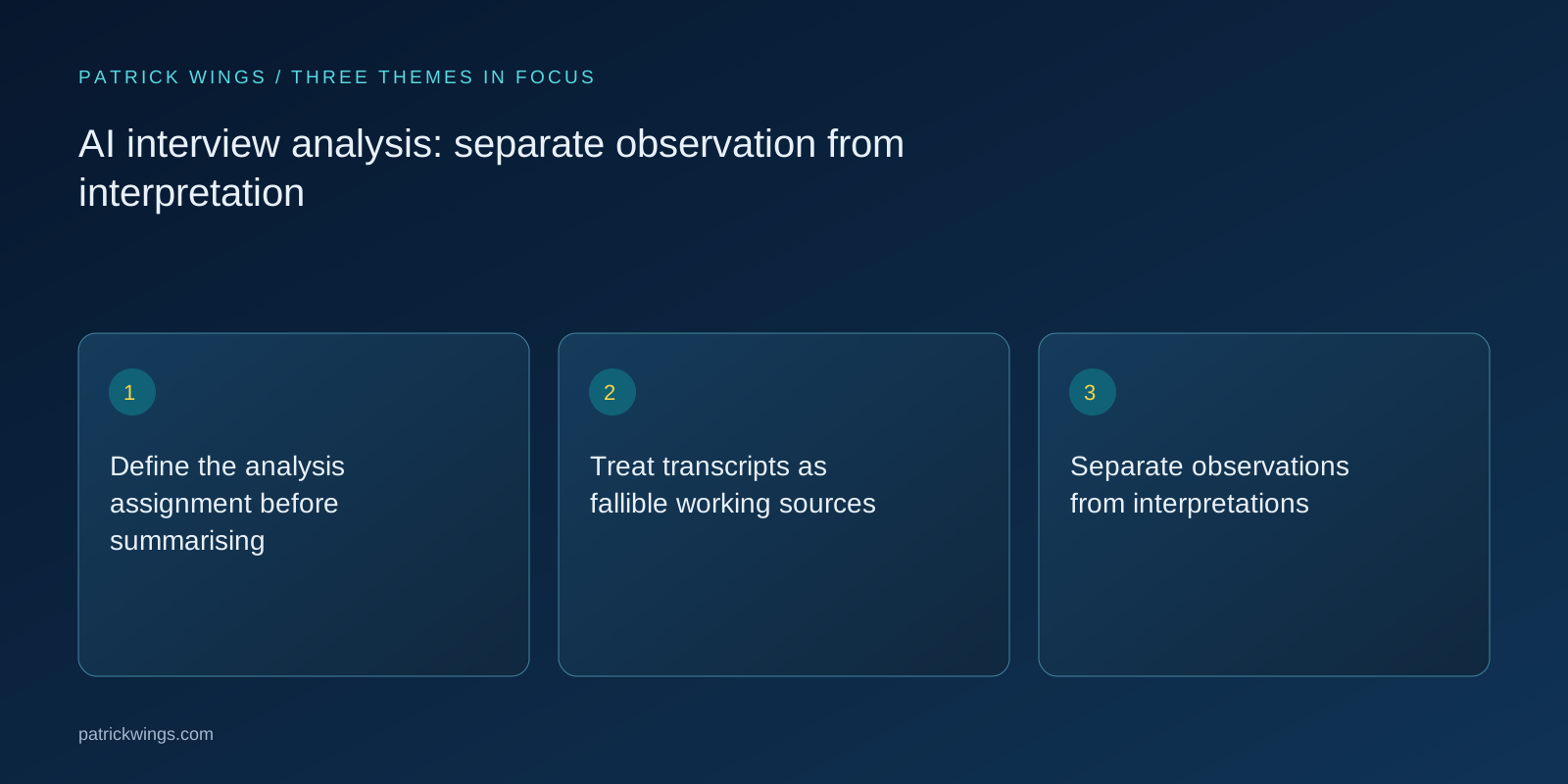
Separate observations from interpretations
Require a narrowly framed observation and a separate possible interpretation for each passage. The GOV.UK research-analysis guidance distinguishes observed material, findings and subsequent actions. That separation provides a useful structure for an AI-assisted process. A statement about a lengthy approval route is initially a reported experience. Concluding that product positioning is unclear is already an interpretation. Link interpretations to specific passages and include alternative explanations where the material permits different readings. Avoid allowing fluent prose to conceal a jump from what was said to what the team believes. Explore this further in the guide SME interviews that turn expertise into useful editorial material.
Build patterns without false precision
Similar statements can arise in different situations. Describe patterns alongside role, buying context and the task affected. Several statements from one person are not independent evidence from several customers. If counting helps, count affected interviews rather than raw mentions and show the denominator. A small qualitative sample does not justify a general market percentage. Recurrence across different contexts and the existence of counterexamples are often more useful. Keep contradictory experiences visible rather than removing them as inconvenient outliers from a tidy executive summary.

Unpack a hypothetical integration problem
Suppose one participant says implementation was delayed because a connector was unavailable. Another says nobody internally had time to approve data access. A broad AI summary labels both weak technical onboarding. Instead, distinguish a product gap from an organisational prerequisite. The first observation leads to a product investigation; the second suggests better implementation preparation. Implementation barriers remain the shared theme. Its subdivision prevents a broad recommendation from obscuring the different underlying causes, owners and next actions that the actual interviews suggest.
Test analysis on difficult passages
Ask two subject reviewers to examine selected passages independently. Compare the observation each records, the context they need and where interpretations diverge. Then run the same passages through the AI-assisted method. Irony, retrospective accounts, contradictions and long answers covering several topics are especially useful. Do not assess only whether the summary reads pleasantly. Check attribution, missing counterevidence and whether each important finding can be traced back. Refine the coding framework before applying it to the full interview collection and sharing its conclusions with decision makers.
Translate findings into bounded next steps
Analysis should end with a defensible decision or a more precise open question. Document which change you intend to test and the observations supporting it. A messaging hypothesis may justify a comprehension test without establishing a need for complete repositioning. Name an owner and identify the additional evidence needed for a larger decision. Retain rejected interpretations with a brief reason. That record helps colleagues distinguish what originated in the conversation from what the team developed during analysis, and makes later disagreements easier to investigate constructively.
INTERACTIVE / FROM READING TO ACTION
Three checkpoints for your implementation
Choose a checkpoint and track your reading progress. Checks are neither saved nor sent and do not score your business.
CHECKPOINT 01
Separate observations from interpretations
Require a narrowly framed observation and a separate possible interpretation for each passage.
Explore in the article ↗CHECKPOINT 02
Build patterns without false precision
Similar statements can arise in different situations.
Explore in the article ↗CHECKPOINT 03
Unpack a hypothetical integration problem
Suppose one participant says implementation was delayed because a connector was unavailable.
Explore in the article ↗Frequently asked questions
Can AI analyse qualitative interviews completely?
It can prepare analysis. Context, counterexamples and the significance of conclusions need subject review.
Can we report frequencies?
Yes, with a clear unit and denominator. Mentions are not market shares, and multiple statements from one person are not independent cases.
What if the transcript is unclear?
Mark the passage uncertain and check the approved original. Unclear wording should not support a confident conclusion.
How can I put “Define the analysis assignment before summarising” into practice?
Describe the decision the interviews should inform. Assessing comprehension of a value proposition requires different categories from investigating failed implementations. State which questions the material cannot answer.
What matters when working on “Treat transcripts as fallible working sources”?
Label speakers, conversation segments and uncertain passages. An automatic transcript can confuse technical terms or misrepresent a negative statement. Check passages on which important conclusions depend.