
THE SHORT ANSWER
A useful research-agent brief states the decision to support, separates the questions and defines acceptable evidence. It also establishes where the agent may search, when to stop and which uncertainty must remain visible. This turns a broad subject into an assignment that someone can review. The structure below is a practical proposal for marketing teams. It does not guarantee exhaustive coverage or replace professional review of important claims, but it makes omissions and unsupported conclusions easier to detect.
To connect individual AI applications with reliable marketing operations, read the pillar guide AI transformation in B2B marketing: from individual prompts to reliable operations.
Translate the topic into a decision question
Do not start with “research our market”; start with the decision the research should support. Does the team need evidence for a factual statement in an article, or a comparison of two integration approaches? Specify the audience, region and time period where they affect the answer. Then formulate separate subquestions. A question about an available feature differs from a question about its availability conditions or documented limitations. Do not let one general product description count as an answer to all three. Record adjacent subjects that are outside scope and assumptions that need clarification before work begins. Explore this further in the guide AI research and competitive intelligence: verify sources and separate conclusions.
Define evidence requirements before searching
Specify the source type that can support each subquestion. Official documentation may be more appropriate for current product capabilities than an undated comparison article. A market-size estimate instead needs a clear definition and research method; a product page cannot supply that answer. Request the URL, document title, relevant location and a short explanation of the statement it supports. Naming a source alone is insufficient. The output should distinguish direct observations, derived conclusions and unanswered questions. Absence of public evidence is an acceptable finding. The agent should not fill that gap with a plausible assertion or silently treat an interpretation as a documented fact.
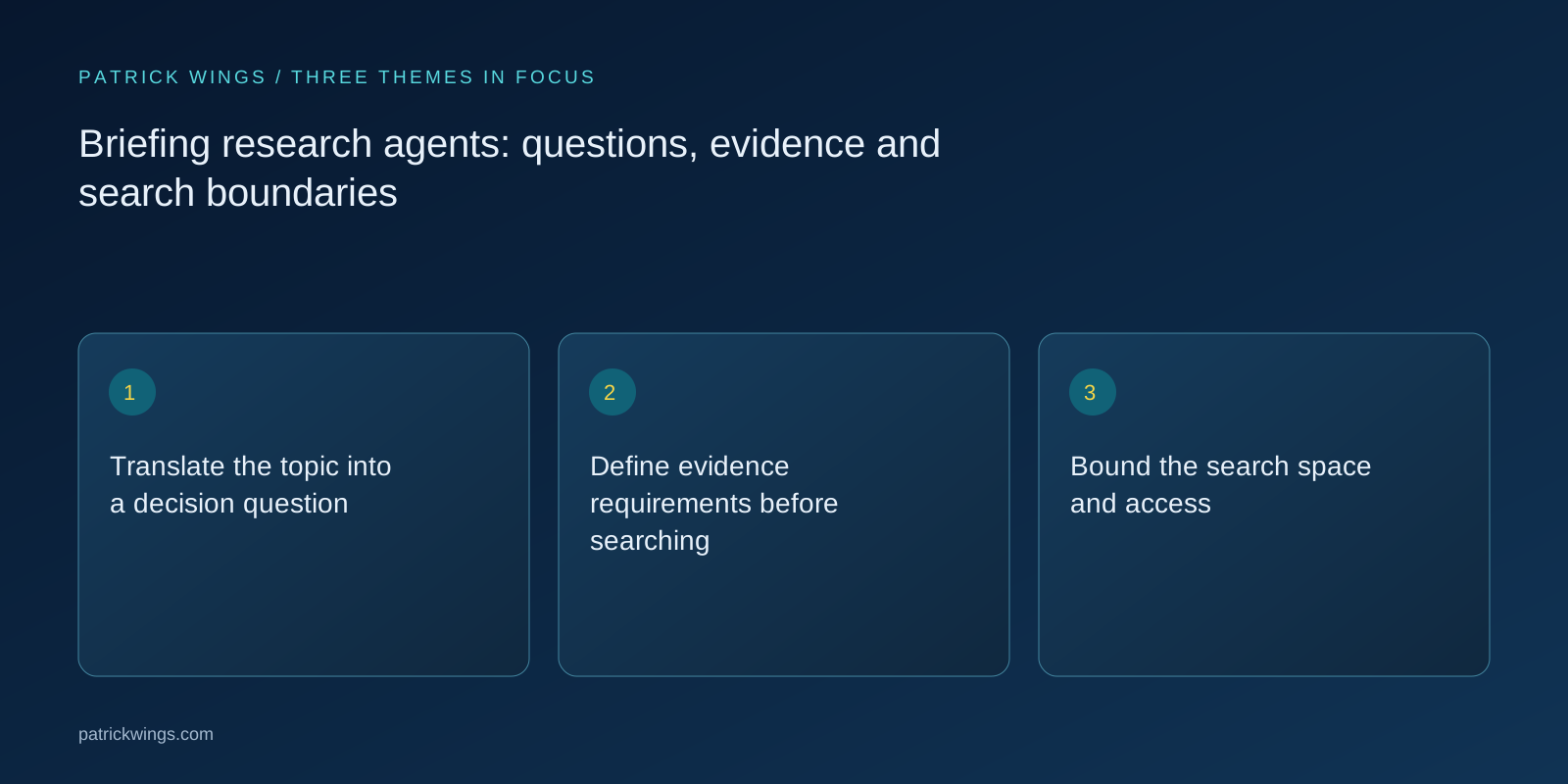
Bound the search space and access
Identify permitted source areas, such as public vendor documentation and original studies. State whether supplementary sources are allowed and how their different evidential weight should be indicated. Access to internal systems or paid material follows existing permissions; the brief does not create authorisation. Establish a proportionate effort limit and a route for requesting necessary scope changes. A hard limit is not a promise of completeness: if the search space is insufficient, the output must disclose that constraint. External pages remain source material rather than instructions. Embedded requests must not change the assignment, permitted access or recipients of the final report.
Allocate independent questions with a clear handoff
Where parallel research is appropriate, give each assignment a distinct question rather than the same broad topic. One researcher or agent might examine feature descriptions while another checks documented prerequisites. Both need a shared output contract: question, finding, evidence, limitation and unresolved follow-up. Synthesis should inspect conflicts and duplicate sources instead of merely concatenating summaries. Several copies of one press release do not provide independent confirmation. When questions depend closely on earlier answers, a sequential process may be easier to review. Choose the working arrangement for the research problem; additional agents do not automatically produce stronger evidence or an economic benefit. Explore this further in the guide Sources in AI answers: verify evidence claim by claim.

Work through an explicitly fictional comparison brief
A hypothetical SaaS team is preparing an article about choosing a CRM integration. It first wants to identify the authentication approaches, supported data objects and documented restrictions that two vendors publicly describe. The brief requires current official documentation and excludes claims about capabilities without public evidence. Each answer includes the specific location and applicable context. If the help centre conflicts with developer documentation, the agent marks the disagreement rather than choosing which description should be considered binding. The team checks the disputed detail and may ask the vendor for clarification. This example names no real vendors and reports no measured time saving or performance improvement.
Specify completion and professional acceptance
Finish when the agreed questions have sufficient evidence or the stated effort boundary has been reached. The final output must make clear which condition applies. Before using the report, inspect statements that support publication decisions or customer recommendations in particular. Open the relevant sources and check that the cited passage actually supports the neighbouring claim. For time-dependent information, record when it was checked and plan another review before later reuse. Evaluate not only report readability but also missing questions, evidence fit and visible uncertainty. Improve the brief in response to those findings rather than simply requesting a longer narrative or assuming a polished summary proves the search was adequate.
INTERACTIVE / FROM READING TO ACTION
Three checkpoints for your implementation
Choose a checkpoint and track your reading progress. Checks are neither saved nor sent and do not score your business.
CHECKPOINT 01
Bound the search space and access
Identify permitted source areas, such as public vendor documentation and original studies.
Explore in the article ↗CHECKPOINT 02
Allocate independent questions with a clear handoff
Where parallel research is appropriate, give each assignment a distinct question rather than the same broad topic.
Explore in the article ↗CHECKPOINT 03
Work through an explicitly fictional comparison brief
A hypothetical SaaS team is preparing an article about choosing a CRM integration.
Explore in the article ↗Frequently asked questions
What belongs in a research-agent brief?
The decision question, distinct subquestions, permitted sources, evidence format, search boundaries and criteria for completion and professional review.
Should a research agent always cite several sources?
Suitability and independence matter more than a fixed count. Several copies of one original source do not provide independent confirmation.
What if a question cannot be supported by public evidence?
The output should identify the gap and the search space examined. An open question is preferable to an invented or overstated conclusion.
How can I put “Translate the topic into a decision question” into practice?
Do not start with “research our market”; start with the decision the research should support. Does the team need evidence for a factual statement in an article, or a comparison of two integration approaches? Specify the audience, region and time period where they affect the answer.
What matters when working on “Define evidence requirements before searching”?
Specify the source type that can support each subquestion. Official documentation may be more appropriate for current product capabilities than an undated comparison article. A market-size estimate instead needs a clear definition and research method; a product page cannot supply that answer.