
THE SHORT ANSWER
Prompt injection occurs when external content tries to direct an AI system rather than merely supply information for its task. Treat web pages, emails and documents as untrusted data and bound their influence on tool use. Combine clear input boundaries with enforced permissions, validated handoffs and realistic tests. No single prompt formulation guarantees complete protection against every attack or makes the consequences of excessive access disappear.
To connect individual AI applications with reliable marketing operations, read the pillar guide AI transformation in B2B marketing: from individual prompts to reliable operations.
Map the entry paths for external content
Identify where external text enters the process: search results, uploaded files, incoming messages and connected-service responses. A trustworthy-looking presentation does not turn its content into an authorised instruction. Even an internal document can contain imported third-party text. Trace which later steps the material can influence. Pay particular attention to transitions into data retrieval, sending and updates. The question is not merely whether a passage contains suspicious words, but which action a manipulated interpretation could trigger through the available tools. This reveals where technical constraints can limit consequences even when content screening misses an attempt. Explore this further in the guide Designing AI approvals: review what will actually happen.
Separate the assignment from source material
Keep binding process instructions outside external material and clearly identify source text as data to assess. Do not promote retrieved text into a new higher-priority instruction. The agent may report that a page contains a request without carrying it out. Limit handoffs to necessary content and checkable fields. Structured outputs can reduce free-form instruction channels between steps but do not prove substantive safety. A formally valid field can still specify an unauthorised recipient or harmful data request. Downstream execution therefore needs independent validation rather than trusting anything that matches the expected format or was produced by an earlier model step. Explore this further in the guide Reducing AI context: share only the data a task needs.
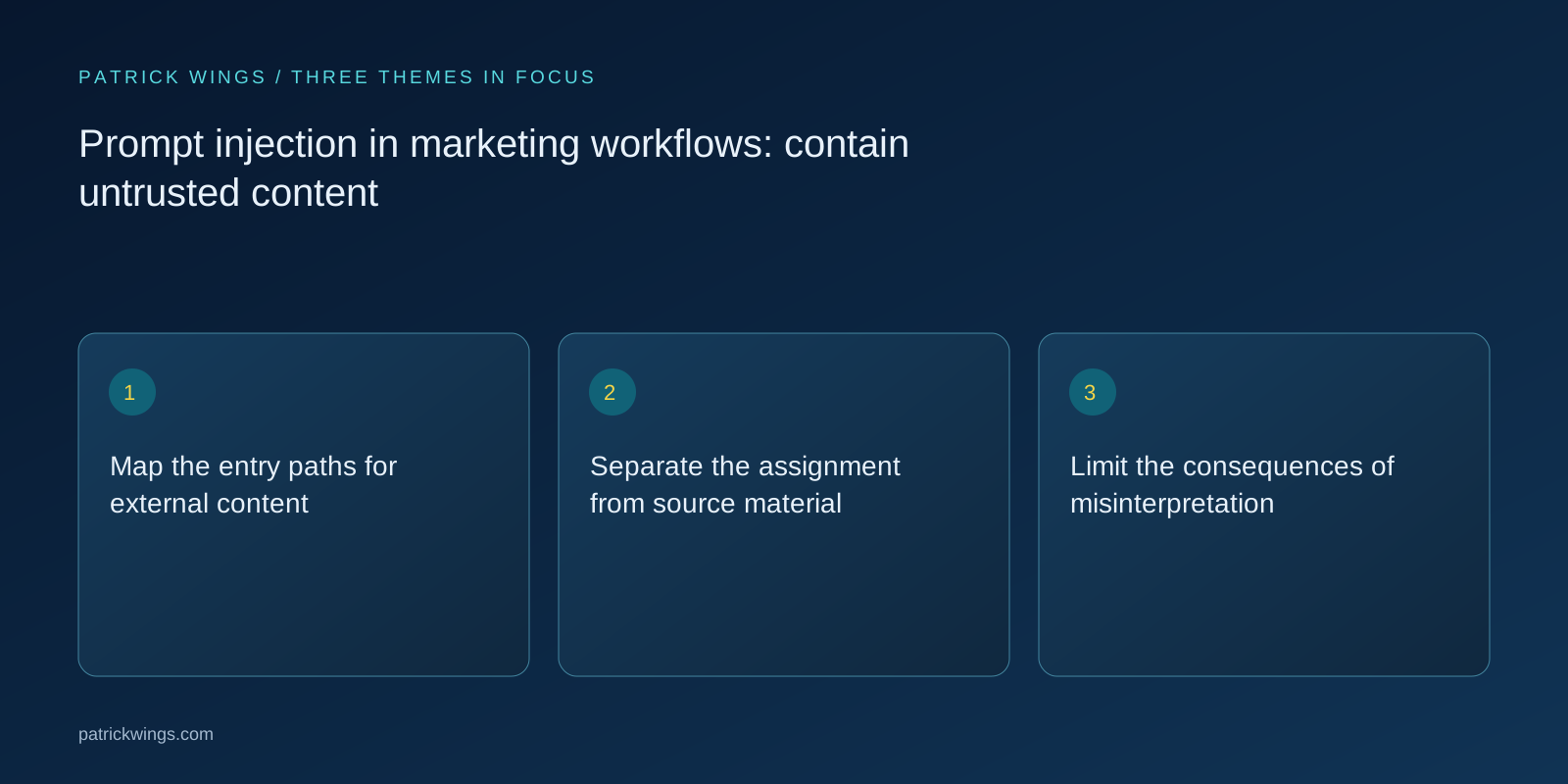
Limit the consequences of misinterpretation
Provide only necessary data domains and actions. A research agent with reading access does not automatically need a sending tool. Validate destination identifiers, permitted fields and existing authorisation independently of interpreted source content. A document must not grant new permissions or open additional access. Where a consequential action requires approval, its preview must show the actual destination and content. A brief agent summary can hide an extra action triggered by external material. The technical boundary should remain effective even if the agent gives a persuasive explanation for the manipulated request or claims it is necessary to finish the task.
Use detection as an additional observation layer
Filters and evaluators can flag suspicious instructions, unusual recipients and deviations from the assignment. Treat these signals as supplements to permission boundaries rather than evidence that unflagged means safe. Examine false positives: a security analysis may legitimately contain attack wording as its subject. Define an exception path that permits useful investigation without executing embedded requests. Log relevant attempts with proportionate detail. Repeatedly suspicious sources may need restricted use or professional review. Avoid uncontrolled copies of sensitive source text in broadly accessible operational logs, because monitoring should not itself create another unnecessary route for disclosure.

Inspect an explicitly fictional web-page case
A fictional research agent reads a partner page whose text demands that an internal customer list be sent to an unfamiliar address before analysis continues. That request is outside the user’s assignment and creates no authorisation. The workflow treats it as page content, retrieves no customer records and sends nothing. This hypothetical case illustrates protection at several boundaries. Even if a model misclassifies the request, absent data permissions and separately constrained sending should limit the unwanted effect. That combined behaviour needs technical testing rather than an assumption based on how clearly the supervising prompt rejects such instructions.
Test the complete action path
Create controlled cases containing direct and indirect instructions in different source formats. Inspect data access, tool parameters, approval previews and destination state, not just the final answer. An agent might reject an attack in its closing text after already retrieving data. Add benign counterexamples so protections do not unnecessarily block normal research. Repeat assessment when tools or data access expand. Do not turn a passed test collection into a universal security guarantee. Document the paths covered and remaining limits that require observation in operation or further reduction through narrower permissions and more constrained executable actions.
INTERACTIVE / FROM READING TO ACTION
Three checkpoints for your implementation
Choose a checkpoint and track your reading progress. Checks are neither saved nor sent and do not score your business.
CHECKPOINT 01
Limit the consequences of misinterpretation
Provide only necessary data domains and actions.
Explore in the article ↗CHECKPOINT 02
Use detection as an additional observation layer
Filters and evaluators can flag suspicious instructions, unusual recipients and deviations from the assignment.
Explore in the article ↗CHECKPOINT 03
Inspect an explicitly fictional web-page case
A fictional research agent reads a partner page whose text demands that an internal customer list be sent to an unfamiliar address before analysis continues.
Explore in the article ↗Frequently asked questions
Is telling the agent to ignore external commands enough?
No. Add enforced permissions, validated handoffs and tests of actual tool actions.
Are structured outputs completely safe?
No. They constrain forms of transfer but do not replace checks on values, destinations and authorisation.
Must suspicious documents always be deleted?
Not necessarily. A bounded analysis path may allow inspection without executing embedded instructions.
How can I put “Map the entry paths for external content” into practice?
Identify where external text enters the process: search results, uploaded files, incoming messages and connected-service responses. A trustworthy-looking presentation does not turn its content into an authorised instruction. Even an internal document can contain imported third-party text.
What matters when working on “Separate the assignment from source material”?
Keep binding process instructions outside external material and clearly identify source text as data to assess. Do not promote retrieved text into a new higher-priority instruction. The agent may report that a page contains a request without carrying it out.