
THE SHORT ANSWER
After a pilot, an AI workflow needs visible ownership for business decisions, technical changes and ongoing operation. In a small team, a few people may perform several roles, but the responsibilities still need to be distinguished. A useful operating model answers concrete questions: who may change sources, who judges difficult outputs and who can stop the process when dependable use is temporarily impossible?
To connect individual AI applications with reliable marketing operations, read the pillar guide AI transformation in B2B marketing: from individual prompts to reliable operations.
Organise ownership around actual decisions
Begin with decisions that arise in ordinary work. Someone must own the purpose and usage boundary, someone must maintain sources and quality criteria, and someone must handle technical failures. NIST’s Govern playbook emphasises documented roles and communication routes. A short assignment of concrete decisions can initially serve your team. Avoid role labels without authority. A business owner can fulfil the responsibility only if they can set priorities, reject changes and request necessary review time. Those powers belong in the role description alongside the name of the person assigned.
Distinguish subject review from technical support
A technically reachable agent can still produce inaccurate content. An accurate template can fail because an interface is broken. Identify separate contacts for output quality and system condition, even when one person initially handles both. Document when responsibility transfers. A source conflict might go to the subject owner, while a failed write operation goes to technical support. Problems then do not automatically land with whoever first demonstrated the pilot, who may have neither the required permissions nor enough time to investigate every issue that later users encounter.
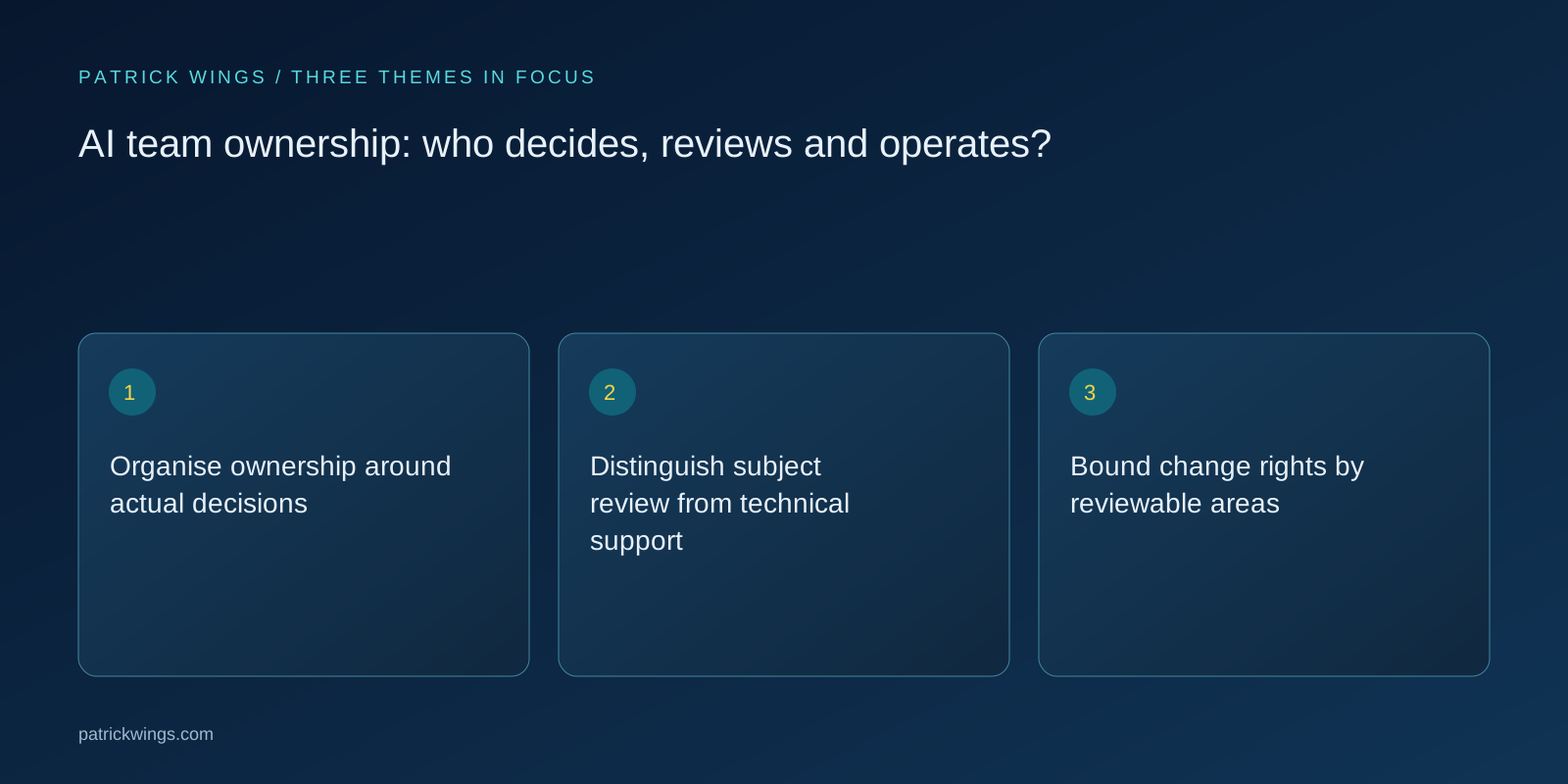
Bound change rights by reviewable areas
Decide who may alter instructions, knowledge sources, tool permissions and evaluation rules. These areas have different consequences. An editorial correction may need a smaller test than a new external action. Connect each change with a short rationale, expected effect and suitable test cases. The author should not become the only subject reviewer purely for convenience. Small teams can reserve a second perspective for consequential changes instead of sending every harmless adjustment through an equally elaborate approval process that gradually discourages timely maintenance and practical ownership.
Set realistic availability and cover
Describe when support is available and what happens outside those hours. A marketing team does not automatically need a continuously staffed technical on-call service. A workflow with external effects may nevertheless require explicit pause and fallback rules. Name a substitute and establish access in advance. A name in an organisation chart is unhelpful if that person cannot inspect or stop the affected run. Also check the manual work created by a prolonged interruption and who could perform it within the capacity genuinely available to the team.

Handle a hypothetical source problem together
Imagine a content agent taking an incorrect service scope from an obsolete product overview. The technical operator finds no system fault. The subject owner blocks the old source, decides which drafts are affected and adds a test case. The operator implements the source change and confirms the new state. The team lead decides whether use can resume. This example contains different decisions within one incident. It does not necessarily require three additional positions, but it does require clear responsibility and visible transfers between tasks rather than an undifferentiated instruction to fix AI. Explore this further in the guide Prioritising AI automation: a backlog for clear decisions.
Test the model through a cover exercise
Give an authorised colleague a documented problem while the original builders are unavailable to help. Can they find the subject reviewer, reconstruct the run and trigger an allowed pause? Do they understand which decisions they may make and where escalation is required? Missing answers expose concrete operational gaps. Add guidance, access or decision rights accordingly. An attractive responsibility document is not sufficient evidence. The model must work when the familiar contact is on leave or the issue arises outside the context in which the original pilot was developed and demonstrated. Explore this further in the guide Writing AI runbooks: operate beyond the original builders.
Review continuation and effort regularly
Connect the operating review with quality findings, support effort and actual value. Check whether the assigned roles still match usage or whether new sources and teams require additional ownership. More active users may justify expansion, but usage does not replace capacity planning for review and operation. Record who can decide on a pause or retirement too. The operating model becomes a practical agreement for dependable use: it makes responsibility visible and identifies when the agreed boundaries must be reconsidered because the workflow, its effects or the team’s available resources have changed.
INTERACTIVE / FROM READING TO ACTION
Three checkpoints for your implementation
Choose a checkpoint and track your reading progress. Checks are neither saved nor sent and do not score your business.
CHECKPOINT 01
Bound change rights by reviewable areas
Decide who may alter instructions, knowledge sources, tool permissions and evaluation rules.
Explore in the article ↗CHECKPOINT 02
Set realistic availability and cover
Describe when support is available and what happens outside those hours.
Explore in the article ↗CHECKPOINT 03
Handle a hypothetical source problem together
Imagine a content agent taking an incorrect service scope from an obsolete product overview.
Explore in the article ↗Frequently asked questions
Does every role need a separate person?
No. Small teams can combine roles. Decision rights, cover and potential conflicts should still be explicit.
Who may stop the workflow?
An explicitly assigned role with technical ability to do so, a clear stopping rule and a reachable escalation route.
Is a central AI lead sufficient?
Only if specific business and technical decisions still have owners. A central lead cannot personally review every product detail.
How can I put “Organise ownership around actual decisions” into practice?
Begin with decisions that arise in ordinary work. Someone must own the purpose and usage boundary, someone must maintain sources and quality criteria, and someone must handle technical failures. NIST’s Govern playbook emphasises documented roles and communication routes.
What matters when working on “Distinguish subject review from technical support”?
A technically reachable agent can still produce inaccurate content. An accurate template can fail because an interface is broken. Identify separate contacts for output quality and system condition, even when one person initially handles both.