
THE SHORT ANSWER
An AI runbook explains how an approved workflow is operated, checked, paused and resumed. It must work for authorised colleagues who did not build the system. That requires more than a collection of technical settings. The guidance connects observable states with permitted actions, clear boundaries and a human handoff when the next dependable step cannot be established from the available evidence.
To connect individual AI applications with reliable marketing operations, read the pillar guide AI transformation in B2B marketing: from individual prompts to reliable operations.
Begin with purpose and recognisable states
Briefly describe what the workflow does, which outputs it may produce and which actions are excluded. Show the normal starting point and visible states through confirmed completion. A running label is insufficient if nobody can determine whether external changes have already occurred. Name the evidence for important transitions, such as a saved draft identifier or confirmed task reference. Operators can then inspect the actual state rather than infer success from the agent’s last natural-language message, which may describe intent more confidently than the underlying system warrants. Explore this further in the guide Recording agent state: what has actually been completed?.
Document access and dependencies without secrets
List required systems, permitted roles, source collections and technical dependencies. Explain where authorised operators obtain access and how to check that it works. Do not put credentials in the instructions. Link the appropriate administration routes and name a responsible contact. Also establish which source is authoritative for which claim. When an output appears wrong, the operator needs to distinguish an outdated source from an access problem or unsuitable processing. That orientation shortens investigation more effectively than an unexplained list of system names, tool settings and configuration details. Explore this further in the guide AI team ownership: who decides, reviews and operates?.
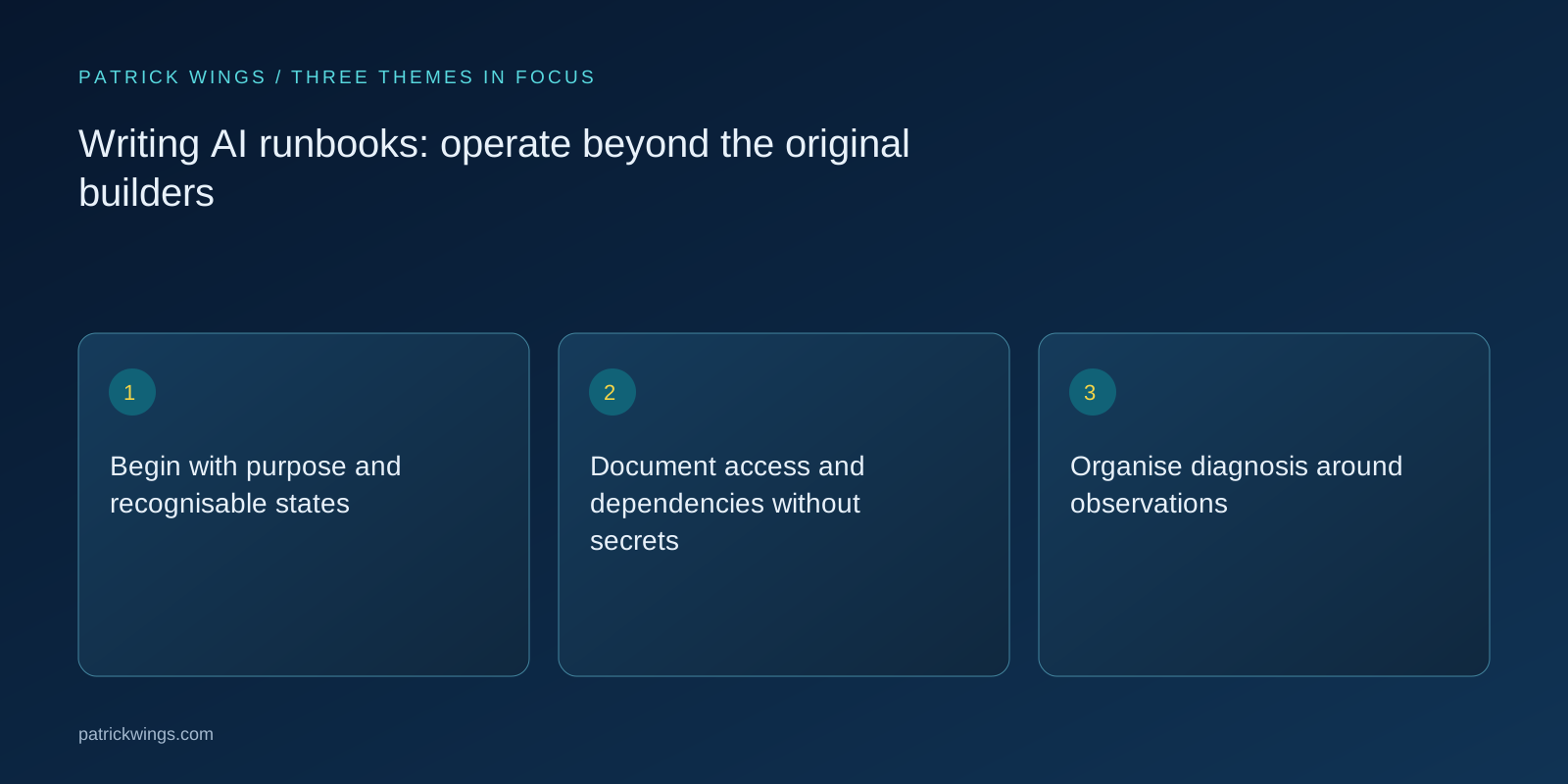
Organise diagnosis around observations
Begin each failure path with an observable symptom and a bounded check. Google SRE describes troubleshooting through hypotheses and tests grounded in system state. For your workflow, that may mean checking run status and input first when output is missing, then source access and only afterwards processing. Record expected and unexpected results for those checks. Avoid blanket instructions such as restart the model. Restarting does not address every cause and can create additional actions or lose diagnostic context when the state of a write operation remains uncertain or a partial result already exists.
Write separate pause and resume procedures
A pause must define which new tasks stop and what happens to steps already running. Resuming requires a different check of completed state and unresolved consequences. An interrupted write must not be repeated automatically. Explain how existing results are searched for and confirmed before new actions begin. Name the person allowed to authorise continuation. If a dependable resume procedure is unavailable, the correct guidance is a bounded manual handoff with documented status, rather than an optimistic restart of the same run that may duplicate or conflict with work already completed.

Work through a hypothetical CRM problem
Suppose an agent receives no CRM response after creating a task. The operator finds the runbook instruction to inspect existing CRM state using the known conversation reference. A task already exists. They record its identifier and stop repetition rather than creating another. If no task could be identified reliably, the documented escalation route would apply. This example shows that a useful runbook does more than repair failures. It also prevents an uncertain repair action from worsening the original incident through additional record changes that obscure what happened and require further investigation.
Test handoff to an uninvolved colleague
Ask an authorised colleague to handle a normal run and a selected failure case using only the guidance. The builders observe but initially provide no hints. Check where unclear terms, missing permissions or invisible states block progress. A runbook does not pass merely because all its links work. The colleague must reach the right decision and support it from observable system state. Add the information genuinely missing, then repeat the affected step. Avoid simply making the document longer with more general advice that does not resolve the specific point at which the operator became stuck.
Maintain guidance alongside system changes
Relevant changes to tools, sources, permissions or states may affect operating instructions. Include their update in change approval. Label the last review, responsible owner and tested workflow version. Remove obsolete repair paths that no longer apply after a change. Retain historical versions where earlier incidents require them, but make the current instructions unmistakable. The runbook then becomes a tested working aid for dependable operation and cover, rather than a document filed away after a successful pilot while the system around it continues evolving without corresponding checks or practical maintenance.
INTERACTIVE / FROM READING TO ACTION
Three checkpoints for your implementation
Choose a checkpoint and track your reading progress. Checks are neither saved nor sent and do not score your business.
CHECKPOINT 01
Organise diagnosis around observations
Begin each failure path with an observable symptom and a bounded check.
Explore in the article ↗CHECKPOINT 02
Write separate pause and resume procedures
A pause must define which new tasks stop and what happens to steps already running.
Explore in the article ↗CHECKPOINT 03
Work through a hypothetical CRM problem
Suppose an agent receives no CRM response after creating a task.
Explore in the article ↗Frequently asked questions
How technical should a runbook be?
Concrete enough for the intended operator to inspect state and execute allowed steps. Unnecessary implementation detail does not help.
Is an architecture diagram sufficient?
No. You also need observable states, diagnosis routes, pause, resume and ownership of unresolved decisions.
How do we test operational cover?
An authorised colleague unfamiliar with development handles normal and failure cases using only the guidance. Fix the gaps observed during that exercise.
How can I put “Begin with purpose and recognisable states” into practice?
Briefly describe what the workflow does, which outputs it may produce and which actions are excluded. Show the normal starting point and visible states through confirmed completion. A running label is insufficient if nobody can determine whether external changes have already occurred.
What matters when working on “Document access and dependencies without secrets”?
List required systems, permitted roles, source collections and technical dependencies. Explain where authorised operators obtain access and how to check that it works. Do not put credentials in the instructions.