
THE SHORT ANSWER
A knowledge agent should find relevant information in approved sources and explain it clearly. A support agent may also assist a defined service process. Both can fail when documents conflict or responsibilities are unclear. For SaaS providers, the work therefore starts with knowledge quality and access. A convincing interface is only the visible part of a broader operating model.
To connect individual AI applications with reliable marketing operations, read the pillar guide AI transformation in B2B marketing: from individual prompts to reliable operations.
Define users and supported questions
An internal employee assistant needs different information from public product support. Specify the audience, supported subjects and excluded tasks. A documentation agent should not automatically answer individual contract questions or expose confidential account data. Decide when a question moves to support. This scope affects access, tone and quality tests. Start with a clear subject area rather than connecting every company document immediately. A small, understandable knowledge base is easier to inspect and improve deliberately. It also makes failures easier to trace to a specific missing or contradictory source. Explore this further in the guide AI research and competitive intelligence: verify sources and separate conclusions.
Prepare knowledge around real questions
Collect frequent questions and check whether approved sources actually answer them. Add prerequisites, version context and known limitations. An instruction should identify the product variant it covers. Mark obsolete documents and identify the valid edition. Avoid contradictions between marketing pages, help articles and internal notes. They do not need identical wording, but they should agree factually. When an answer currently exists only in an employee’s memory, knowledge work comes first. An agent cannot reliably reproduce information that has never been captured in an accessible, approved source.
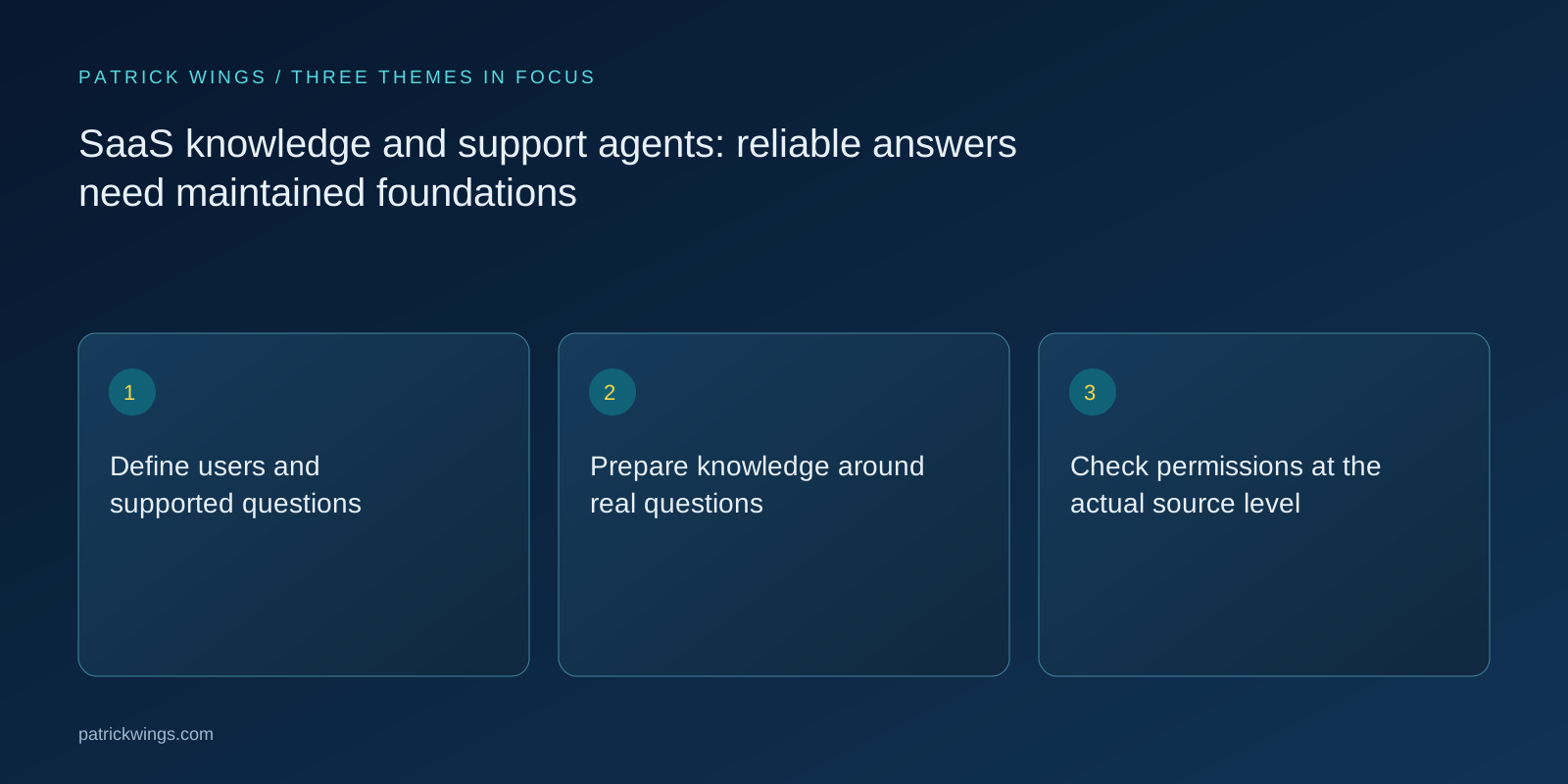
Check permissions at the actual source level
Not every user may see every piece of information. An internal agent should not bypass existing access boundaries through a shared knowledge collection. Inspect how authentication, source access and answer delivery interact in the chosen implementation. Microsoft, for example, documents different authentication requirements for different knowledge sources; that does not automatically approve every possible configuration. Test with users in different roles. An administrator-only test can easily miss both excessive disclosure and insufficient access that ordinary employees later encounter during real use.
Make evidence and missing knowledge visible
A useful answer refers to the documentation it used and states important prerequisites. A citation alone does not prove that the whole answer follows correctly from its source. Check the statement and evidence together. Define appropriate behaviour when information is missing: a targeted question, a relevant reference or a handover. The agent should not invent a plausible product capability to make an answer appear complete. For individual plans or error causes in particular, an honest boundary can be more useful than an immediate guess that sends the customer in the wrong direction.

Design handover as part of the service
When a person takes over, they need the question, information already checked and unresolved uncertainty. Avoid requiring customers to repeat everything when permitted data handling enables an appropriate handoff. Treat automatic summaries as reviewable assistance. Specify who receives the case and how its open status remains visible. An agent that displays a generic contact link has not created a complete support process. The actual service route must be available and understandable to the employees expected to respond, with enough context for them to continue usefully. Explore this further in the guide AI governance in marketing: meaningful ownership and human review.
Test quality and maintain after product changes
Create questions covering common requests, ambiguous wording and unsupported situations. Assess accuracy, source fit, permissions and handover behaviour. Include old documents and conflicting instructions. Repeat relevant tests after changes to product, knowledge or prompts. Observe correction and clarification needs in operation without distributing sensitive material unnecessarily. Do not only count automatically answered questions. A seemingly high resolution rate has little value if users receive incorrect information and return later with a larger problem. Service quality depends on what actually happened, not simply whether the conversation ended.
INTERACTIVE / FROM READING TO ACTION
Three checkpoints for your implementation
Choose a checkpoint and track your reading progress. Checks are neither saved nor sent and do not score your business.
CHECKPOINT 01
Check permissions at the actual source level
Not every user may see every piece of information.
Explore in the article ↗CHECKPOINT 02
Make evidence and missing knowledge visible
A useful answer refers to the documentation it used and states important prerequisites.
Explore in the article ↗CHECKPOINT 03
Design handover as part of the service
When a person takes over, they need the question, information already checked and unresolved uncertainty.
Explore in the article ↗Frequently asked questions
Do citations automatically prevent wrong answers?
No. An answer can misinterpret its cited source. Check whether the evidence genuinely supports the statement.
Should we connect every document immediately?
A bounded, current collection with clear ownership is usually easier to test. Expand according to real questions.
When should a person take over?
When dependable information is missing, a request is outside scope or defined sensitive decisions arise. The handover route must actually work.
How can I put “Define users and supported questions” into practice?
An internal employee assistant needs different information from public product support. Specify the audience, supported subjects and excluded tasks. A documentation agent should not automatically answer individual contract questions or expose confidential account data.
What matters when working on “Prepare knowledge around real questions”?
Collect frequent questions and check whether approved sources actually answer them. Add prerequisites, version context and known limitations. An instruction should identify the product variant it covers.