
THE SHORT ANSWER
A useful agent tool explains its purpose, inputs, side effects and verifiable outcomes clearly enough to support the next decision. Design tools around concrete tasks and bounded data domains. A technical interface alone does not tell an agent when to use it, what incomplete responses mean or how to handle an uncertain execution state after a request.
To connect individual AI applications with reliable marketing operations, read the pillar guide AI transformation in B2B marketing: from individual prompts to reliable operations.
Name the purpose and its boundaries
Update record is less informative than apply an approved CRM field suggestion. Explain when the tool is appropriate and which similar tasks it does not perform. Avoid overlapping tools without a meaningful distinction. If reading, drafting and changing require separate permissions, make those boundaries visible through purpose and access. Anthropic’s tool guidance treats clear descriptions and useful responses as important design work. Your process must additionally specify the business result expected from a call and the responsibilities that remain outside the tool rather than assuming the interface covers them.
Make inputs unambiguous and checkable
Use stable identifiers, defined fields and explicit units. A number without currency, period or denominator is not an adequately specified change request. Validate allowed values and record scope on the server before side effects occur. A model should not have to reinterpret a name as an identifier when several people match. Provide a separate search or explicit selection step instead. Also document whether omitted fields remain unchanged, are cleared or cause rejection. Those differences should be visible in the proposed action so reviewers understand what accepting the request would actually change.
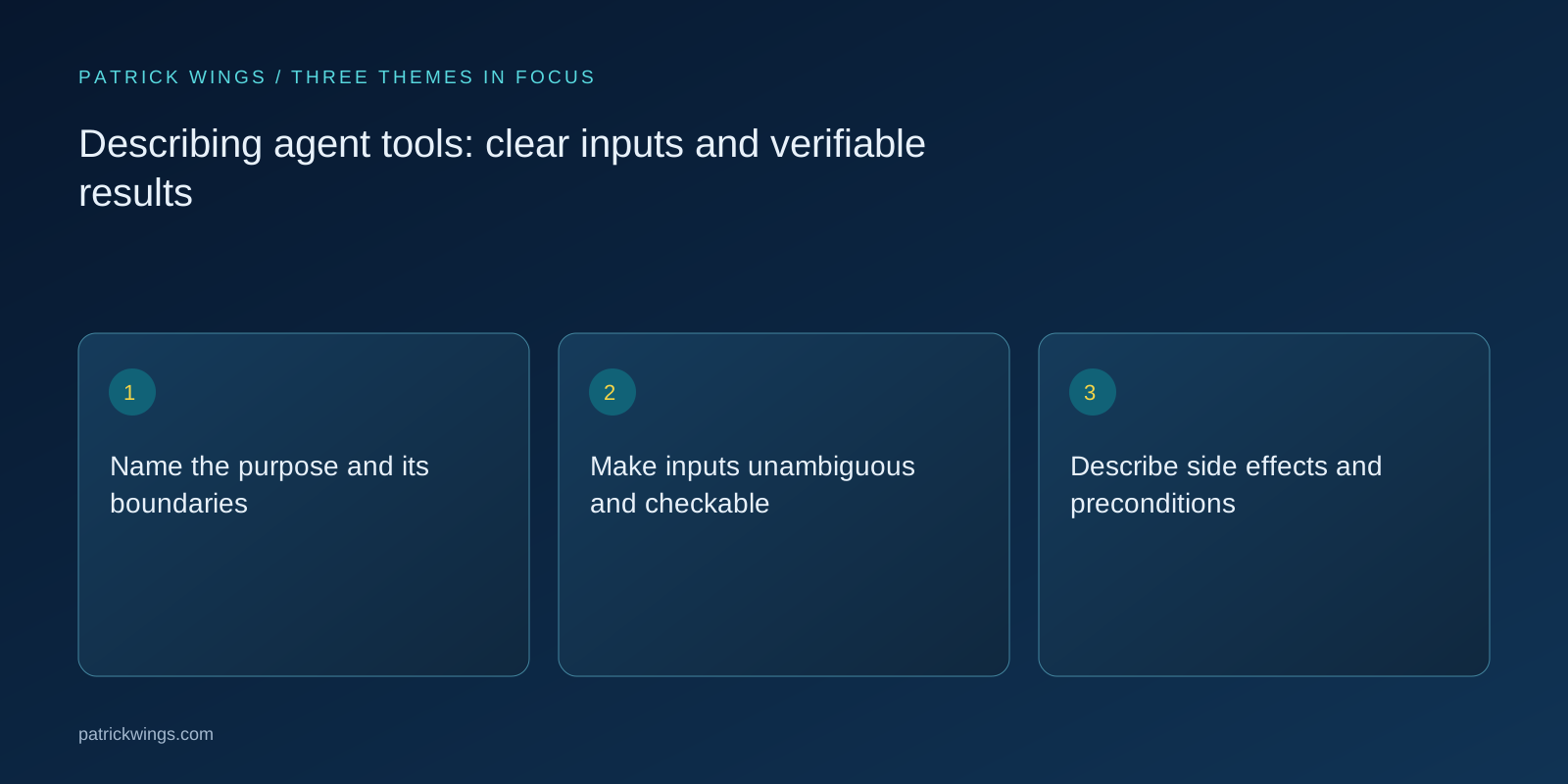
Describe side effects and preconditions
State whether a call reads data, creates a draft or changes existing state. Enforce necessary approval and version conditions at the execution boundary. A prompt description is insufficient if the same request can technically overwrite arbitrary records. Define what happens when the target version changes: a conflict should cause renewed inspection rather than silent replacement. Document indirect consequences such as notifications or downstream workflows. This lets professional review assess the real scope of the operation, including consequences that may not be obvious from the primary field update or tool name. Explore this further in the guide Rule, workflow or agent: choose the right automation.
Return results that support action
A response should contain a result identifier, execution state, relevant data and limitations. Distinguish complete, partial, rejected and uncertain where the integration can determine those conditions. Errors should explain a permitted next step, such as checking an identifier or obtaining missing approval. Do not return every accessible record when a bounded search will suffice. Large responses create search work and can obscure access limits. The agent should be able to recognise that more results exist and request them deliberately rather than assuming the first response represents the entire available collection. Explore this further in the guide Read, draft, change: permissions for marketing agents.

Inspect a fictional CRM operation
A fictional team provides a tool applying one reviewed industry suggestion to one CRM record. The request includes the record identifier, expected version, suggestion identifier and approval reference. If the record has changed, the tool reports a conflict without making an update. On success it returns the new version and the field actually stored. This hypothetical example illustrates a bounded contract. A general free-text command operating across the whole database would be harder to review and would combine business permissions within an opaque act of interpretation by the model.
Test understanding and execution together
Include tasks requiring the tool and similar tasks where it should not be used. Add invalid identifiers, missing approval, version conflicts and ambiguous responses. Assess appropriate tool selection and correct interpretation as well as technically successful requests. If the agent claims completion after a partial response, the contract may need clearer states. Update evaluations after tool changes. A better name or more informative error can be more effective than adding general instructions to the supervising prompt. Retain examples showing why a call was inappropriate so improvements do not simply increase tool usage.
INTERACTIVE / FROM READING TO ACTION
Three checkpoints for your implementation
Choose a checkpoint and track your reading progress. Checks are neither saved nor sent and do not score your business.
CHECKPOINT 01
Describe side effects and preconditions
State whether a call reads data, creates a draft or changes existing state.
Explore in the article ↗CHECKPOINT 02
Return results that support action
A response should contain a result identifier, execution state, relevant data and limitations.
Explore in the article ↗CHECKPOINT 03
Inspect a fictional CRM operation
A fictional team provides a tool applying one reviewed industry suggestion to one CRM record.
Explore in the article ↗Frequently asked questions
Should every API endpoint become an agent tool?
No. Choose tools around meaningful tasks and verifiable boundaries rather than exposing every technical function.
Is a JSON schema enough?
It helps with structure but does not fully explain business meaning, side effects or completion conditions.
What belongs in an error response?
A clear state, affected component and permitted next step without unnecessary internal or sensitive details.
How can I put “Name the purpose and its boundaries” into practice?
Update record is less informative than apply an approved CRM field suggestion. Explain when the tool is appropriate and which similar tasks it does not perform. Avoid overlapping tools without a meaningful distinction.
What matters when working on “Make inputs unambiguous and checkable”?
Use stable identifiers, defined fields and explicit units. A number without currency, period or denominator is not an adequately specified change request. Validate allowed values and record scope on the server before side effects occur.