
THE SHORT ANSWER
An AI process inventory starts with actual work samples. Collect recurring marketing tasks and examine inputs, decisions, handoffs and the consequences of mistakes. A long list of ideas adds little if nobody can explain which work should improve. The following inventory produces a reasoned shortlist for an initial experiment. These are practical design recommendations for your organisation, rather than a universal formula for automation success or a claim that every repeatable activity should use a model.
To connect individual AI applications with reliable marketing operations, read the pillar guide AI transformation in B2B marketing: from individual prompts to reliable operations.
Collect completed work rather than imagined workflows
Take a recent brief, an internal research assignment and a completed reporting run. Ask the colleagues involved which information was missing and what required correction. Retain the actual documents and handoffs where their use is approved. An idealised process conceals the exceptions that will create extra work later. Distinguish the task from its tool: exporting a spreadsheet is a step, while the intended outcome may be a verified decision brief. This distinction prevents the inventory from becoming a project to accelerate existing clicks without improving the work product.
Map decisions and dependencies
For each step, record whether it requires a fixed rule, expert judgment or additional information. Matching records by an exact identifier differs from interpreting conflicting customer statements. Identify who waits for the result and which subsequent actions it triggers. If quality becomes visible only weeks later, the pilot needs intermediate checks. The main bottleneck may also sit outside the selected step. Faster summarisation offers little benefit when an unresolved product approval still blocks the entire handoff. Record this dependency before deciding where AI belongs. Explore this further in the guide Prioritising AI automation: a backlog for clear decisions.
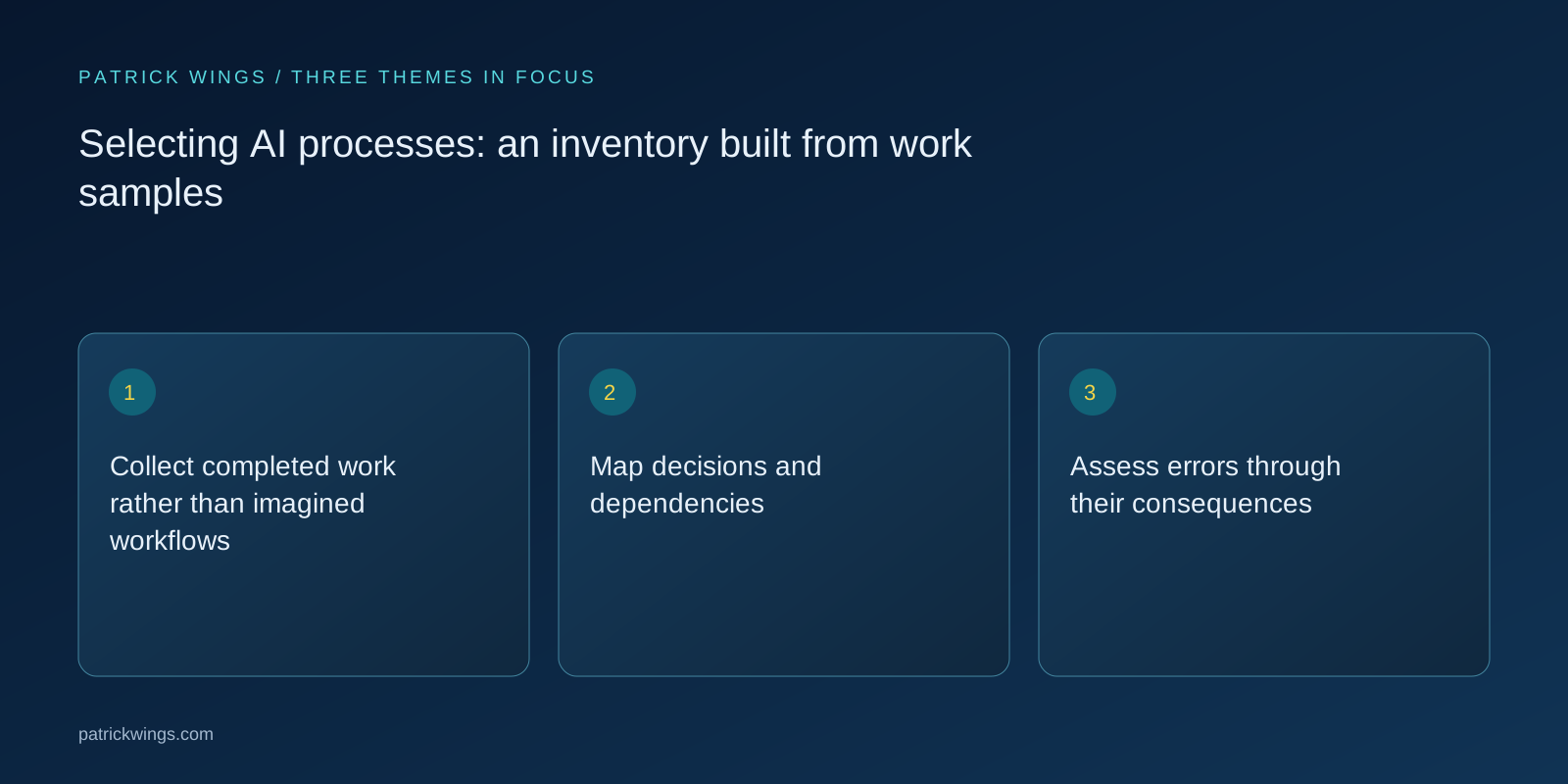
Assess errors through their consequences
Describe a plausible mistake and its consequences in ordinary language. A missing source in an internal draft might require further research. An overwritten contract detail could involve several teams. Also assess whether a change can be detected and reversed. Avoid a seemingly precise total score that allows substantial time savings to offset an unacceptable failure. Your organisation can treat certain consequences as exclusion criteria until appropriate controls exist. That is an operational decision, and the people accountable for the affected work should explicitly support it.
Check access to data and reviewers
An attractive use case is not yet an executable pilot. Establish whether its sources are accessible, current and approved for this purpose. Name someone who can distinguish an acceptable result from a persuasive false claim. Check their actual capacity rather than general willingness to help. If every output needs an expert who is rarely available, the process may simply move the bottleneck. Specify which preparation the wider team can perform and which situations require the accountable person to intervene before downstream work begins. Explore this further in the guide AI readiness in marketing: is your team ready for a first pilot?.

Compare a simpler alternative
Before planning an agent, consider a better form, a search interface or a fixed workflow. Distinguishing predefined workflows from flexible agents helps architecture discussions, but does not establish business value. A model might help interpret unstructured inputs, while an explicit rule can enforce known thresholds. For each candidate, identify the particular uncertainty that calls for model judgment. If you cannot name one, an ordinary process improvement may be the more useful next step. Give that alternative equal consideration rather than treating AI adoption as the predetermined outcome.
Walk through a hypothetical example
A fictional IT SaaS team regularly collects internal questions from product conversations. Its inventory reveals substantial searching when categorising questions and linking existing answers. An initial pilot suggests categories and relevant sources; experts confirm the matches. It does not independently answer customers. This illustrates a bounded design rather than an achieved time saving. If approved answers are missing, source maintenance comes first. Automated summarisation would not replace that foundation and could conceal its absence by producing fluent responses from incomplete or unsuitable material.
Make a reasoned selection
Produce a shortlist containing purpose, the existing problem, prerequisites, error consequences and the next review step. Record deliberately deferred ideas with reasons. Validate the shortlist with the people whose work it affects: are the examples accurate, is a recurring exception missing, and would the output be useful? A suitable candidate has a recognisable input, an accountable user and assessable quality criteria. Update the inventory after a pilot with the limits you observed. It then supports investment decisions rather than collecting fashionable ideas without ownership.
INTERACTIVE / FROM READING TO ACTION
Three checkpoints for your implementation
Choose a checkpoint and track your reading progress. Checks are neither saved nor sent and do not score your business.
CHECKPOINT 01
Assess errors through their consequences
Describe a plausible mistake and its consequences in ordinary language.
Explore in the article ↗CHECKPOINT 02
Check access to data and reviewers
An attractive use case is not yet an executable pilot.
Explore in the article ↗CHECKPOINT 03
Compare a simpler alternative
Before planning an agent, consider a better form, a search interface or a fixed workflow.
Explore in the article ↗Frequently asked questions
How many tasks belong in the first inventory?
Enough to reveal normal work and important exceptions. Start with a manageable domain and expand when necessary.
Does repetition alone justify automation?
No. Also examine data availability, output quality and the consequences of errors.
Who should assess the shortlist?
Output users, the process owner and people who understand the relevant data and integration.
How can I put “Collect completed work rather than imagined workflows” into practice?
Take a recent brief, an internal research assignment and a completed reporting run. Ask the colleagues involved which information was missing and what required correction. Retain the actual documents and handoffs where their use is approved.
What matters when working on “Map decisions and dependencies”?
For each step, record whether it requires a fixed rule, expert judgment or additional information. Matching records by an exact identifier differs from interpreting conflicting customer statements. Identify who waits for the result and which subsequent actions it triggers.