
THE SHORT ANSWER
Business-case content helps buyers inspect an investment assumption. It does not supply guaranteed returns or a deceptively precise figure from unknown inputs. Start with the workflow to be changed, its current effort and the conditions required for improvement. Separate cash-relevant benefit, capacity and qualitative advantages. This article addresses how to explain a calculation and make it useful editorially. It does not replace an individual financial decision or assessment by finance and business owners. A good outcome is an inspectable discussion of assumptions, not an automatically positive argument for buying the vendor's product.
To see how this step fits into your content strategy, read the pillar guide Content marketing for B2B SaaS: strategy, formats and qualified demand.
Define the decision and the baseline fairly
Explain which option is being compared with which current state. Do not compare a carefully designed future with an artificially poor present. The existing process may have costs, advantages and investments already made. State the period, workload and person able to confirm baseline assumptions. A department-level case is not automatically transferable across the company. GOV.UK's benefits guidance connects problems, value and costs, but your SaaS calculation remains your own model. Specify the decision the material supports: further investigation, a bounded pilot and budget approval are different outcomes requiring different evidence. A useful baseline is a documented starting condition rather than a dramatic scenario built to make any replacement appear attractive. Explore this further in the guide B2B calculators as content: make assumptions and outputs understandable.
Obtain inputs from observed work
Ask about completed tasks, time spent, rework and relevant cost components. A single recollection in a sales conversation is a clue, not a reliable process measurement. Explain a small buyer-led observation exercise: choose a period, define tasks, record exceptions and distinguish observed values from estimates.
Which input needs evidence?
Prevent the same minute appearing in multiple benefit categories. If current effort is unknown, show a blank input or a justified range instead of automatically inserting a persuasive default. A calculation with visible gaps can prompt useful preparation. A fully populated invented calculation produces only apparent certainty and may make later review harder because nobody remembers which values came from actual observation.
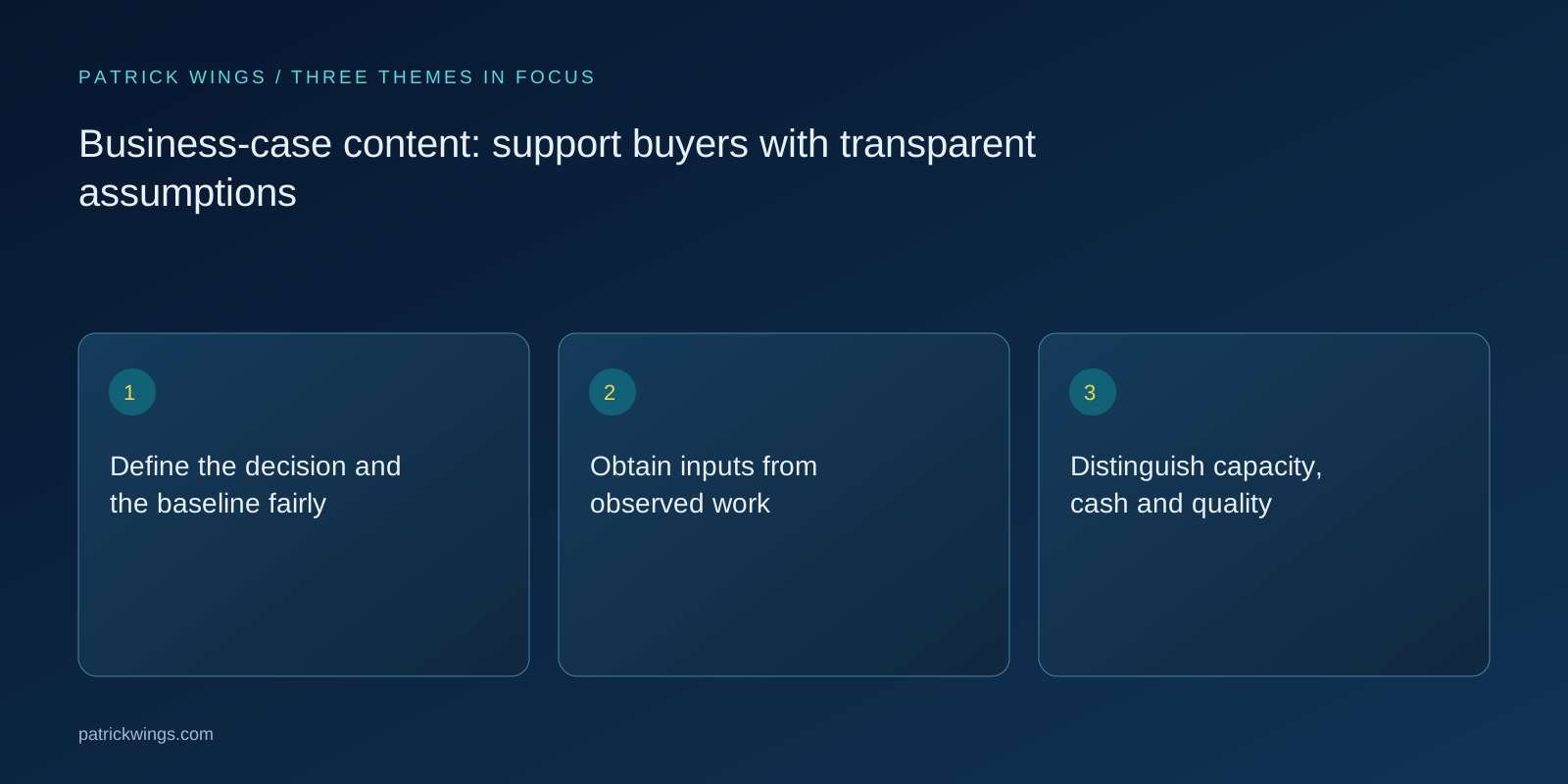
Distinguish capacity, cash and quality
An hour of work avoided does not necessarily become an immediate reduction in payroll expenditure. It may create capacity without reducing any payment. Explain how released time could actually be used and which management decision enables that use. Cash savings, avoided future work and qualitative improvement belong on separate lines. Quality benefits can remain relevant even when they cannot yet be priced reliably. Do not assign automatic monetary values to every better user experience. Finance and business owners should assess which assumptions are defensible for the planned use. Content should support that assessment rather than combine unlike benefits into an impressive total that appears more precise than the underlying evidence.
| Review field | Evidence or observation | Next decision |
|---|---|---|
| Baseline | Observed quantity or explicit assumption | Present the result as conditional arithmetic |
| input | Observed quantity or explicit assumption | Present the result as conditional arithmetic |
| scenario | Observed quantity or explicit assumption | Present the result as conditional arithmetic |
Include implementation and continuing effort
Place licences, configuration, integration, data preparation, training and continuing support beside assumed benefits. Relevant internal customer time counts as well as external invoices. Explain which costs are one-off and which recur. Identify changing usage and optional packages as scenario drivers without inventing contract terms. A vendor cannot know every individual cost component, so provide a visible row for additions. The cheapest assumed case must not become the default expectation. Clear cost scope helps buyers compare offers and align calculations with their own budget rules rather than considering only list price. It also makes objections useful: a missing cost can be added without rebuilding the entire argument around a new headline figure.

Fictional example: capacity is not yet cash saved
This calculation is entirely fictional. SaaS vendor Countpath assumes 40 hours of avoidable rework in a customer team each month. Under the invented scenario, a supported workflow initially releases ten hours, while four hours of monthly maintenance and one-off introduction work are added. The model therefore shows six hours of possible net capacity before attaching a monetary value. Whether this produces additional output or reduced expenditure remains a separate decision. Every number is an illustrative assumption, not an observed customer result or benchmark. The example separates gross relief, extra operating work and realised financial benefit, preventing the common mistake of treating each apparently saved hour as an immediate cash return.
Explain uncertainty with scenarios rather than decimals
Show conservative, plausible and favourable cases where the input uncertainty justifies them. Change a small number of important drivers so readers can see what determines the outcome. Extra decimal places do not reduce uncertainty about assumed time savings. Explain what observation would strengthen or falsify the main input.
What changes in the conservative scenario?
Name a stopping condition, such as maintenance exceeding expected benefit or a required data route being unavailable. A next step may be a bounded pilot with explicit measurement questions. Its purpose is to test the most uncertain input at proportionate cost, not to confirm a result chosen in advance. A genuinely useful model can support a decision not to proceed.
Publish the calculation as understandable content
Define each unit and show the formula in ordinary prose. Readers must know whether a value applies per user, month, task or company. Offer a fully labelled fictional example and a blank version for customer inputs. Explain required fields and treatment of unknowns. A graphic should not hide assumptions. Short answers about cost scope, time horizon and benefit realisation also help buyers share the material with other decision makers. This clarity can support discovery and reuse but guarantees no search ranking or AI citation. Distinguish a methodological source from your own pricing or benefit assumptions, and do not imply that a respected reference validates the commercial outcome of your model. Explore this further in the guide Explaining SaaS pricing through clear scope and cost content.
Agree review and later comparison
Have finance inspect calculation logic, business owners inspect baseline inputs and delivery review introduction effort. Record which assumptions are confirmed, estimated or unresolved. Before investment, agree when and how a later comparison can be made. Subsequent changes to workflow or workload may limit what can be inferred about the original case. A completed worksheet is not realised benefit. Instead, assess whether buyers can explain their assumptions and recognise important counterquestions. When a central assumption proves wrong, update the model, article examples and sales statements together. A traceable revision preserves the material's usefulness even if expected economics decline, because the objective is a better decision rather than an unchanged positive result.
INTERACTIVE / FROM READING TO ACTION
Three checkpoints for your implementation
Choose a checkpoint and track your reading progress. Checks are neither saved nor sent and do not score your business.
CHECKPOINT 01
Distinguish capacity, cash and quality
An hour of work avoided does not necessarily become an immediate reduction in payroll expenditure.
Explore in the article ↗CHECKPOINT 02
Include implementation and continuing effort
Place licences, configuration, integration, data preparation, training and continuing support beside assumed benefits.
Explore in the article ↗CHECKPOINT 03
Fictional example: capacity is not yet cash saved
This calculation is entirely fictional.
Explore in the article ↗Frequently asked questions
What should a business case show?
Connect baseline, alternative, cost scope, possible benefit types and unresolved assumptions. A positive result is not mandatory; further investigation or a substantiated decision not to proceed may be equally useful.
Does time saved automatically create financial return?
No. Time can create capacity without reducing expenditure. Explain how released effort could actually be used, and distinguish potential capacity from realised cash savings and qualitative improvements.
Which inputs most need supporting evidence?
Prioritise values that materially change the outcome: workload, current effort, additional operating costs and assumed improvement. Clearly distinguish observations, estimates and unknowns rather than treating them as equally reliable.
Can default values be prefilled?
Only with clear provenance and visible limits. Invented example values must be explicitly fictional and must not appear to be universal industry benchmarks or promised customer results for the reader.
How should uncertain figures be handled?
Use understandable scenarios or open fields and explain which observation could reduce uncertainty. Additional decimal places do not replace better inputs, appropriate measurement or qualified review of the assumptions.
What is an appropriate next step?
Often a bounded pilot or joint review of the most important input. Tie it to a measurement question, accountable person and stopping rule rather than making the model an automatic purchase argument.