
THE SHORT ANSWER
Pricing content explains what buyers pay for, what can change the amount and which services are included. It complements pricing architecture rather than replacing it. Start with actual comprehension questions from sales and implementation. Turn them into worked examples with visible assumptions. This article addresses the editorial explanation of existing SaaS prices; it does not prescribe an optimal price. A readable pricing page cannot make an unsuitable offer commercially sound or remove the need for an appropriate contractual review.
To see how this step fits into your content strategy, read the pillar guide Content marketing for B2B SaaS: strategy, formats and qualified demand.
Identify the cost question behind the question
Collect specific questions from proposals, invoice queries and lost evaluations. “What does it cost?” may concern monthly entry cost, an annual commitment or implementation effort. Preserve the original wording beside your interpretation. Distinguish unclear explanation from dissatisfaction with the actual price. Assign each question to the right information layer: public overview, package comparison, technical detail or individual quotation. A general FAQ should not imitate the binding special terms of one contract. Prioritise questions that block a useful next evaluation step. Explore this further in the guide Alternatives pages: explain switching reasons and limitations.
Define the billing unit concretely
Explain what counts as a user, transaction, record or unit of consumption. State relevant conditions and exceptions, such as invited versus active people or initiated versus completed operations. The explanation must match the product and billing process. Stripe documents several recurring and usage-based models; that does not recommend one for your offer. Ask finance and product specialists whether readers translate the same scenario into the same unit. A familiar label such as “seat” is not yet a clear definition without that agreement.
How are quantity limits explained?
State the counted unit and reference period together. Explain what happens above the boundary and which details require individual clarification. Avoid calculations whose usage assumption does not match the advertised scenario.
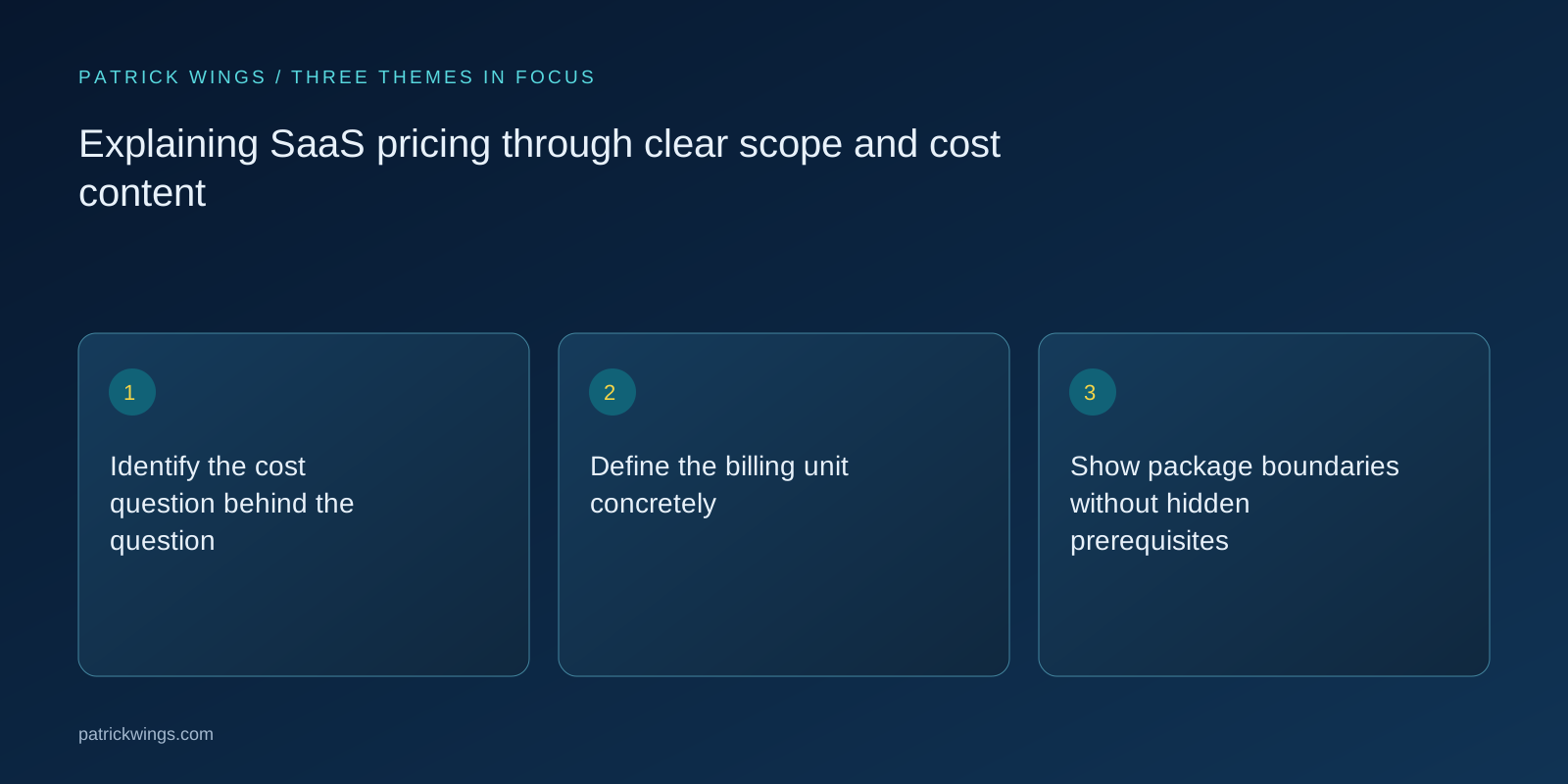
Show package boundaries without hidden prerequisites
Compare packages through consistent buyer tasks rather than differently phrased feature lists. Explain whether a capability is included, optional, quantity-limited or unsuitable for the scenario. Identify required implementation, integrations and support. A low base amount becomes misleading if a commonly advertised use case needs an unnamed additional service. Link the defensible detail instead of hiding every qualification in a tiny footnote. Decide which condition needs to appear beside the price by considering its consequence for the buyer and their next evaluation decision. Explore this further in the guide Business-case content: support buyers with transparent assumptions.
| Information | Explanation | Acceptance |
|---|---|---|
| Unit | Which event is counted? | Product and finance |
| Period | When does the charge arise? | Finance |
| Service scope | What is required or optional? | Commercial owner |
Work from assumptions to the complete example amount
Choose a bounded scenario and state period, quantity, currency and included cost categories. Separate recurring charges from one-off setup and optional services. Show the calculation so readers can substitute their own assumptions. Explain uncertainty where usage is unknown. An example is not a quotation for every customer. If the result covers only part of the cost, show that scope beside the amount rather than leaving it for a sales conversation. A mathematically correct figure can still communicate the wrong commercial commitment.

Explain changes during use
Describe events that may create a higher bill, package change or additional approval. These can include more users, processed units or a new use case. Distinguish a product feature showing consumption from the commercial rule used for invoicing. Verify that promised warnings and limits exist in the actual offer before describing them. Refer individual agreements to the accountable specialist. This editorial explanation does not replace contract review and must not imply safeguards that the product does not provide. Keep uncertainty explicit where a scenario requires an individual assessment.
Test comprehension with someone outside the team
Give a suitable person a realistic anonymised scenario. Ask them to explain which package fits, which inputs change the amount and what remains unresolved. Ask for their reasoning rather than a general preference score. Observe confusion over units, periods and required components. Repair the specific explanation and repeat the task. A small comprehension check evaluates the usability of the information, not market-wide willingness to pay or a proven conversion improvement caused by the new wording. Record the misunderstandings that remain after the revision.
How is a misunderstanding recorded?
Preserve the task, page version, interpretation and specific confusing passage. Another person should understand what changed in the explanation. Repeat the task with the revised version before merely adding more footnotes or warnings.
Fictional example: calculate approval costs transparently
An explicitly fictional SaaS provider uses an illustrative monthly base charge of €200 plus €0.20 per completed operation. Assuming 1,000 operations, the example shows €400 for those two components. Setup, taxes and additional services are not automatically covered. These invented figures illustrate arithmetic and are not market prices. Beside the calculation, editors explain what counts as completed and how cancelled operations would be treated. If the rule remains unresolved, do not publish a deceptively precise calculator. Product and finance must first accept the same explanation and underlying scenario.
Maintain pricing knowledge accountably
Assign owners for amounts, service scope, examples and translated editions. A billing change can affect the website, proposal, calculator and onboarding simultaneously. Record a change date and dependent explanations. Check whether old downloads need updating or explicit context. Review unresolved comprehension questions and conflicting expectations alongside pricing-page visits. Fewer questions alone do not establish a better buying process: people can leave because the explanation is unclear without reporting why. Preserve a route for those observations to return to the product and commercial owners.
INTERACTIVE / FROM READING TO ACTION
Three checkpoints for your implementation
Choose a checkpoint and track your reading progress. Checks are neither saved nor sent and do not score your business.
CHECKPOINT 01
Show package boundaries without hidden prerequisites
Compare packages through consistent buyer tasks rather than differently phrased feature lists.
Explore in the article ↗CHECKPOINT 02
Work from assumptions to the complete example amount
Choose a bounded scenario and state period, quantity, currency and included cost categories.
Explore in the article ↗CHECKPOINT 03
Explain changes during use
Describe events that may create a higher bill, package change or additional approval.
Explore in the article ↗Frequently asked questions
Is pricing content part of pricing strategy?
It explains the selected architecture and supports evaluation. Price levels, units and packaging need their own evidence. Better wording cannot replace a defensible commercial model or validate willingness to pay.
Must every price be public?
Not necessarily. An individual quotation process can still explain cost drivers, required inputs and the next step. Avoid presenting an apparently fixed price without defining the associated scope and prerequisites.
How many calculations are useful?
Choose meaningfully different relevant scenarios rather than numerous cosmetic variations. Each needs a period, unit, assumptions and cost scope. Test whether buyers can subsequently apply the underlying rule themselves.
Can examples be simplified?
Yes, if the simplification is visible and does not hide a material required charge. Identify open items. Label invented figures as illustrations rather than typical customer prices or promised invoice outcomes.
Who should accept the explanation?
Product verifies the capability and unit, finance checks arithmetic and scope, and commercial owners confirm offer statements. Editors make the result comprehensible and consistent across formats and language editions.
Which metric demonstrates understanding?
No single metric proves it. Observe a specific selection or calculation task, document errors and add actual buyer questions. Page views and dwell time alone cannot establish that someone understood the bill.