
THE SHORT ANSWER
Proof-of-concept content helps a buying group resolve a bounded uncertainty through an inspectable product evaluation. It explains the question, prerequisites, method and acceptance before people begin a demo or test environment. This article concerns editorial working materials rather than the technical operation of every product. The proposed method is an original decision aid. A successful PoC establishes only the agreed conditions actually tested; it does not replace production implementation or a general assessment of commercial viability and operational suitability.
To see how this step fits into your content strategy, read the pillar guide Content marketing for B2B SaaS: strategy, formats and qualified demand.
Start with an unresolved decision
Ask which specific uncertainty currently blocks evaluation. “Does the software work?” is too broad. “Can this approved data type be processed with our role arrangement?” may support a bounded investigation. Separate technical feasibility from intended use and commercial value. State which decisions the PoC is explicitly not meant to resolve. Put that boundary on the first page of the materials rather than only in an internal brief. It protects both buyer and provider against a success criterion changed after results are known and keeps later interpretation tied to the original task.
Make participants and acceptance questions visible
A business user may accept a workflow while IT still sees unresolved prerequisites. Identify the relevant roles and their specific questions. The materials do not need a separate brochure for every role, but they should show who reviews each piece of evidence and who can approve continuation. Agree a substitute if the responsible person is absent. General enthusiasm during a meeting cannot replace a recorded domain acceptance. Treat missing ownership as an unresolved prerequisite before further test work begins, rather than assuming that participation itself confers authority to sign off the outcome. Explore this further in the guide Technical evaluation content: connect IT and business questions.
How are different interests handled?
Record business and technical criteria alongside each other. Faster work for a business user may create extra administration. The evaluation contract should permit both observations rather than excluding the adverse effect from the success narrative.
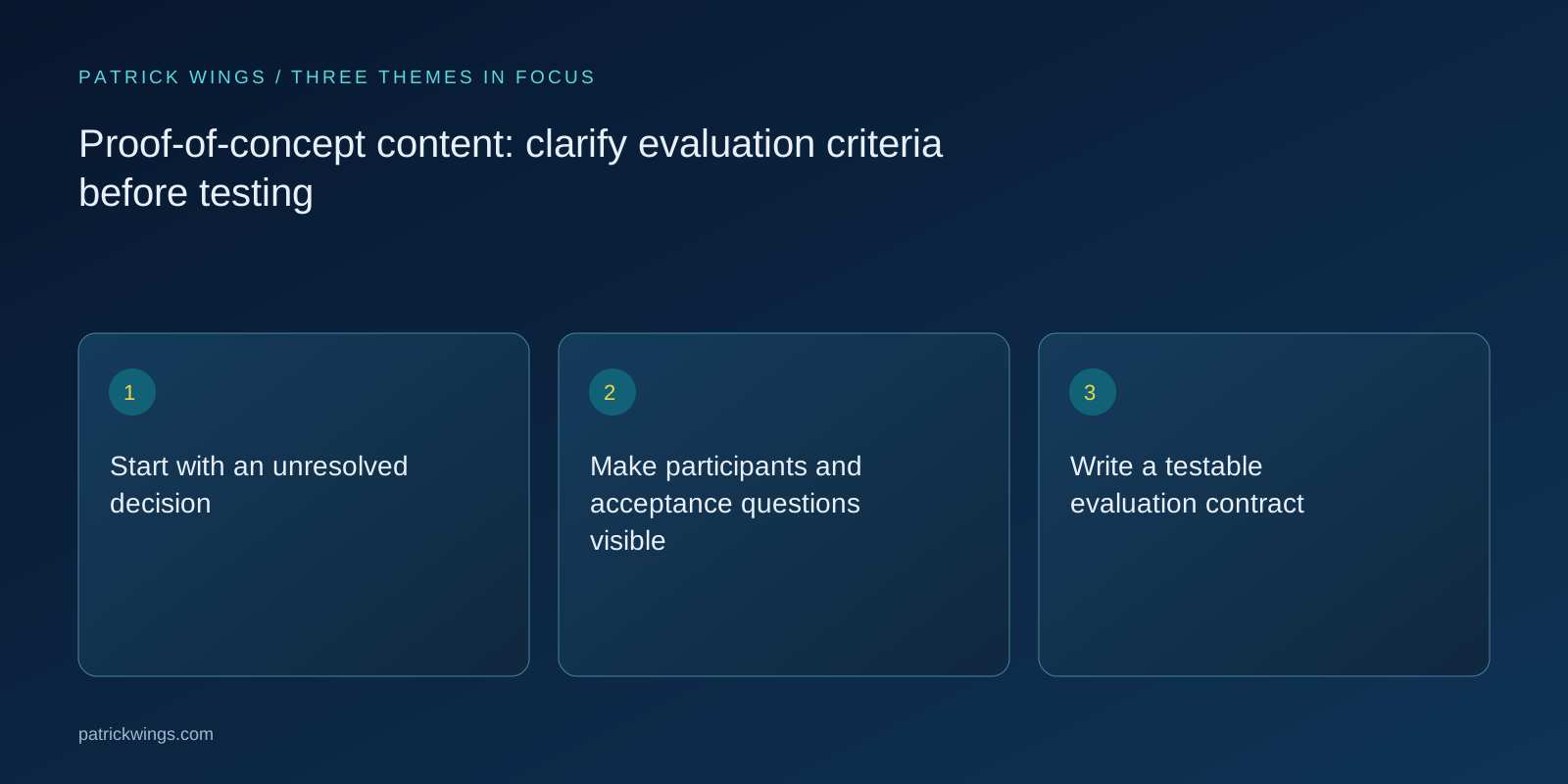
Write a testable evaluation contract
For each question specify inputs, permitted actions, observable expected result and relevant limit. A criterion such as “fast and intuitive” needs a concrete task and observation. Record the product version, approved environment and necessary permissions. Keep unknown details open. Technical specialists confirm feasibility before editors publish the sequence as a promised test route. Microsoft discusses PoCs in several solution contexts; those documents do not establish product capabilities for your own SaaS offer. A general structure cannot replace technical verification of the actual system and the buyer’s proposed evaluation conditions.
| Field | Evidence | Boundary |
|---|---|---|
| Question | Specific blocked decision | Not a universal product assessment |
| Environment | Version, permissions and inputs | No unchecked production extrapolation |
| Outcome | Observation and acceptance | Open questions remain visible |
Prepare evidence and countercases
Useful evidence shows more than a successful ideal route. Plan a boundary case relevant to the question and record the expected limitation. This may be an incomplete record or a role without permission. Use approved material and resolve sensitive-data handling with accountable specialists. Record observation, interpretation and follow-up question separately. A screenshot is helpful only when its environment and meaning remain understandable. Avoid decorative success graphics without a reproducible context. Explain where an outcome was achieved only under particular conditions, and retain the failed cases rather than curating them out of the record. Explore this further in the guide Security content for B2B buyers: evidence for procurement review.

Explain the process and effort honestly
Describe preparation, joint testing and results review with the contributions needed from each party. Identify dependencies such as data approval or an environment still awaiting setup. A short meeting requirement does not automatically mean low total effort. Ask both sides about available specialist time and narrow the scope if the planned evaluation cannot fit. The materials should support a decision, not sell an unrealistically frictionless process. A pause caused by an absent prerequisite differs from a negative technical result. Keep that distinction visible in scheduling, reporting and any later commercial discussion.
Turn results into a decision note
The final template records question, conditions, actual observation, deviation and next decision. Distinguish passed, failed and insufficiently tested. The last state is neither defeat nor success. Record the missing evidence and the effort required to obtain it. Link the note to underlying artefacts. A presentation without inspectable support cannot be rescued by unanimous agreement in the closing meeting. Buyers should understand which statement they can relay internally and which remains unproven. Include unresolved disagreements so that a later stakeholder can review the same evidence without inheriting an artificially confident conclusion.
When should a claim be narrowed?
If evidence covers one data type or role arrangement, state that condition precisely. Do not turn it into a universal product advantage. A further test can expand the boundary without retrospectively enlarging the existing observation.
Fictional example: bound one import case
An explicitly fictional SaaS team tests an approved sample file in an approval workflow. The business question concerns field mapping and error handling, not migration of the entire existing dataset. A complete record and a deliberately incomplete one are processed under agreed roles. If only the complete case works, the missing error explanation is recorded. The team can correct the workflow and retest instead of calling the whole PoC successful. This is not a real customer reference and includes no claimed success rate. A subsequent production launch needs its own additional operational prerequisites and acceptance criteria.
Maintain materials for reuse
Keep the shared structure separate from product-specific evidence. The evaluation contract can be reused; an earlier result does not automatically apply to a new version, environment or buyer requirement. Assign domain ownership and a concrete review trigger. Observe whether new participants understand the contract without an additional spoken history. Questions arising during handoff feed into the next edition. This creates a usable library of evaluation materials instead of a collection of apparently successful tests whose original conditions can no longer be named. Preserve version references so a reused template does not silently carry obsolete assumptions.
INTERACTIVE / FROM READING TO ACTION
Three checkpoints for your implementation
Choose a checkpoint and track your reading progress. Checks are neither saved nor sent and do not score your business.
CHECKPOINT 01
Write a testable evaluation contract
For each question specify inputs, permitted actions, observable expected result and relevant limit.
Explore in the article ↗CHECKPOINT 02
Prepare evidence and countercases
Useful evidence shows more than a successful ideal route.
Explore in the article ↗CHECKPOINT 03
Explain the process and effort honestly
Describe preparation, joint testing and results review with the contributions needed from each party.
Explore in the article ↗Frequently asked questions
Is a PoC the same as a demo?
No. A demo shows a selected workflow. A PoC investigates an agreed uncertainty under defined conditions and evidence requirements. A convincing presentation does not automatically satisfy that acceptance contract.
Who defines success criteria?
Business and technical owners agree them with the buyer. Editors make them understandable. The provider should not change the standard after seeing results or treat an ambiguous criterion as accepted without clarification.
What does insufficiently tested mean?
Existing observations do not yet support an answer to the agreed question. Name the missing evidence and its cost. Do not reinterpret that status as either a negative product verdict or a successful evaluation.
Does every PoC require real customer data?
Not necessarily. Inputs must fit the question and be permitted for the purpose. A synthetic case may test specific workflows but cannot establish unrestricted suitability for every production dataset or operating environment.
How many questions should it contain?
Only as many as can be evaluated reliably with clear conditions and evidence. More scope does not automatically mean more learning. Prioritise the uncertainty that changes the next accountable decision.
How can the materials be reused?
Reuse the structure and instructions only after reviewing the new context. Update version, environment and ownership. An earlier result is not a general reference for another buyer or a later set of technical requirements.