
THE SHORT ANSWER
Credible evidence on a service page addresses concrete doubts: does the provider understand the task, can it deliver the stated scope and what does the work look like? Match evidence to the claim and explain context. An inspectable work sample may help more than a prominent unexplained logo. Every experience has boundaries that should remain visible when readers assess relevance.
To see how this step fits into your content strategy, read the pillar guide B2B content marketing: From useful expertise to qualified demand.
Collect doubts along the page
For each important service component, identify a reasonable buyer question. Is it about expertise, collaboration, feasibility or the output's form? These questions determine evidence needs. Avoid expecting one general trust section to answer everything through logos. Inspect existing material for actual relevance. Evidence should support the service claim at that location. An unsupported assertion creates a research task or a reason to narrow wording, not a reason to add decorative trust signals that make the page appear established without resolving the underlying question the buyer needs answered. Explore this further in the guide Build an evidence architecture for B2B product claims.
Distinguish evidence types
A work sample shows the form of a deliverable. A case study describes experience in a particular setting. An approved quotation expresses someone's assessment. A qualification can establish expertise within a named field. None automatically proves every other claim. Label samples and anonymized cases clearly. For certifications or partnerships, represent actual scope. Choose evidence according to the question it can answer, rather than visual impact or convenience. This prevents a familiar badge or enthusiastic quotation from being asked to substantiate delivery details it never addressed in the first place.
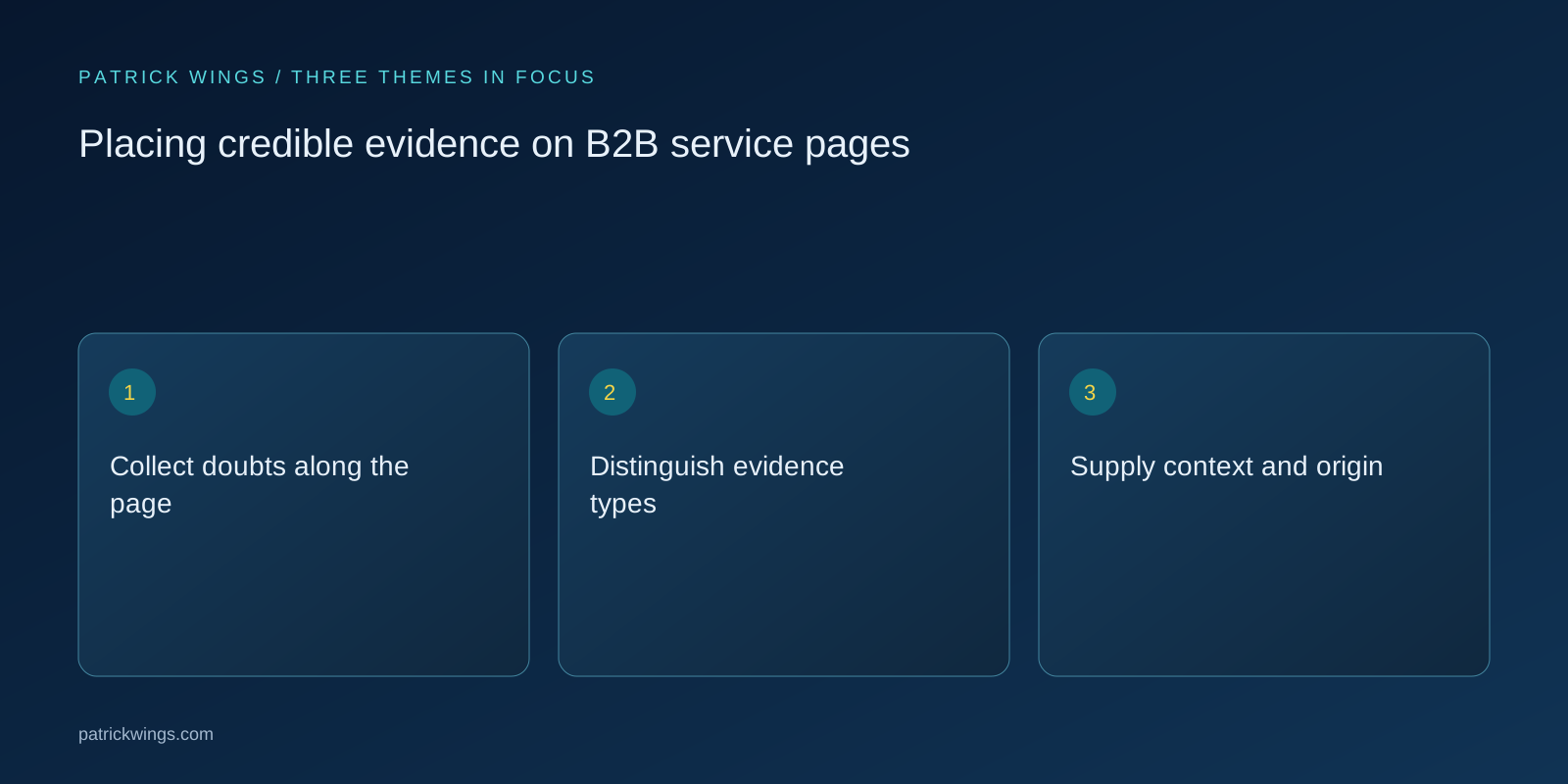
Supply context and origin
Explain baseline, scope and your team's role to the extent needed for interpretation. Results require measurement, denominator and relevant conditions. A quotation should have an approved attribution or transparently anonymized role. Resolve publication rights and retain approval. Do not edit away significant qualifications. Context contributes to credibility by allowing buyers to assess whether an experience resembles their own situation or depends on unusual prerequisites. It also gives sales and reviewers a consistent explanation of what the evidence actually establishes when prospects ask more detailed questions after reading the service page.
Place hypothetical support
Suppose a service page promises a prioritized action plan after an assessment. Beside the statement, a labeled sample shows how observations, recommendations and unresolved dependencies are documented. Copy explains that it is not a real customer analysis. A separate approved account describes comparable work. This hypothetical example invents no customer outcome. It demonstrates two functions: the sample makes the deliverable tangible, while project experience explains actual application. Keeping them distinct prevents a useful illustration from acquiring the appearance of measured evidence merely because it is placed beside a commercial promise. Explore this further in the guide Service pages that make scope and collaboration concrete.

Connect evidence to decisions
Place support near its claim and link to a fuller explanation where appropriate. A long quotation at the bottom may not answer a specific earlier concern. Shorten previews without losing important conditions. Describe destinations clearly. Inspect mobile presentation and textual access to visual evidence. If an example is embedded as an image, its decisive information must not exist only in tiny lettering. The relationship between promise and support should remain understandable in the published layout, rather than relying on an association obvious only to editors who reviewed the source material together.
Maintain approval and relevance
Give evidence a source, owner and permitted use. When the offer changes, check whether the experience still supports the same service. Older cases may remain useful but should not silently establish newly introduced capabilities. Test which question readers believe the material answers. If they say only “it looks professional,” the substantive connection may be missing. Maintenance should preserve claim, context and presentation together, removing evidence whose permission or relevance is no longer secure instead of retaining it by habit because it has occupied the same position on the page for years.
INTERACTIVE / FROM READING TO ACTION
Three checkpoints for your implementation
Choose a checkpoint and track your reading progress. Checks are neither saved nor sent and do not score your business.
CHECKPOINT 01
Supply context and origin
Explain baseline, scope and your team's role to the extent needed for interpretation.
Explore in the article ↗CHECKPOINT 02
Place hypothetical support
Suppose a service page promises a prioritized action plan after an assessment.
Explore in the article ↗CHECKPOINT 03
Connect evidence to decisions
Place support near its claim and link to a fuller explanation where appropriate.
Explore in the article ↗Frequently asked questions
Is a customer logo enough?
Without context, it says little about the work or claim it supports.
Can samples be used?
Yes, when clearly labeled and not presented as real customer experience.
Does every service need a results figure?
No. An inspectable work example may provide suitable support without inventing a number.
How can I put “Collect doubts along the page” into practice?
For each important service component, identify a reasonable buyer question. Is it about expertise, collaboration, feasibility or the output's form? These questions determine evidence needs.
What matters when working on “Distinguish evidence types”?
A work sample shows the form of a deliverable. A case study describes experience in a particular setting. An approved quotation expresses someone's assessment.